Centre for Research in Evidence Based Practice (CREBP), Faculty of Health Science and Medicine, Bond University, Robina, QLD, Australia.
Evidence-Based Medicine Unit, Faculty of Medicine, Islamic University, Gaza, Palestine.
Health Res Policy Syst. 2018 Mar 15;16(1):25. doi: 10.1186/s12961-018-0302-4.
Research conducted on conditions responsible for the greatest disease burden should be given the highest priority, particularly in resource-limited settings. The present study aimed to assess the research output in relation to disease burden in Palestine and to identify the conditions which are under- or over-investigated, if any.
We searched PubMed and Scopus for reports of original research relevant to human health or healthcare authored by researchers affiliated with Palestinian institutions and published between January 2000 and December 2015. We categorised the condition studied in included articles using the Global Burden of Disease (GBD) taxonomy. Data regarding burden of disease (percentage of deaths and disability-adjusted life years (DALYs)) was obtained from the Palestine profile in the GBD study. We examined the degree of discordance between the observed number of published articles for each disease/condition with the expected number based on the proportion of disease burden of that disease/condition.
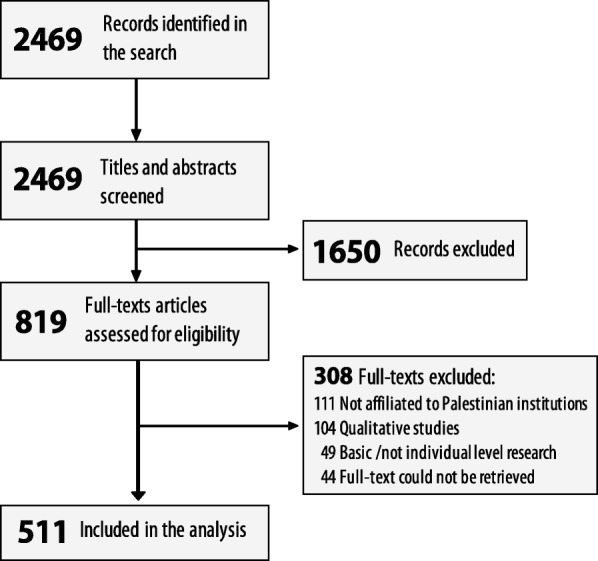
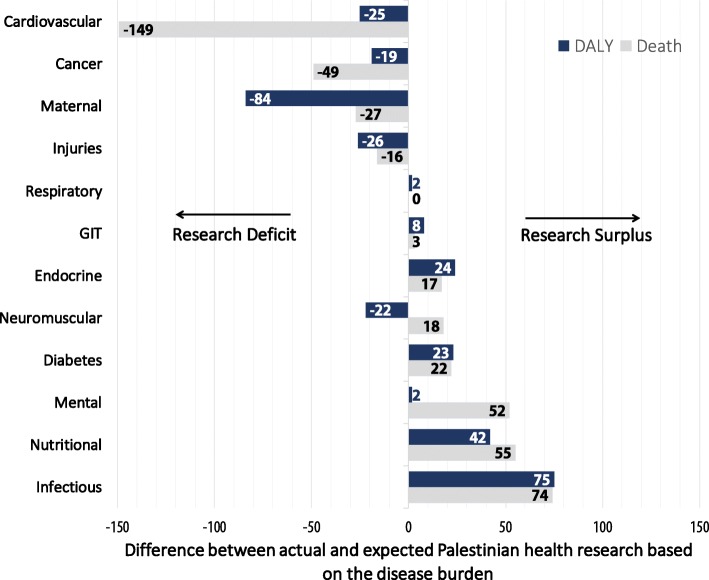
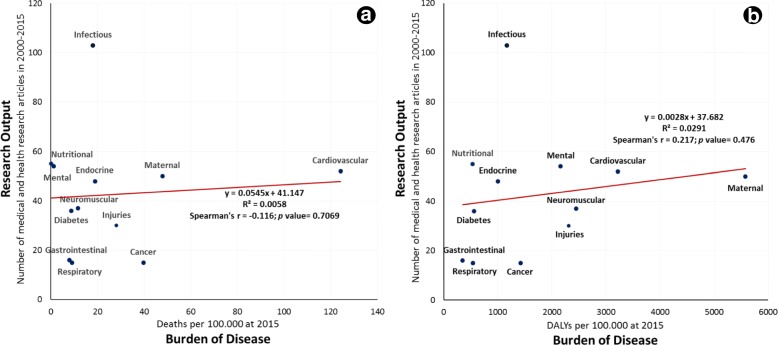
Our search identified 2469 potentially relevant records, from which 1650 were excluded following the screening of titles and abstracts. Of the remaining 819 full-text articles, we included 511 in our review. Communicable (infectious) diseases (n = 103; 20%) was the condition with the highest number of published studies. However, cancer (n = 15; 3%) and chronic respiratory diseases (n = 15; 3%) were the conditions with the lowest number of published studies. Research output was poorly associated with disease burden, irrespective of whether it was measured in terms of DALYs (rho = -0.116, P = 0.7) or death (rho = 0.217, P = 0.5). Cardiovascular disease, cancer, and maternal and neonatal deaths accounted for more than two-thirds of the total deaths in Palestine (67%), but were infrequently addressed (23%) in published articles.
There is evidence of research waste measured by a mismatch between the health burden of certain diseases/conditions and the number of published research reports on those diseases/conditions in Palestine. A national research priority-setting agenda should be developed to meet the local community's need for quality evidence to implement independent and informed health policies.
对于导致最大疾病负担的条件的研究应给予最高优先级,特别是在资源有限的环境中。本研究旨在评估与巴勒斯坦疾病负担相关的研究产出,并确定任何情况下被过度或欠调查的条件。
我们在 PubMed 和 Scopus 中搜索了 2000 年 1 月至 2015 年 12 月期间由巴勒斯坦机构附属的研究人员撰写并发表的与人类健康或医疗保健相关的原始研究报告。我们使用全球疾病负担(GBD)分类法对纳入文章中研究的疾病进行分类。关于疾病负担(死亡百分比和伤残调整生命年(DALY))的数据来自 GBD 研究中的巴勒斯坦概况。我们检查了观察到的每种疾病/状况的发表文章数量与该疾病/状况的疾病负担比例所预期的文章数量之间的差异程度。
我们的搜索确定了 2469 条潜在相关记录,其中 1650 条在标题和摘要筛选后被排除。在剩余的 819 篇全文文章中,我们有 511 篇被纳入了我们的综述。传染病(感染性)疾病(n = 103;20%)是发表研究数量最多的疾病。然而,癌症(n = 15;3%)和慢性呼吸道疾病(n = 15;3%)是发表研究数量最少的疾病。研究产出与疾病负担的相关性较差,无论以 DALY(rho = -0.116,P = 0.7)还是死亡(rho = 0.217,P = 0.5)来衡量。心血管疾病、癌症和产妇和新生儿死亡占巴勒斯坦总死亡人数的三分之二以上(67%),但在发表的文章中很少涉及(23%)。
有证据表明存在研究浪费,这表现在某些疾病/状况的健康负担与巴勒斯坦发表的关于这些疾病/状况的研究报告数量之间存在不匹配。应制定国家研究重点设定议程,以满足当地社区对实施独立和知情的卫生政策所需优质证据的需求。