Kaizu Yoichi, Watanabe Hideomi, Yamaji Takehiko
Hidaka Hospital: 886 Nakao-machi, Takasaki, Gunma, Japan.
Department of Rehabilitation Sciences, Gunma University Graduate School of Health Sciences, Japan.
J Phys Ther Sci. 2018 Feb;30(2):223-230. doi: 10.1589/jpts.30.223. Epub 2018 Feb 20.
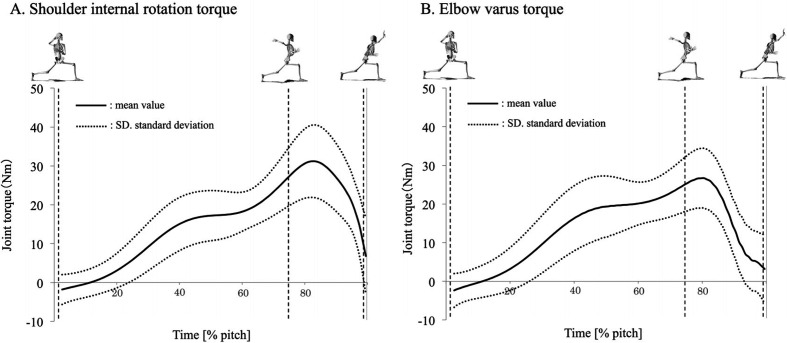
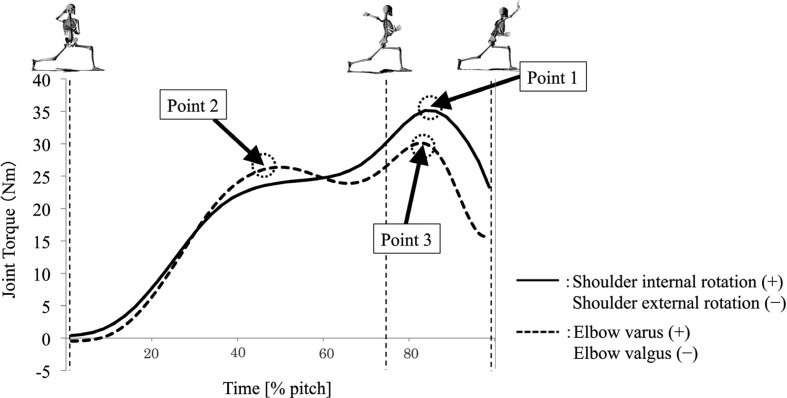
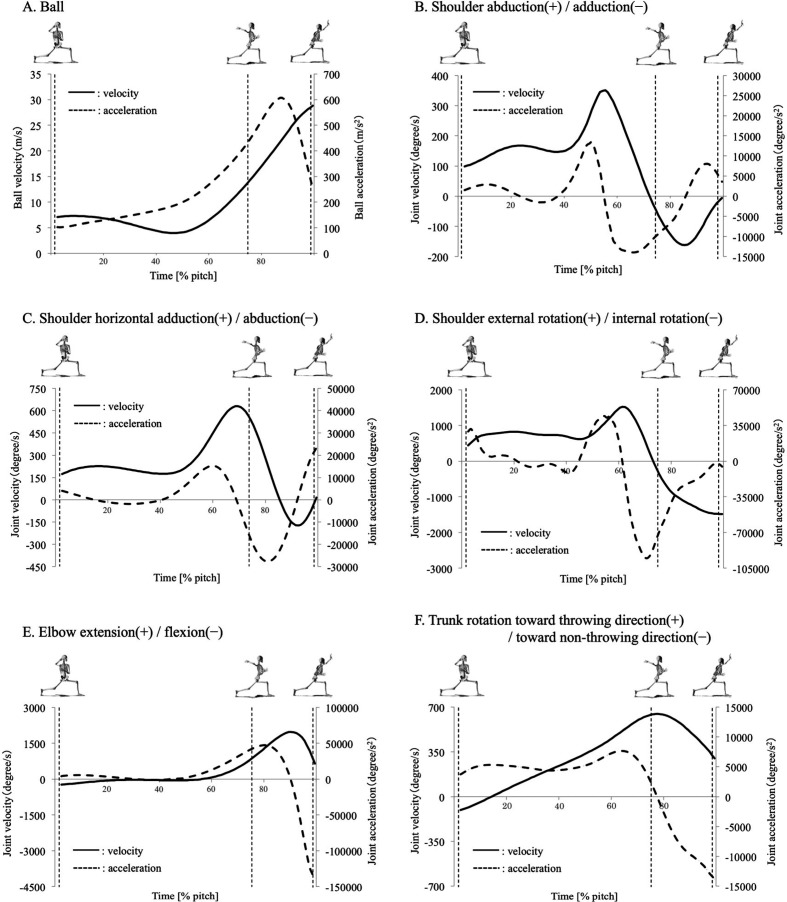
[Purpose] The purpose of this study was to provide information regarding the knowledge of mechanical principles related to the load applied to the shoulder and elbow during the pitching motion. [Subjects and Methods] The three-dimensional kinematics of body segments were measured in 19 amateur baseball players with a VICON motion capture system. The correlation between maximum shoulder internal torque, maximum elbow varus torque, and simultaneous kinematic parameters including joint angular acceleration and ball acceleration was investigated. [Results] Peak shoulder internal rotation torque and elbow varus torque averaged 31 Nm and 26 Nm, respectively. Ball acceleration had the strongest influence on shoulder internal rotational torque (standardized partial regression coefficient 0.69). During previous maximum external rotation (pre-MER), the main cause parameter of elbow varus torque was shoulder horizontal adduction velocity (r=0.672). On the other hand, after MER (post-MER), the main cause was ball acceleration (r=0.745). [Conclusion] Results of our study suggest that one of the main mechanical principles of joint load during the baseball pitching motion may be the 'inertia' yielded on the segment distal to the certain joint.
[目的]本研究旨在提供有关棒球投球动作中肩部和肘部所受负荷相关力学原理的知识信息。[对象与方法]使用VICON运动捕捉系统测量了19名业余棒球运动员身体各节段的三维运动学数据。研究了最大肩部内旋扭矩、最大肘部内翻扭矩与包括关节角加速度和球加速度在内的同步运动学参数之间的相关性。[结果]肩部内旋扭矩峰值和肘部内翻扭矩峰值平均分别为31 Nm和26 Nm。球加速度对肩部内旋扭矩的影响最强(标准化偏回归系数为0.69)。在先前最大外旋(pre - MER)期间,肘部内翻扭矩的主要成因参数是肩部水平内收速度(r = 0.672)。另一方面,在最大外旋之后(post - MER),主要成因是球加速度(r = 0.745)。[结论]我们的研究结果表明,棒球投球动作中关节负荷的主要力学原理之一可能是特定关节远端节段产生的“惯性”。