Department of Dermatology, Xijing Hospital, Fourth Military Medical University, Xi'an, China.
Department of Dermatology, School of Medicine, University of North Carolina at Chapel Hill, Chapel Hill, NC, United States.
Front Immunol. 2018 Mar 1;9:407. doi: 10.3389/fimmu.2018.00407. eCollection 2018.
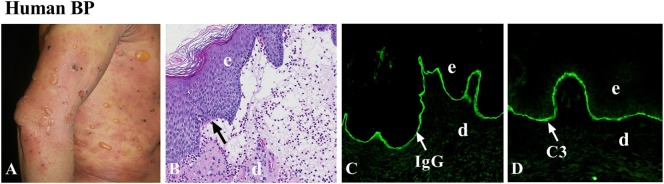
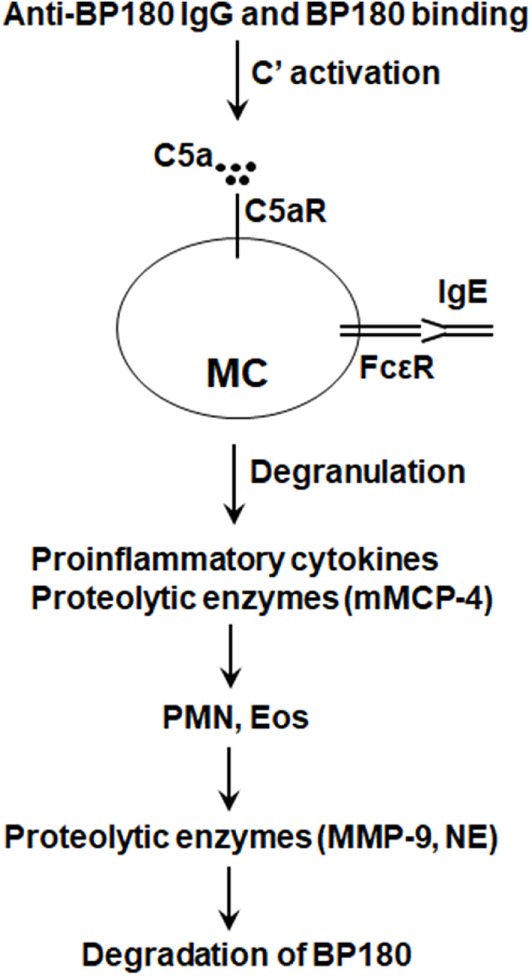
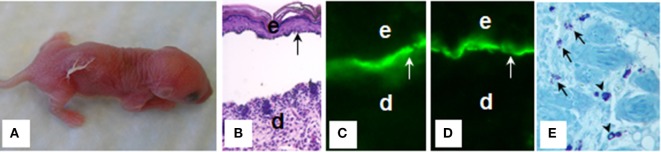
Bullous pemphigoid (BP) is an autoimmune and inflammatory skin disease associated with subepidermal blistering and autoantibodies directed against the hemidesmosomal components BP180 and BP230. Animal models of BP were developed by passively transferring anti-BP180 IgG into mice, which recapitulates the key features of human BP. By using these model systems, key cellular and molecular events leading to the BP disease phenotype are identified, including binding of pathogenic IgG to its target, complement activation of the classical pathway, mast cell degranulation, and infiltration and activation of neutrophils. Proteinases released by infiltrating neutrophils cleave BP180 and other hemidesmosome-associated proteins, causing DEJ separation. Mast cells and mast cell-derived mediators including inflammatory cytokines and proteases are increased in lesional skin and blister fluids of BP. BP animal model evidence also implicates mast cells in the pathogenesis of BP. However, recent studies questioned the pathogenic role of mast cells in autoimmune diseases such as multiple sclerosis, rheumatoid arthritis, and epidermolysis bullosa acquisita. This review highlights the current knowledge on BP pathophysiology with a focus on a potential role for mast cells in BP and mast cell-related critical issues needing to be addressed in the future.
大疱性类天疱疮(BP)是一种自身免疫性和炎症性皮肤病,与表皮下水疱形成有关,自身抗体针对的是半桥粒成分 BP180 和 BP230。BP 的动物模型是通过将抗 BP180 IgG 被动转移到小鼠中建立的,这再现了人类 BP 的关键特征。通过使用这些模型系统,确定了导致 BP 疾病表型的关键细胞和分子事件,包括致病性 IgG 与其靶标的结合、经典途径补体的激活、肥大细胞脱颗粒以及中性粒细胞的浸润和激活。浸润的中性粒细胞释放的蛋白酶切割 BP180 和其他半桥粒相关蛋白,导致 DEJ 分离。肥大细胞和肥大细胞衍生的介质,包括炎症细胞因子和蛋白酶,在 BP 的皮损皮肤和水疱液中增加。BP 动物模型的证据也表明肥大细胞在 BP 发病机制中的作用。然而,最近的研究质疑了肥大细胞在多发性硬化症、类风湿关节炎和获得性大疱性表皮松解症等自身免疫性疾病中的致病作用。本综述强调了 BP 病理生理学的最新知识,重点介绍了肥大细胞在 BP 中的潜在作用以及未来需要解决的与肥大细胞相关的关键问题。