Department of Dermatology, Division of Immunology, Allergy and Infectious Diseases, Medical University of Vienna, Vienna, 1090, Austria.
Br J Dermatol. 2017 Dec;177(6):1644-1653. doi: 10.1111/bjd.15924. Epub 2017 Nov 28.
Bullous pemphigoid (BP) is an autoimmune disease characterized by tense blisters that are usually preceded by urticarial eruptions. Affected patients exhibit IgG and/or IgE autoantibodies against BP180 and/or BP230. Their relative importance in disease pathogenesis has not been fully elucidated.
The aim of this study was to provide a better characterization of the circulating and tissue-resident IgE in patients with BP at the serological, structural and functional levels.
Sera (n = 19) and skin (n = 33) from patients with BP were analysed via enzyme-linked immunosorbent assay (ELISA) and immunofluorescence, respectively.
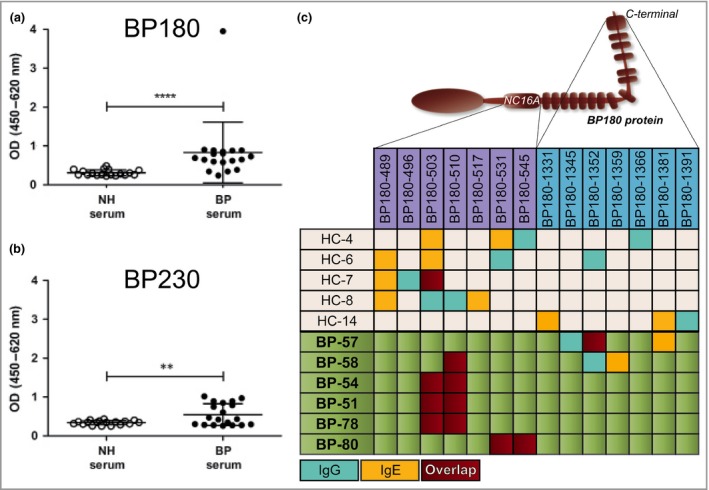
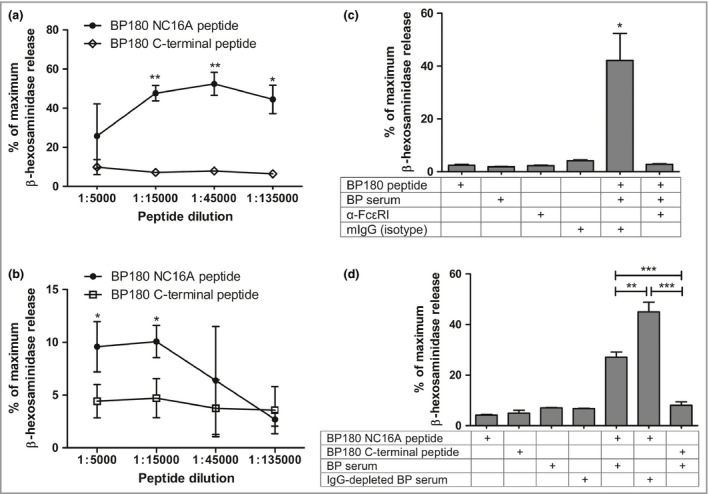
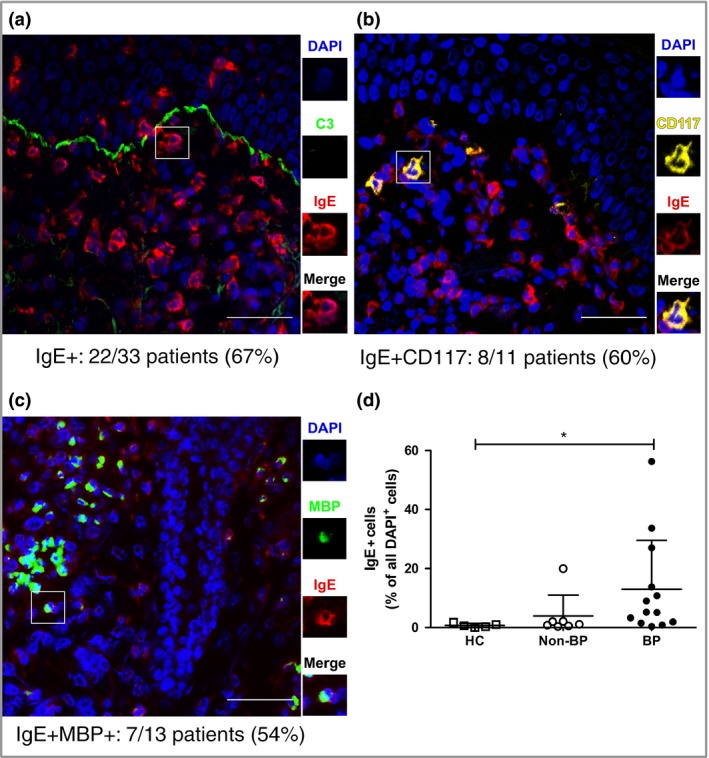
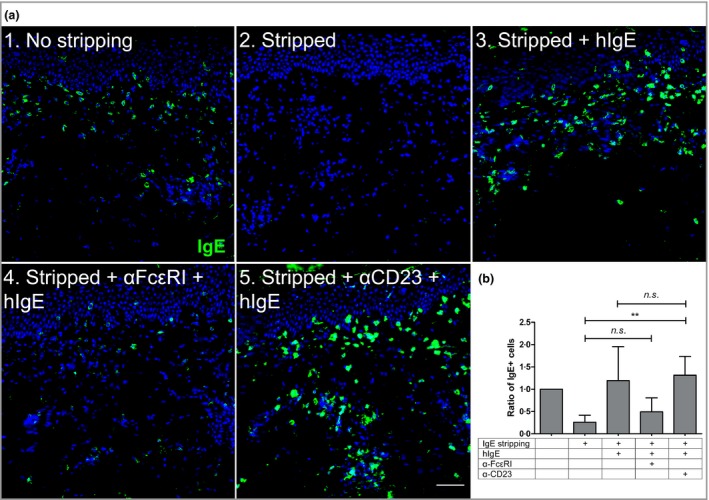
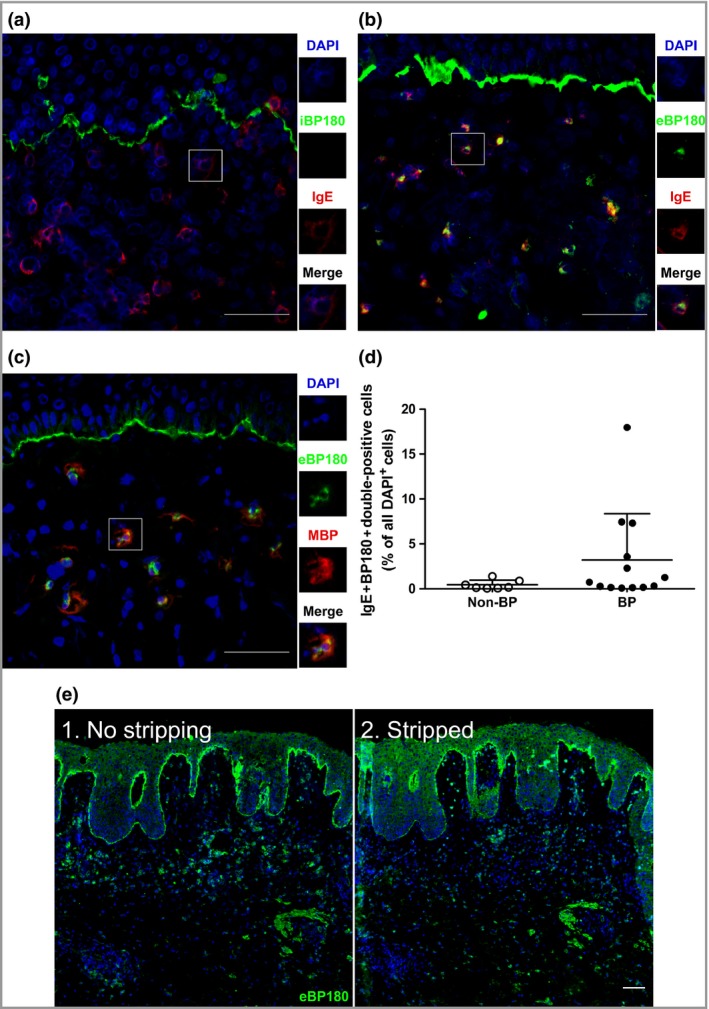
The results obtained show that many patients with BP exhibit elevated IgE levels in the serum and in the skin. In the skin, it is very rarely and only sparsely found along the basement membrane zone, but is prominently present on mast cells and eosinophils. At least a portion of these IgE antibodies are BP-specific, as evidenced by serum ELISA and by the colocalization of BP180 and FcεRI-bound IgE on mast cells and/or eosinophils. An important role of these immune reactants can be inferred from our additional finding that cross-linking of IgE, derived from BP sera, on FcεRI-expressing rat basophils with BP180 results in robust degranulation of these cells.
We propose the existence of a disease pathway alternative to IgG and complement that may well be responsible for some of the clinical features of this autoimmune disease.
大疱性类天疱疮(BP)是一种自身免疫性疾病,其特征为紧张性水疱,通常伴有荨麻疹样疹。受影响的患者表现出针对 BP180 和/或 BP230 的 IgG 和/或 IgE 自身抗体。它们在疾病发病机制中的相对重要性尚未完全阐明。
本研究旨在通过血清学、结构和功能水平,更好地描述 BP 患者循环和组织固有 IgE。
通过酶联免疫吸附试验(ELISA)和免疫荧光分别分析 BP 患者的血清(n=19)和皮肤(n=33)。
结果表明,许多 BP 患者的血清和皮肤中 IgE 水平升高。在皮肤中,它非常罕见且仅稀疏地存在于基底膜带,但在肥大细胞和嗜酸性粒细胞上明显存在。至少一部分这些 IgE 抗体是 BP 特异性的,这可以通过血清 ELISA 以及 BP180 和 FcεRI 结合的 IgE 在肥大细胞和/或嗜酸性粒细胞上的共定位来证明。这些免疫反应物的重要作用可以从我们的其他发现推断出来,即来自 BP 血清的 IgE 与 FcεRI 表达的大鼠嗜碱性粒细胞上的 BP180 交联导致这些细胞强烈脱颗粒。
我们提出了一种替代 IgG 和补体的疾病途径的存在,它可能是这种自身免疫性疾病的某些临床特征的原因。