Chen Zi-Ru, Kuang Lu, Gao Yi-Qun, Wang Ya-Ling, Salt David E, Chao Dai-Yin
National Key Laboratory of Plant Molecular Genetics, CAS Center for Excellence in Molecular Plant Sciences, Institute of Plant Physiology and Ecology, Shanghai Institutes for Biological Sciences, Chinese Academy of Sciences, Shanghai, China.
University of Chinese Academy of Sciences, Beijing, China.
Front Plant Sci. 2018 Mar 1;9:270. doi: 10.3389/fpls.2018.00270. eCollection 2018.
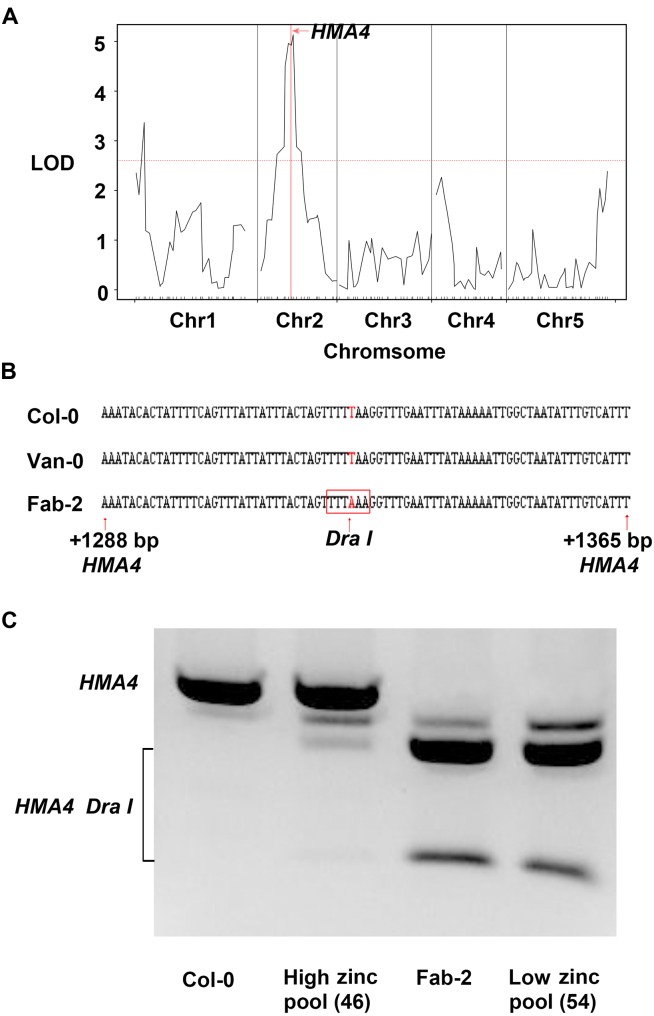
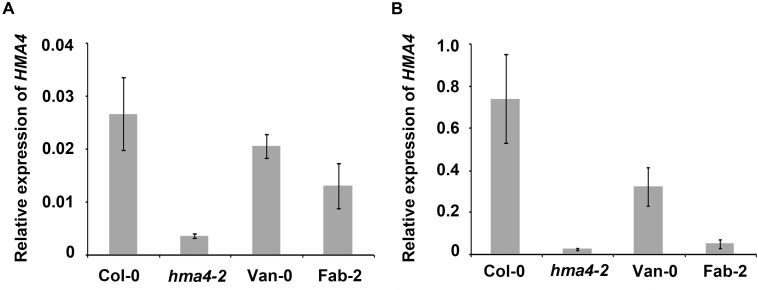
Zinc (Zn) is an essential element for plant growth and development, and Zn derived from crop plants in the diet is also important for human health. Here, we report that genetic variation in () controls natural variation in leaf Zn content. Investigation of the natural variation in leaf Zn content in a world-wide collection of 349 wild collected accessions identified two accessions, Van-0 and Fab-2, which accumulate significantly lower Zn when compared with Col-0. Both quantitative trait loci (QTL) analysis and bulked segregant analysis (BSA) identified as a strong candidate accounting for this variation in leaf Zn concentration. Genetic complementation experiments confirmed this hypothesis. Sequence analysis revealed that a 1-bp deletion in the third exon of from Fab-2 is responsible for the lose of function of driving the low Zn observed in Fab-2. Unlike in Fab-2 polymorphisms in the promoter region were found to be responsible for the weak function of in Van-0. This is supported by both an expression analysis of in Van-0 and through a series of T-DNA insertion mutants which generate truncated promoters in the Col-0 background. In addition, we also observed that Fab-2, Van-0 and the null mutant in the Col-0 background show enhanced resistance to a combination of high Zn and high Cd in the growth medium, raising the possibility that variation at may play a role in environmental adaptation.
锌(Zn)是植物生长发育所必需的元素,饮食中来自农作物的锌对人体健康也很重要。在此,我们报告称,()中的遗传变异控制着叶片锌含量的自然变异。对全球收集的349份野生采集种质的叶片锌含量自然变异进行调查,发现了两个种质Van-0和Fab-2,与Col-0相比,它们积累的锌显著更低。数量性状位点(QTL)分析和混合分离分析(BSA)均确定()是导致叶片锌浓度这种变异的一个强有力候选基因。遗传互补实验证实了这一假设。序列分析表明,Fab-2的()第三个外显子中的1个碱基缺失导致了()功能丧失,从而导致Fab-2中观察到的低锌现象。与Fab-2不同,在Van-0中发现启动子区域的多态性是导致()功能减弱的原因。这一观点得到了Van-0中()表达分析以及一系列在Col-0背景下产生截短()启动子的T-DNA插入突变体的支持。此外,我们还观察到,Fab-2、Van-0以及Col-0背景下的()缺失突变体在生长培养基中对高锌和高镉的组合表现出增强的抗性,这增加了()变异可能在环境适应中发挥作用的可能性。