Department of Psychiatry, University of California, San Diego, La Jolla, CA, United States; Center for Behavior Genetics of Aging, University of California, San Diego, La Jolla, CA, United States.
Department of Psychiatry, University of California, San Diego, La Jolla, CA, United States; Center for Behavior Genetics of Aging, University of California, San Diego, La Jolla, CA, United States; Center of Excellence for Stress and Mental Health, VA San Diego Healthcare System, San Diego, CA, United States.
Psychoneuroendocrinology. 2018 May;91:115-122. doi: 10.1016/j.psyneuen.2018.03.003. Epub 2018 Mar 9.
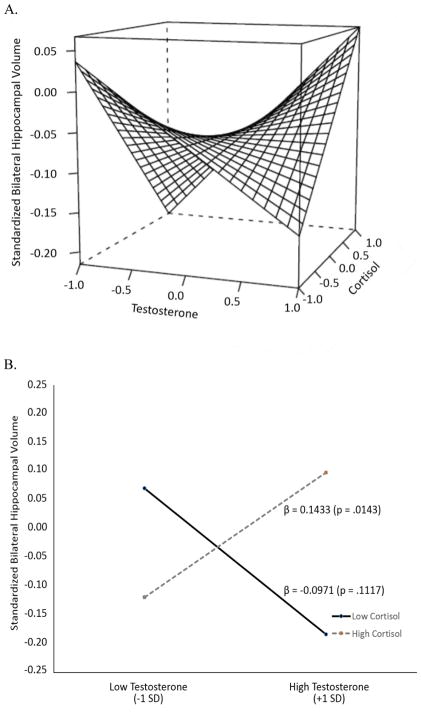
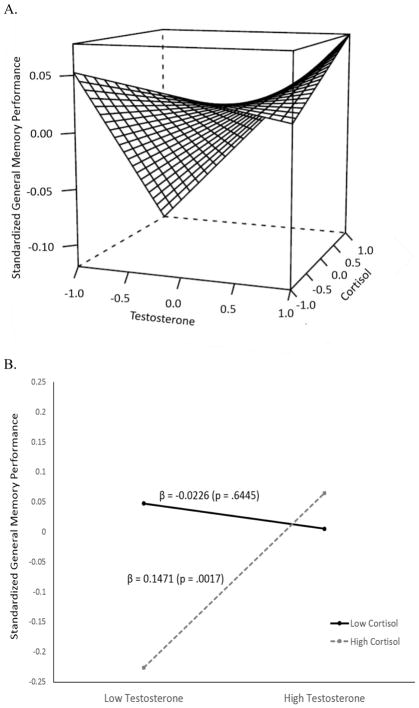
Animal and human research suggests that testosterone is associated with hippocampal structure and function. Studies examining the association between testosterone and either hippocampal structure or hippocampal-mediated cognitive processes have overwhelmingly focused on the effects of testosterone alone, without considering the interaction of other neuroendocrine factors. The aim of the present study was to examine the interactive effects of testosterone and cortisol in relation to hippocampal volume and episodic memory in a sample of late-middle aged men from the Vietnam Era Twin Study of Aging. The average age of participants was 56.3 years (range 51-60). Salivary hormone samples were collected at multiple time-points on two non-consecutive at-home days, and an in-lab assessment. Area under the curve with respect to ground measures for cortisol and testosterone were utilized. Significant testosterone-by-cortisol interactions were observed for hippocampal volume, and episodic memory. When cortisol levels were elevated (1 SD above the mean), testosterone levels were positively associated with hippocampal volume and memory performance. However, when cortisol levels were low (1 SD below the mean), testosterone levels were inversely related to hippocampal volume and memory performance. These findings suggest that in context of high cortisol levels, testosterone may be neuroprotective. In contrast, low testosterone may also be neuroprotective in the context of low cortisol levels. To our knowledge this is the first demonstration of such an interaction in a structural brain measure and an associated cognitive ability. These results argue in favor of broadening neuroendocrine research to consider the simultaneous and interactive effects of multiple hormones on brain structure and function.
动物和人类研究表明,睾丸激素与海马体结构和功能有关。研究检查了睾丸激素与海马体结构或海马体介导的认知过程之间的关系,绝大多数都集中在睾丸激素单独的影响上,而没有考虑其他神经内分泌因素的相互作用。本研究的目的是在越南时代老化双胞胎研究的中老年男性样本中,检查睾丸激素和皮质醇之间的相互作用与海马体体积和情景记忆的关系。参与者的平均年龄为 56.3 岁(范围为 51-60 岁)。在两个非连续的家庭日收集了多次唾液激素样本,并进行了实验室评估。利用皮质醇和睾丸激素相对于地面的曲线下面积。观察到海马体体积和情景记忆方面的显著睾丸激素-皮质醇相互作用。当皮质醇水平升高(高于平均值 1 个标准差)时,睾丸激素水平与海马体体积和记忆表现呈正相关。然而,当皮质醇水平较低(低于平均值 1 个标准差)时,睾丸激素水平与海马体体积和记忆表现呈负相关。这些发现表明,在高皮质醇水平的情况下,睾丸激素可能具有神经保护作用。相反,在皮质醇水平低的情况下,低睾丸激素也可能具有神经保护作用。据我们所知,这是在结构脑测量和相关认知能力方面首次证明这种相互作用。这些结果支持拓宽神经内分泌研究,以考虑多种激素对大脑结构和功能的同时和相互作用。