Department of Medicine, University of Cambridge, Cambridge, UK.
Cambridge University Hospitals NHS Foundation Trust, Cambridge, UK.
J Antimicrob Chemother. 2018 Jun 1;73(6):1692-1699. doi: 10.1093/jac/dky075.
VRE bacteraemia has a high mortality and continues to defy control. Antibiotic risk factors for VRE bacteraemia have not been adequately defined. We aimed to determine the risk factors for VRE bacteraemia focusing on duration of antibiotic exposure.
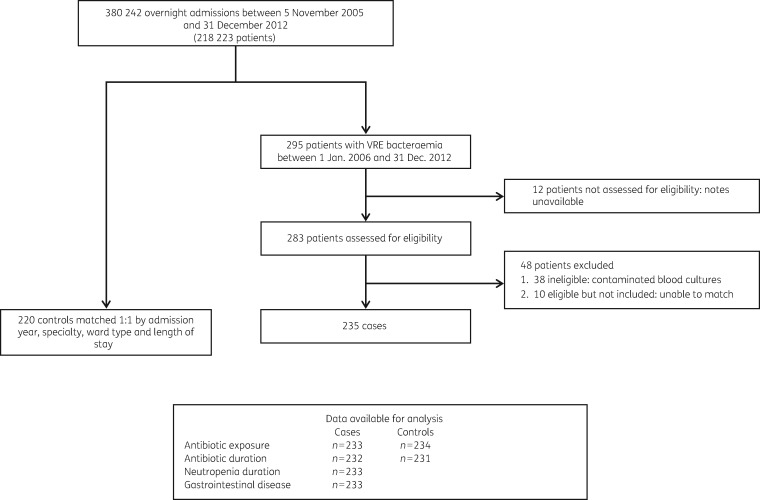
A retrospective matched nested case-control study was conducted amongst hospitalized patients at Cambridge University Hospitals NHS Foundation Trust (CUH) from 1 January 2006 to 31 December 2012. Cases who developed a first episode of VRE bacteraemia were matched 1:1 to controls by length of stay, year, specialty and ward type. Independent risk factors for VRE bacteraemia were evaluated using conditional logistic regression.
Two hundred and thirty-five cases were compared with 220 controls. Duration of exposure to parenteral vancomycin, fluoroquinolones and meropenem was independently associated with VRE bacteraemia. Compared with patients with no exposure to vancomycin, those who received courses of 1-3 days, 4-7 days or >7 days had a stepwise increase in risk of VRE bacteraemia [conditional OR (cOR) 1.2 (95% CI 0.4-3.8), 3.8 (95% CI 1.2-11.7) and 6.6 (95% CI 1.9-22.8), respectively]. Other risk factors were: presence of a central venous catheter (CVC) [cOR 8.7 (95% CI 2.6-29.5)]; neutropenia [cOR 15.5 (95% CI 4.2-57.0)]; hypoalbuminaemia [cOR 8.5 (95% CI 2.4-29.5)]; malignancy [cOR 4.4 (95% CI 1.6-12.0)]; gastrointestinal disease [cOR 12.4 (95% CI 4.2-36.8)]; and hepatobiliary disease [cOR 7.9 (95% CI 2.1-29.9)].
Longer exposure to vancomycin, fluoroquinolones or meropenem was associated with VRE bacteraemia. Antimicrobial stewardship interventions targeting high-risk antibiotics are required to complement infection control procedures against VRE bacteraemia.
VRE 菌血症死亡率高,且持续难以控制。目前尚未充分明确 VRE 菌血症的抗生素相关危险因素。本研究旨在明确 VRE 菌血症的危险因素,重点关注抗生素暴露时间。
本研究为回顾性匹配嵌套病例对照研究,纳入 2006 年 1 月 1 日至 2012 年 12 月 31 日期间在剑桥大学医院 NHS 基金会信托(Cambridge University Hospitals NHS Foundation Trust,CUH)住院的患者。将首次发生 VRE 菌血症的患者与住院时间、年份、科室和病房类型相匹配的对照组进行 1:1 匹配。采用条件逻辑回归分析 VRE 菌血症的独立危险因素。
共比较了 235 例病例和 220 例对照。静脉注射万古霉素、氟喹诺酮类和美罗培南的暴露时间与 VRE 菌血症独立相关。与未使用万古霉素的患者相比,万古霉素使用 1-3 天、4-7 天或>7 天的患者发生 VRE 菌血症的风险逐渐增加[条件比值比(conditional odds ratio,cOR)分别为 1.2(95%置信区间 0.4-3.8)、3.8(95%置信区间 1.2-11.7)和 6.6(95%置信区间 1.9-22.8)]。其他危险因素包括:中心静脉导管(central venous catheter,CVC)[cOR 8.7(95%置信区间 2.6-29.5)];中性粒细胞减少症[cOR 15.5(95%置信区间 4.2-57.0)];低白蛋白血症[cOR 8.5(95%置信区间 2.4-29.5)];恶性肿瘤[cOR 4.4(95%置信区间 1.6-12.0)];胃肠道疾病[cOR 12.4(95%置信区间 4.2-36.8)];肝胆疾病[cOR 7.9(95%置信区间 2.1-29.9)]。
万古霉素、氟喹诺酮类或美罗培南暴露时间较长与 VRE 菌血症相关。需要针对高危抗生素实施抗菌药物管理干预,以补充 VRE 菌血症的感染控制措施。