Department of Parasitology and Medical Entomology, Institute of Endemic Diseases, University of Khartoum, Khartoum, Republic of the Sudan.
Global and Tropical Health Division, Menzies School of Health Research and Charles Darwin University, Casuarina, PO Box 41096, Darwin, NT, 0811, Australia.
Malar J. 2018 Mar 16;17(1):117. doi: 10.1186/s12936-018-2266-9.
First-line schizontocidal treatment for uncomplicated malaria in the Republic of the Sudan is artesunate (total dose 12 mg/kg) plus Sulphadoxine/pyrimethamine (25/1.25 mg/kg) (AS/SP). Patients with Plasmodium vivax are also treated with 14 days primaquine (total dose 3.5 mg/kg) (PQ). The aim of this study was to assess the efficacy of the national policy.
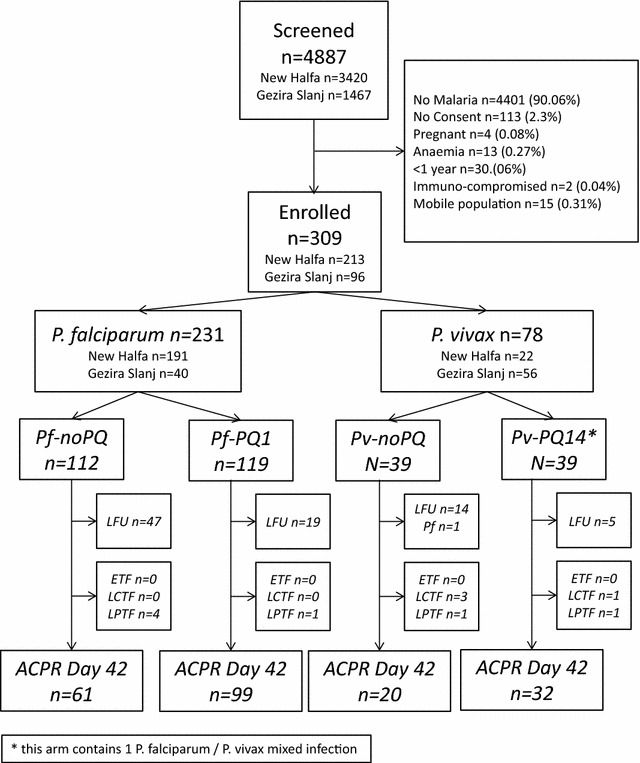
Patients above 1 year, with microscopy-confirmed, Plasmodium falciparum and/or P. vivax malaria were treated with AS/SP. Patients with P. falciparum were randomized to no primaquine (Pf-noPQ) or a single 0.25 mg/kg dose of PQ (Pf-PQ1). Patients with P. vivax received 14 days unsupervised 3.5 mg/kg PQ (Pv-PQ14) on day 2 or at the end of follow up (Pv-noPQ). Primary endpoint was the risk of recurrent parasitaemia at day 42. G6PD activity was measured by spectrophotometry and the Accessbio Biosensor™.
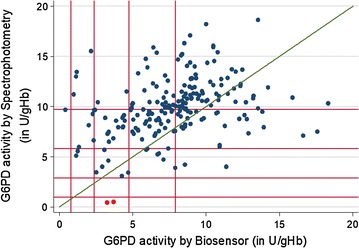
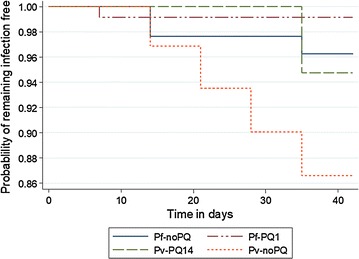
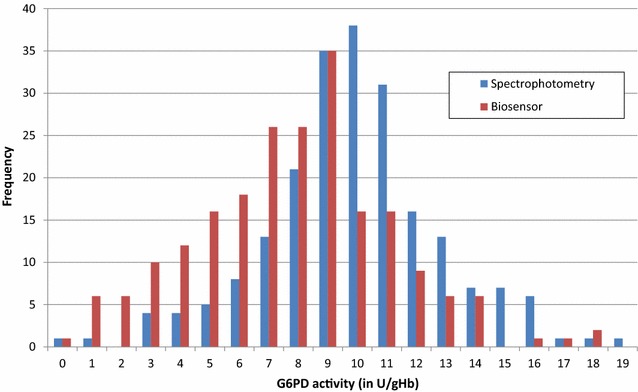
231 patients with P. falciparum (74.8%), 77 (24.9%) with P. vivax and 1 (0.3%) patient with mixed infection were enrolled. The PCR corrected cumulative risk of recurrent parasitaemia on day 42 was 3.8% (95% CI 1.2-11.2%) in the Pf-noPQ arm compared to 0.9% (95% CI 0.1-6.0%) in the Pf-PQ1 arm; (HR = 0.25 [95% CI 0.03-2.38], p = 0.189). The corresponding risks of recurrence were 13.4% (95% CI 5.2-31.9%) in the Pv-noPQ arm and 5.3% (95% CI 1.3-19.4%) in the Pv-PQ14 arm (HR 0.36 [95% CI 0.1-2.0], p = 0.212). Two (0.9%) patients had G6PD enzyme activity below 10%, 19 (8.9%) patients below 60% of the adjusted male median. Correlation between spectrophotometry and Biosensor™ was low (r = 0.330, p < 0.001).
AS/SP remains effective for the treatment of P. falciparum and P. vivax. The addition of PQ reduced the risk of recurrent P. falciparum and P. vivax by day 42, although this did not reach statistical significance. The version of the Biosensor™ assessed is not suitable for routine use. Trial registration https://clinicaltrials.gov/ct2/show/NCT02592408.
在苏丹共和国,治疗无并发症疟疾的一线裂殖体杀灭治疗药物是青蒿琥酯(总剂量 12mg/kg)加磺胺多辛/乙胺嘧啶(25/1.25mg/kg)(AS/SP)。患有间日疟原虫的患者还需服用 14 天的伯氨喹(总剂量 3.5mg/kg)(PQ)。本研究旨在评估国家政策的疗效。
年龄在 1 岁以上,经显微镜确认患有恶性疟原虫和/或间日疟原虫疟疾的患者采用 AS/SP 治疗。患有恶性疟原虫的患者随机分为不服用伯氨喹(Pf-noPQ)或服用单次 0.25mg/kg 剂量的伯氨喹(Pf-PQ1)。患有间日疟原虫的患者在第 2 天或随访结束时(Pv-noPQ)服用 14 天未监督的 3.5mg/kg 伯氨喹(Pv-PQ14)。主要终点是第 42 天复发寄生虫血症的风险。G6PD 活性通过分光光度法和 Accessbio Biosensor™进行测量。
共纳入 231 例恶性疟原虫(74.8%)、77 例间日疟原虫(24.9%)和 1 例混合感染(0.3%)患者。PCR 校正的第 42 天复发寄生虫血症累积风险在 Pf-noPQ 组为 3.8%(95%CI 1.2-11.2%),而 Pf-PQ1 组为 0.9%(95%CI 0.1-6.0%);(HR=0.25 [95%CI 0.03-2.38],p=0.189)。Pv-noPQ 组的复发风险相应为 13.4%(95%CI 5.2-31.9%),Pv-PQ14 组为 5.3%(95%CI 1.3-19.4%)(HR 0.36 [95%CI 0.1-2.0],p=0.212)。有 2 例(0.9%)患者 G6PD 酶活性低于 10%,19 例(8.9%)患者低于男性调整中位数的 60%。分光光度法和 Biosensor™之间的相关性较低(r=0.330,p<0.001)。
AS/SP 仍然是治疗恶性疟原虫和间日疟原虫的有效药物。加用伯氨喹可降低第 42 天复发恶性疟原虫和间日疟原虫的风险,尽管这并未达到统计学意义。评估的 Biosensor™版本不适合常规使用。试验注册:https://clinicaltrials.gov/ct2/show/NCT02592408。