El-Sayed Badria, El-Zaki Salah-Eldin, Babiker Hamza, Gadalla Nahla, Ageep Tellal, Mansour Fathi, Baraka Omer, Milligan Paul, Babiker Ahmed
Department of Epidemiology, Tropical Medicine Research Institute, National Centre for Research, Khartoum, Sudan.
PLoS One. 2007 Dec 12;2(12):e1311. doi: 10.1371/journal.pone.0001311.
In areas of seasonal malaria transmission, treatment of asymptomatic carriers of malaria parasites, whose parasitaemia persists at low densities throughout the dry season, could be a useful strategy for malaria control. We carried out a randomized trial to compare two drug regimens for clearance of parasitaemia in order to identify the optimum regimen for use in mass drug administration in the dry season.
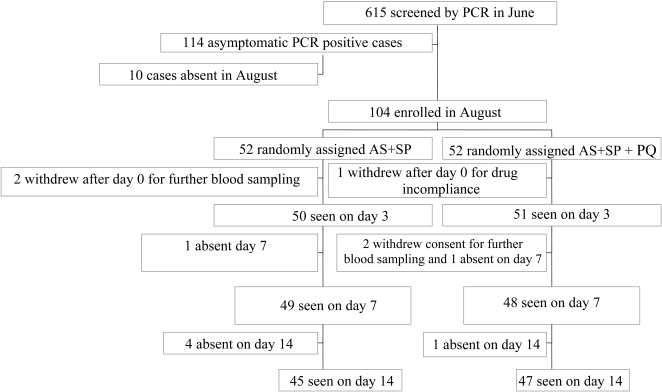
A two-arm open-label randomized controlled trial was conducted during the dry season in an area of distinct seasonal malaria in two villages in Gedarif State in eastern Sudan. Participants were asymptomatic adults and children aged over 6 months, with low-density P. falciparum infection detected by PCR. Participants were randomized to receive artesunate/sulfadoxine-pyrimethamine (AS+SP) combination for three days with or without a dose of primaquine (PQ) on the fourth day. Parasitaemia detected by PCR on days 3, 7 and 14 after the start of treatment and gametocytes detected by RT-PCR on days 7 and 14 were then recorded. 104 individuals who had low density parasitaemia at screening were randomized and treated during the dry season. On day 7, 8.3% were positive by PCR in the AS+SP+PQ group and 6.5% in the AS+SP group (risk difference 1.8%, 95%CI -10.3% to +13.8%). At enrolment, 12% (12/100) were carrying gametocytes. This was reduced to 6.4% and 4.4% by day 14 (Risk difference 1.9% (95%CI -9.3% to +13.2%) in AS+SP+PQ and AS+SP groups, respectively.
Addition of primaquine to artemisinin combination treatment did not improve elimination of parasitaemia and prevention of gametocyte carriage in carriers with low-density parasitaemia in the dry season.
ClinicalTrials.gov NCT00330902.
在季节性疟疾传播地区,治疗疟原虫无症状携带者(其寄生虫血症在整个旱季持续处于低密度水平)可能是疟疾控制的一项有效策略。我们开展了一项随机试验,比较两种药物方案清除寄生虫血症的效果,以确定旱季大规模药物管理中使用的最佳方案。
在苏丹东部加达里夫州两个村庄的一个明显季节性疟疾流行地区的旱季期间,进行了一项双臂开放标签随机对照试验。参与者为无症状的成年人及6个月以上儿童,通过聚合酶链反应(PCR)检测出低密度恶性疟原虫感染。参与者被随机分配接受青蒿琥酯/磺胺多辛 - 乙胺嘧啶(AS + SP)联合用药三天,第四天加或不加一剂伯氨喹(PQ)。记录治疗开始后第3、7和14天通过PCR检测的寄生虫血症以及第7和14天通过逆转录 - 聚合酶链反应(RT - PCR)检测的配子体。104名在筛查时寄生虫血症低密度的个体在旱季被随机分组并接受治疗。在第7天,AS + SP + PQ组中通过PCR检测为阳性的比例为8.3%,AS + SP组为6.5%(风险差异1.8%,95%置信区间 - 10.3%至 + 13.8%)。在入组时,12%(12/100)携带配子体。到第14天,这一比例分别降至6.4%和4.4%(AS + SP + PQ组和AS + SP组的风险差异分别为1.9%(95%置信区间 - 9.3%至 + 13.2%))。
在旱季,对于低密度寄生虫血症携带者,在青蒿素联合治疗中添加伯氨喹并不能改善寄生虫血症的清除及预防配子体携带。
ClinicalTrials.gov NCT00330902