Cardiology Department, Balikesir University Faculty of Medicine, Balikesir, Turkey.
Cardiology Department, Ataturk Education and Research Hospital, Izmir, Turkey.
Lipids Health Dis. 2018 Mar 16;17(1):53. doi: 10.1186/s12944-018-0709-5.
The red cell distribution width (RDW) is a numerical measurement of variability in the size of red blood cells. Many studies have shown that high-density lipoprotein cholesterol (HDL-C), has an anti-inflammatory effect. The aim of this study was to investigate the relationship between the serum HDL-C level and RDW in patients with coronary artery disease (CAD).
Patients who underwent coronary angiography were reviewed. Patients who had moderate or severe heart failure, moderate or severe renal failure, significant systemic disease, anemia, a blood transfusion within the last 3 months, or a hematologic disease, as well as those who were taking lipid-lowering medication, were excluded from the study. The Gensini scoring system was used to determine the severity of CAD. Biochemical and hematological parameters were measured from venous blood samples taken after the patient fasted for at least 8 h. The RDW was routinely obtained from a hemogram.
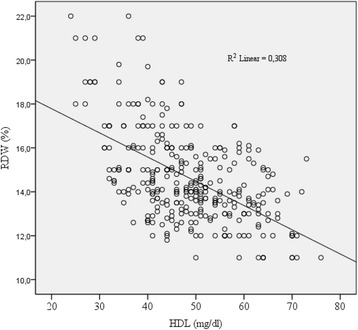
In total, 328 patients were included in the study. The patients were categorized according to quartiles. There were 80 patients in Quartile 1 (RDW < 13.2), 84 patients in Quartile 2 (13.2 ≥ RDW < 14.15), 81 patients in Quartile 3 (14.15 ≥ RDW < 16), and 83 patients in Quartile 4 (RDW ≥ 16). There was a significant and inverse relationship between the serum HDL level and RDW. Regression analysis showed that the HDL-C, hemoglobin, and hs-CRP levels and Gensini score were predictors for the RDW.
We found an inverse and gradual association between the serum HDL-C level and RDW, and the serum HDL-C level was an independent predictor for the RDW.
红细胞分布宽度(RDW)是红细胞大小变异性的数值测量。许多研究表明,高密度脂蛋白胆固醇(HDL-C)具有抗炎作用。本研究旨在探讨冠心病(CAD)患者血清 HDL-C 水平与 RDW 之间的关系。
回顾行冠状动脉造影的患者。排除中重度心力衰竭、中重度肾功能衰竭、严重全身性疾病、贫血、近 3 个月内输血或血液系统疾病以及服用降脂药物的患者。使用 Gensini 评分系统确定 CAD 的严重程度。从禁食至少 8 小时后的静脉血样中测量生化和血液学参数。RDW 从血常规中常规获得。
共纳入 328 例患者。根据四分位数将患者进行分类。第 1 四分位数(RDW < 13.2)有 80 例患者,第 2 四分位数(13.2 ≤ RDW < 14.15)有 84 例患者,第 3 四分位数(14.15 ≤ RDW < 16)有 81 例患者,第 4 四分位数(RDW ≥ 16)有 83 例患者。血清 HDL 水平与 RDW 呈显著负相关。回归分析显示,HDL-C、血红蛋白和 hs-CRP 水平和 Gensini 评分是 RDW 的预测因子。
我们发现血清 HDL-C 水平与 RDW 之间存在负相关且逐渐相关,血清 HDL-C 水平是 RDW 的独立预测因子。