Department of Dermatology and Allergology, University Hospital, Ludwig Maximilian University of Munich, Munich, Germany.
Institute of Human Genetics, University Hospital, Ludwig Maximilian University of Munich, Goethestr. 29, D-80336, Munich, Germany.
BMC Med Genet. 2018 Mar 16;19(1):45. doi: 10.1186/s12881-018-0558-0.
Birt-Hogg-Dubé syndrome is a genetic syndrome caused by mutations in the FLCN gene. The main symptoms are lung bullae and pneumothorax, benign and malignant kidney tumors, and facial fibrofolliculoma. The risk of pneumothorax is considerable between ages 20-40 years, but decreases markedly after this age range and first-time pneumothorax after age 50 years is rare. Fibrofolliculomas usually occur between ages 35 and 45 years, while the risk for kidney cancer increases steadily with age, starting in young adulthood. However, we demonstrate here that within the same family patients might develop symptoms significantly before or after the usual age range, obscuring the typical clinical pattern and delaying diagnosis.
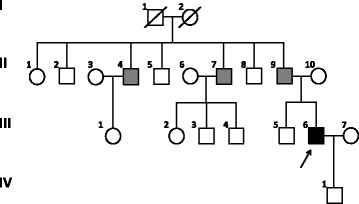
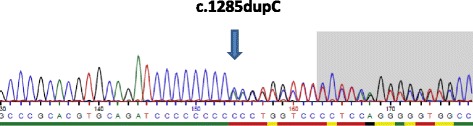
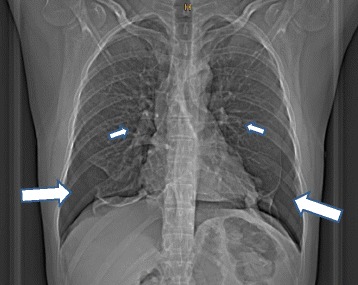
The 43 year old index patient had a history of lung bullae and recurrent pneumothoraces starting 14 years earlier. His father (age 83 years) and one of the paternal uncles experienced their first pneumothorax unusually late after the age of 60 years. The uncle subsequently had four more pneumothoraces, and was diagnosed with kidney in his early 70s. Considerable differences in age of onset were also observed with regard to facial fibrofolliculomas that both paternal uncles developed very early around age 20 years, but which the father only started to show in his eighth decade. Birt-Hogg-Dubé syndrome was finally diagnosed when the index patient started to develop fibrofolliculomas within the typical age range.
The family described here illustrates that Birt-Hogg-Dubé syndrome can be difficult to recognize, if presenting with considerable intrafamilial clinical variability. With a life-time kidney cancer risk of about 14-35% the consequences of delayed diagnosis might be grave for the affected family members. The possibility of Birt-Hogg-Dubé syndrome should therefore be taken into consideration in apparently sporadic patients presenting with lung bullae and pneumothorax.
Birt-Hogg-Dubé 综合征是一种由 FLCN 基因突变引起的遗传综合征。主要症状是肺大疱和气胸、良性和恶性肾肿瘤以及面部纤维毛囊瘤。气胸的风险在 20-40 岁之间相当大,但在此年龄范围之后显著降低,50 岁以后首次发生气胸很少见。纤维毛囊瘤通常发生在 35 至 45 岁之间,而肾癌的风险随着年龄的增长而稳步增加,始于青年期。然而,我们在这里证明,在同一个家庭中,患者的症状可能会在通常的年龄范围之前或之后显著出现,这使得典型的临床模式变得模糊,并导致诊断延迟。
这位 43 岁的指数患者有肺大疱和反复发作的气胸病史,始于 14 年前。他的父亲(83 岁)和一位叔伯在 60 岁以后出现了异常晚的首次气胸。这位叔伯随后又发生了四次气胸,并在 70 多岁时被诊断出患有肾脏疾病。在面部纤维毛囊瘤方面,也观察到了相当大的发病年龄差异,两位叔伯都在 20 岁左右很早就出现了这种情况,但父亲直到 80 多岁才开始出现。当指数患者开始在典型的年龄范围内出现纤维毛囊瘤时,最终诊断为 Birt-Hogg-Dubé 综合征。
这里描述的家族表明,如果家族内存在相当大的临床表现变异性,Birt-Hogg-Dubé 综合征可能难以识别。由于终生肾癌的风险约为 14-35%,因此对受影响的家庭成员来说,延迟诊断的后果可能是严重的。因此,对于表现为肺大疱和气胸的明显散发性患者,应考虑 Birt-Hogg-Dubé 综合征的可能性。