Department of Psychology & Neuroscience, University of North Carolina, Chapel Hill, NC, USA; Bowles Center for Alcohol Studies, University of North Carolina, Chapel Hill, NC, USA.
Department of Psychology & Neuroscience, University of North Carolina, Chapel Hill, NC, USA; Fred P. Wilson School of Pharmacy, High Point University, High Point, NC, USA.
Pharmacol Biochem Behav. 2018 May;168:1-7. doi: 10.1016/j.pbb.2018.03.006. Epub 2018 Mar 15.
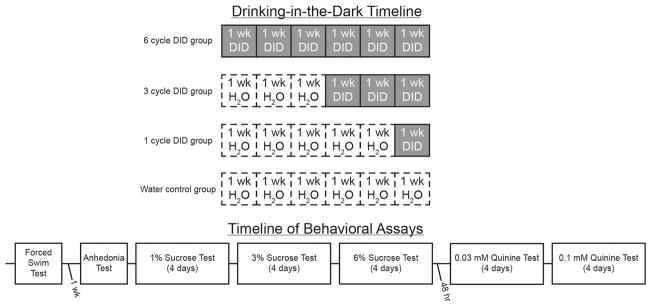
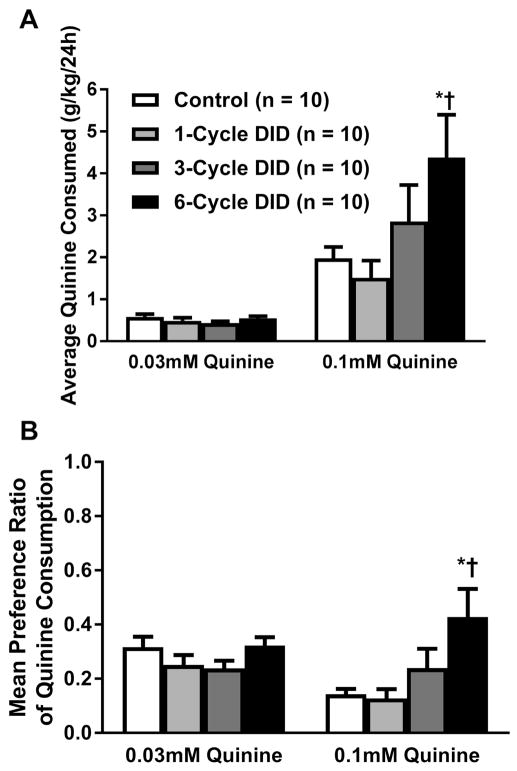
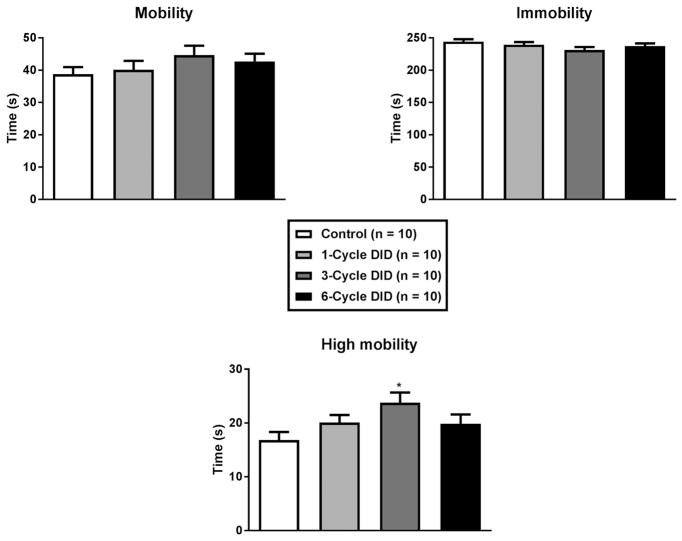
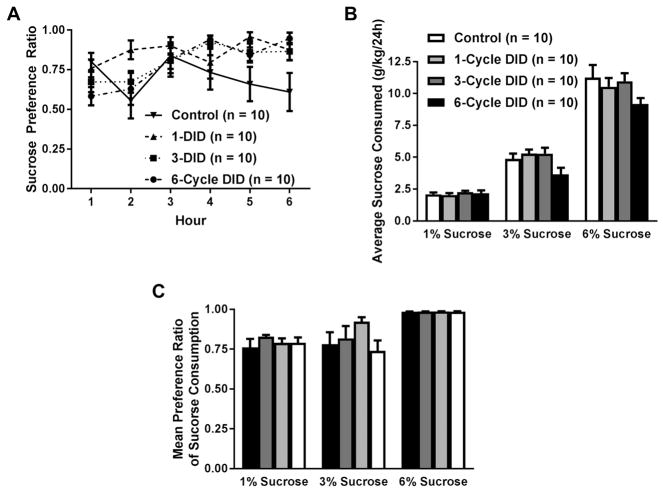
Psychological depression is frequently linked to alcohol abuse and even serves as key indicators of an alcohol use disorder (AUD). This relationship is supported by preclinical findings in which depression-like phenotypes develop in animals exposed to chronic intermittent ethanol vapor, a common preclinical model of alcohol dependence. However, the emergence of these maladaptive phenotypes following repeated binge-like ethanol drinking remains relatively unexplored. The purpose of this study was to evaluate depression-like behaviors associated with binge-like consumption in mice. Using the drinking-in-the-dark (DID) paradigm, we examined the impact of multiple binge-like cycles (1, 3, or 6) on depression-like behaviors in the forced swim test (FST) and sucrose preference as a test for anhedonia. We also assessed the effect of repeated binge cycles on the consumption of bitter and sweet tastants over a range of concentrations. Results indicated that binge-like ethanol drinking did not lead to depression-like behavior as repeated cycles of DID did not alter sucrose consumption or preference nor did it impact time spent immobile during the FST. Animals that experienced six cycles of DID showed increased quinine consumption and increased quinine preference, which may be indicative of an escalated preference for tastants that resemble the gustatory aspects of ethanol. Interestingly, an unexpected ~20% increase in hypermobility was observed after three cycles of binge-like ethanol drinking. Although the FST is most frequently used to model depression-like behavior, emerging evidence suggests that increased hypermobility during the FST could be indicative of an inability to cope in a stressful situation, suggesting that repeated ethanol exposure in the present experiment transiently enhances stress reactivity.
心理抑郁常与酗酒有关,甚至是酒精使用障碍(AUD)的关键指标。这种关系得到了临床前研究结果的支持,即在慢性间歇性乙醇蒸气暴露的动物中会出现类似抑郁的表型,这是一种常见的酒精依赖的临床前模型。然而,在反复暴饮乙醇后,这些适应不良的表型的出现仍然相对未知。本研究的目的是评估与小鼠暴饮相关的类似抑郁的行为。使用暗饮(DID)范式,我们检查了多次暴饮周期(1、3 或 6)对强迫游泳试验(FST)中类似抑郁行为和蔗糖偏好的影响,作为快感缺失的测试。我们还评估了重复暴饮周期对苦味和甜味味觉剂在一系列浓度下的消耗的影响。结果表明,暴饮乙醇不会导致类似抑郁的行为,因为 DID 的重复周期不会改变蔗糖的消耗或偏好,也不会影响 FST 期间的不动时间。经历了六次 DID 周期的动物表现出更多的奎宁消耗和更高的奎宁偏好,这可能表明对类似于乙醇味觉方面的味觉剂的偏好增加。有趣的是,在经历三次暴饮乙醇后,观察到意外的约 20%的过度活动增加。虽然 FST 最常用于模拟类似抑郁的行为,但新出现的证据表明,FST 期间过度活动的增加可能表明无法应对紧张情况,这表明在本实验中重复乙醇暴露暂时增强了应激反应。