Department of Psychiatry and Behavioral Sciences, Duke University Medical Center, Durham, NC, USA; Department of Medicine, Division of General Internal Medicine, Duke University Medical Center, Durham, NC, USA; Duke Clinical Research Institute, Duke University Medical Center, Durham, NC, USA; Center for Child and Family Policy, Sanford School of Public Policy, Duke University, Durham, NC, USA.
National Institute on Drug Abuse, Bethesda, MD, USA.
Drug Alcohol Depend. 2018 May 1;186:86-93. doi: 10.1016/j.drugalcdep.2018.01.008. Epub 2018 Mar 3.
The majority of the U.S. healthcare resources are utilized by a small population characterized as high-risk, high-need persons with complex care needs (e.g., adults with multiple chronic conditions). Substance use disorders (SUDs) and mental health disorders (MHDs) are a driver of poor health and additional healthcare costs, but they are understudied among high-need patients.
We examine the prevalence and correlates of SUDs and MHDs among adults with high-risk diabetes, who are patients at the top 10% risk score for developing poor outcomes (hospital admission or death).
A risk algorithm developed from Duke University Health System electronic health records (EHRs) data was used to identify patients with high-risk diabetes for targeting home-based primary care. The EHR data of the 263 patients with high-risk diabetes were analyzed to understand patterns of SUDs and MHDs to inform care-coordinating efforts.
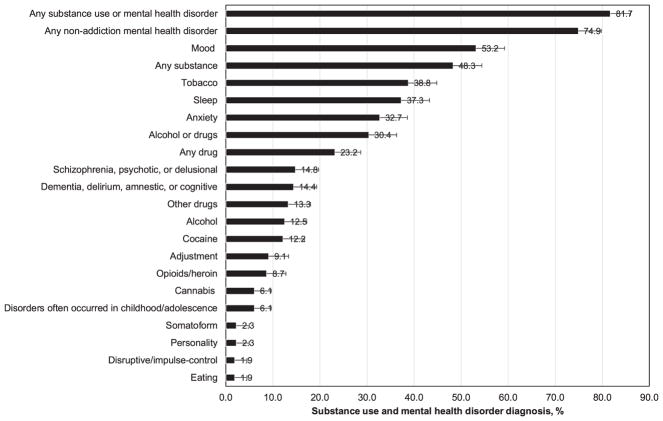
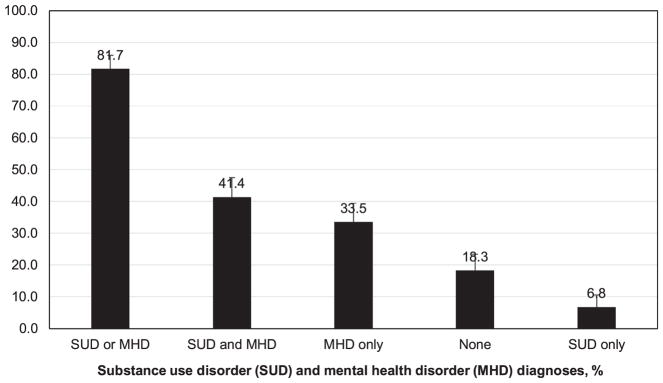
Both SUDs (any SUD 48.3%, alcohol 12.5%, tobacco 38.8%, drug 23.2%) and MHDs (any MHD 74.9%, mood 53.2%, sleep 37.3%, anxiety 32.7%, schizophrenia/psychotics/delusional 14.8%, dementia/delirium/amnestic/cognitive 14.4%, adjustment 9.1%) were prevalent. Overall, 81.7% of the sample had SUD or MHD. Elevated odds of SUD were noted among men (tobacco, alcohol) and those who were never-married (alcohol, cannabis). African-American race (vs. other race/ethnicity) was associated with lower odds of anxiety disorders.
While data are limited to one large academic health system, they provide clinical evidence revealing that 82% of patients with high-risk diabetes had SUD and/or MHD recorded in their EHRs, highlighting a need for developing service models to optimize high-risk care.
大多数美国医疗保健资源都被一小部分人群利用,这些人群被认为是高风险、高需求的人,他们有复杂的医疗需求(例如,患有多种慢性疾病的成年人)。物质使用障碍(SUDs)和精神健康障碍(MHDs)是导致健康状况不佳和额外医疗费用的原因,但在高需求患者中研究不足。
我们研究了患有高危糖尿病的成年人中 SUDs 和 MHDs 的患病率和相关因素,这些成年人的风险评分处于发展不良结局(住院或死亡)的前 10%。
使用来自杜克大学健康系统电子健康记录(EHRs)数据的风险算法来识别高危糖尿病患者,以便针对这些患者开展家庭为基础的初级保健。分析了 263 名高危糖尿病患者的 EHR 数据,以了解 SUDs 和 MHDs 的模式,为协调护理工作提供信息。
SUDs(任何 SUD 占 48.3%,酒精 12.5%,烟草 38.8%,药物 23.2%)和 MHDs(任何 MHD 占 74.9%,情绪障碍 53.2%,睡眠障碍 37.3%,焦虑障碍 32.7%,精神分裂症/精神病/妄想症 14.8%,痴呆/谵妄/遗忘症/认知障碍 14.4%,适应障碍 9.1%)都很常见。总体而言,81.7%的样本患有 SUD 或 MHD。男性(吸烟、饮酒)和未婚者(饮酒、大麻)SUD 的患病风险较高。非裔美国人种族(与其他种族/族裔相比)与焦虑障碍的低患病风险相关。
尽管数据仅限于一个大型学术医疗系统,但它们提供了临床证据,表明 82%的高危糖尿病患者在其 EHRs 中记录了 SUD 和/或 MHD,这凸显了开发服务模式以优化高危护理的必要性。