Valeri Jake, Gisabella Barbara, Pantazopoulos Harry
Department of Psychiatry and Human Behavior, University of Mississippi Medical Center, Jackson, MS, United States.
Graduate Program in Neuroscience, University of Mississippi Medical Center, Jackson, MS, United States.
Front Cell Neurosci. 2023 Jun 16;17:1208974. doi: 10.3389/fncel.2023.1208974. eCollection 2023.
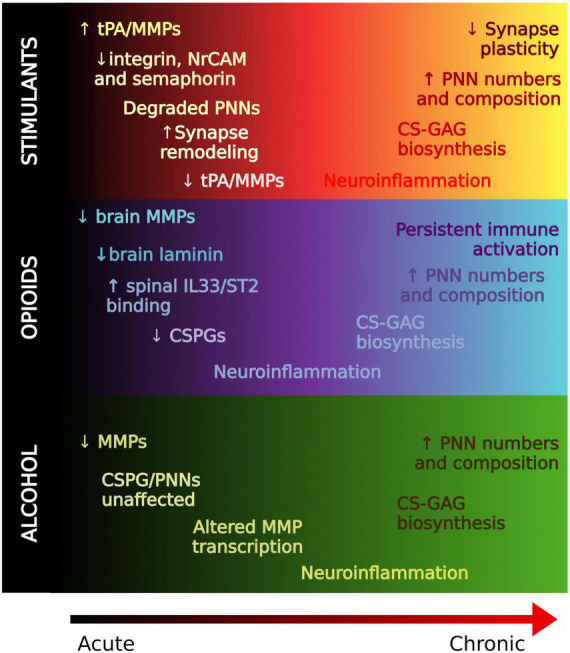
Substance use disorders are a global health problem with increasing prevalence resulting in significant socioeconomic burden and increased mortality. Converging lines of evidence point to a critical role of brain extracellular matrix (ECM) molecules in the pathophysiology of substance use disorders. An increasing number of preclinical studies highlight the ECM as a promising target for development of novel cessation pharmacotherapies. The brain ECM is dynamically regulated during learning and memory processes, thus the time course of ECM alterations in substance use disorders is a critical factor that may impact interpretation of the current studies and development of pharmacological therapies. This review highlights the evidence for the involvement of ECM molecules in reward learning, including drug reward and natural reward such as food, as well as evidence regarding the pathophysiological state of the brain's ECM in substance use disorders and metabolic disorders. We focus on the information regarding time-course and substance specific changes in ECM molecules and how this information can be leveraged for the development of therapeutic strategies.
物质使用障碍是一个全球性的健康问题,其患病率不断上升,导致了巨大的社会经济负担和死亡率的增加。越来越多的证据表明,脑细胞外基质(ECM)分子在物质使用障碍的病理生理学中起着关键作用。越来越多的临床前研究强调,ECM是开发新型戒烟药物疗法的一个有前景的靶点。脑ECM在学习和记忆过程中受到动态调节,因此物质使用障碍中ECM改变的时间进程是一个关键因素,可能会影响对当前研究的解释和药物治疗的开发。本综述强调了ECM分子参与奖赏学习的证据,包括药物奖赏和食物等自然奖赏,以及关于物质使用障碍和代谢紊乱中脑ECM病理生理状态的证据。我们关注ECM分子随时间进程和物质特异性变化的信息,以及如何利用这些信息来制定治疗策略。