Khairallah Joelle, Sadeghi Ekbatan Shima, Sabally Kebba, Iskandar Michèle M, Hussain Raza, Nassar Atef, Sleno Lekha, Rodes Laetitia, Prakash Satya, Donnelly Danielle J, Kubow Stan
School of Human Nutrition, McGill University, 21111 Lakeshore, Ste. Anne de Bellevue, QC H9X 3V9, Canada.
Plant Science Department, McGill University, 21111 Lakeshore, Ste. Anne de Bellevue, QC H9X 3V9, Canada.
Antioxidants (Basel). 2018 Mar 20;7(3):43. doi: 10.3390/antiox7030043.
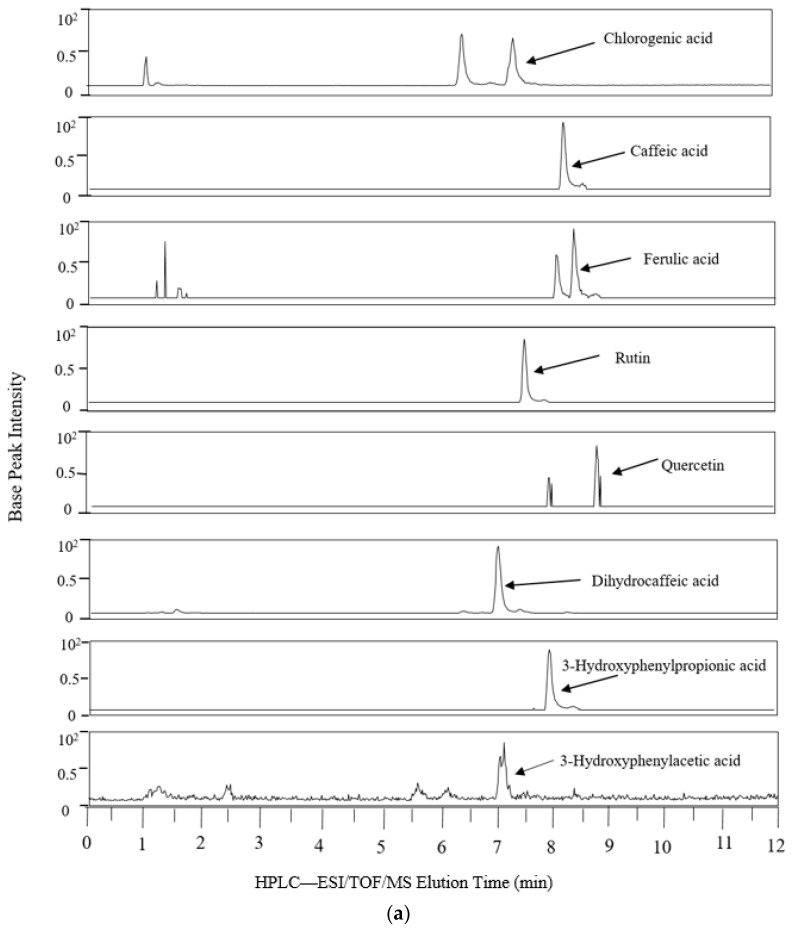
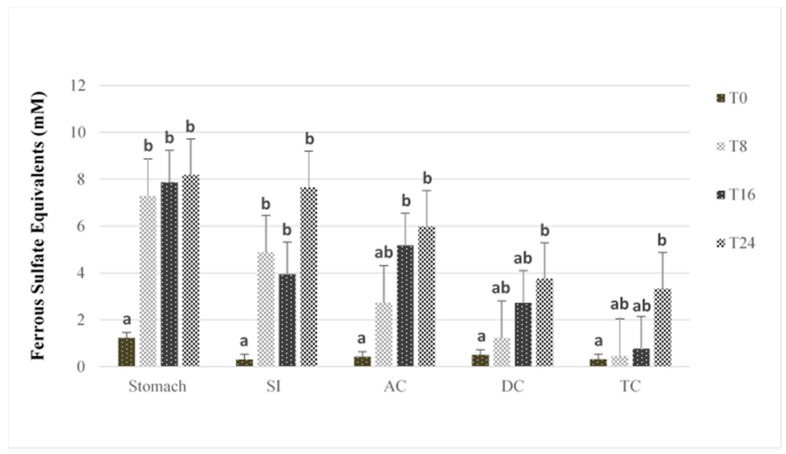
A multistage human gastrointestinal model was used to digest a polyphenol-rich potato extract containing chlorogenic acid, caffeic acid, ferulic acid, and rutin as the primary polyphenols, to assess for their microbial biotransformation and to measure changes in antioxidant capacity in up to 24 h of digestion. The biotransformation of polyphenols was assessed by liquid chromatography-mass spectrometry. Antioxidant capacity was measured by the ferric reducing antioxidant power (FRAP) assay. Among the colonic reactors, parent (poly)phenols were detected in the ascending (AC), but not the transverse (TC) or descending (DC) colons. The most abundant microbial phenolic metabolites in all colonic reactors included derivatives of propionic acid, acetic acid, and benzoic acid. As compared to the baseline, an earlier increase in antioxidant capacity ( = 8 h) was seen in the stomach and small intestine vessels as compared to the AC ( = 16 h) and TC and DC ( = 24 h). The increase in antioxidant capacity observed in the DC and TC can be linked to the accumulation of microbial smaller-molecular-weight phenolic catabolites, as the parent polyphenolics had completely degraded in those vessels. The colonic microbial digestion of potato-based polyphenols could lead to improved colonic health, as this generates phenolic metabolites with significant antioxidant potential.
使用多阶段人体胃肠道模型消化富含多酚的马铃薯提取物,该提取物含有绿原酸、咖啡酸、阿魏酸和芦丁作为主要多酚,以评估它们的微生物生物转化,并测量长达24小时消化过程中抗氧化能力的变化。通过液相色谱-质谱法评估多酚的生物转化。通过铁还原抗氧化能力(FRAP)测定法测量抗氧化能力。在结肠反应器中,在升结肠(AC)中检测到母体(多)酚,但在横结肠(TC)或降结肠(DC)中未检测到。所有结肠反应器中最丰富的微生物酚类代谢产物包括丙酸、乙酸和苯甲酸的衍生物。与基线相比,胃和小肠血管中抗氧化能力的增加时间更早(=8小时),而AC中为16小时,TC和DC中为24小时。在DC和TC中观察到的抗氧化能力增加可能与微生物小分子酚类分解代谢物的积累有关,因为母体多酚类物质在这些血管中已完全降解。基于马铃薯的多酚的结肠微生物消化可能会改善结肠健康,因为这会产生具有显著抗氧化潜力的酚类代谢产物。