College of Food Science and Engineering, Northwest A & F University, Yangling 712100, China.
State Key Laboratory of Plateau Ecology and Agriculture, Qinghai University, Xining, Qinghai 810016, China.
Molecules. 2018 Apr 11;23(4):879. doi: 10.3390/molecules23040879.
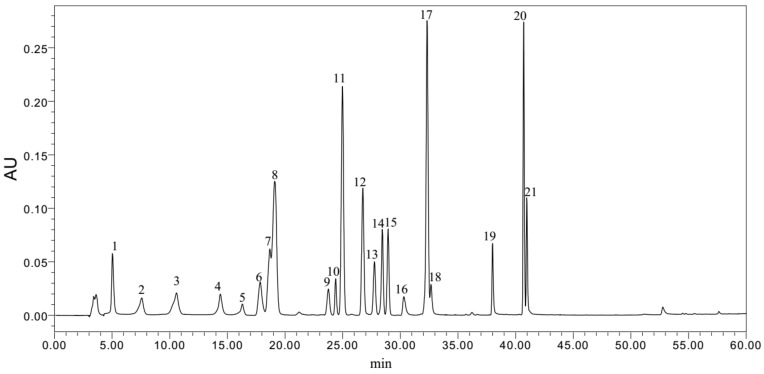
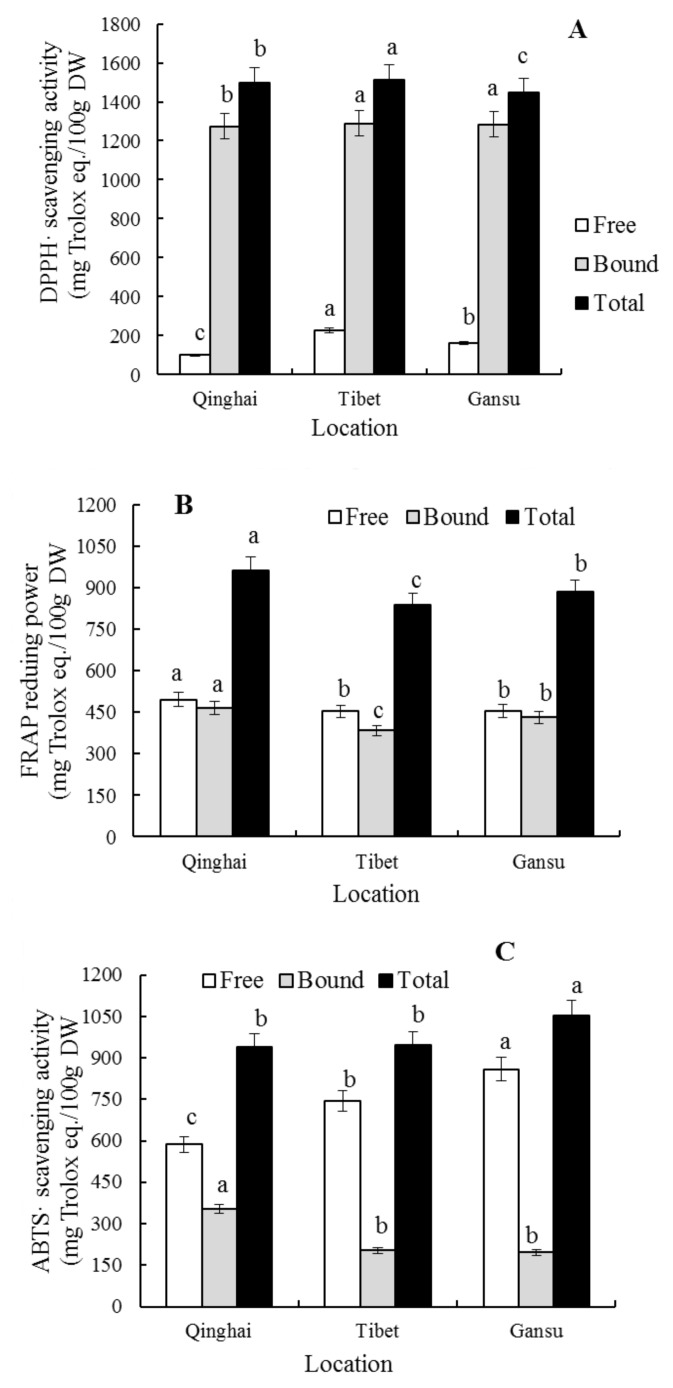
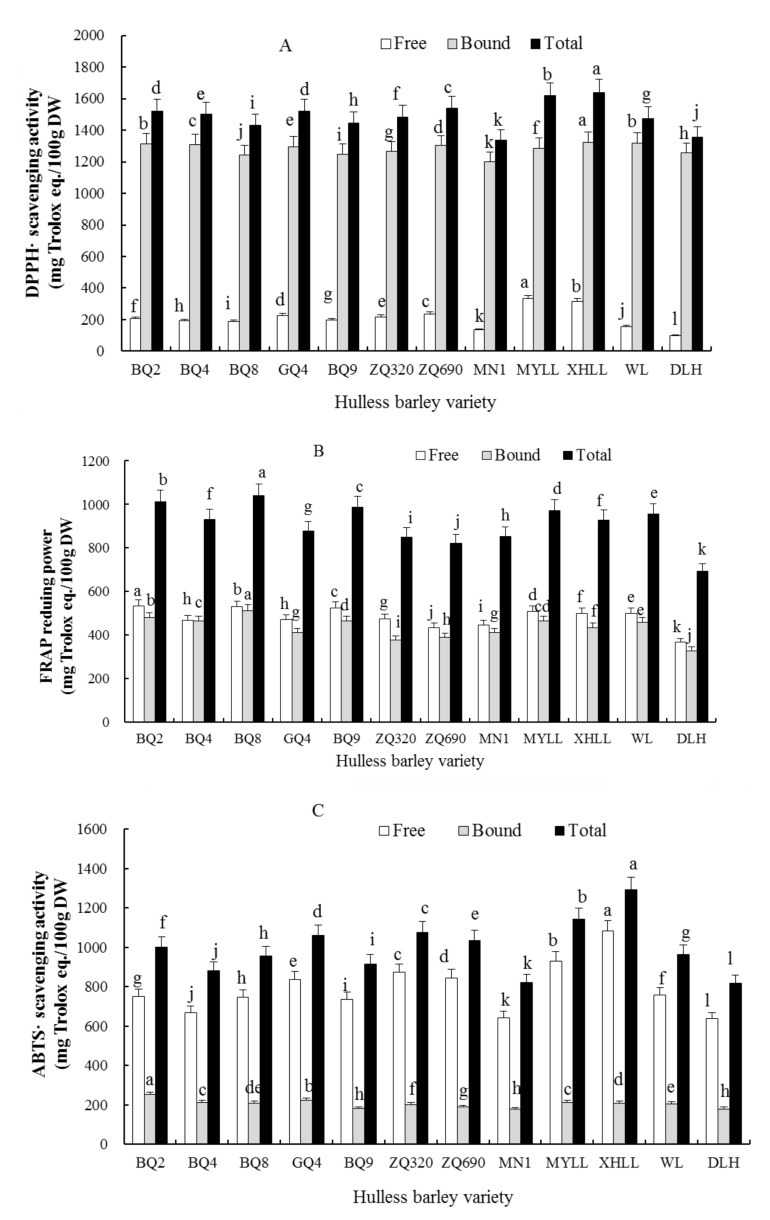
In this study, the polyphenols composition and antioxidant properties of 12 blue highland barley varieties planted on the Qinghai-Tibet Plateau area were measured. The contents of the free, bound and total phenolic acids varied between 166.20-237.60, 170.10-240.75 and 336.29-453.94 mg of gallic acid equivalents per 100 g of dry weight (DW) blue highland barley grains, while the free and bound phenolic acids accounted for 50.09% and 49.91% of the total phenolic acids, respectively. The contents of the free, bound and total flavones varied among 20.61-25.59, 14.91-22.38 and 37.91-47.98 mg of catechin equivalents per 100 g of dry weight (DW) of blue highland barley grains, while the free and bound flavones accounted for 55.90% and 44.10% of the total flavones, respectively. The prominent phenolic compounds in the blue hulless barley grains were gallic acid, benzoic acid, syringic acid, 4-coumaric acid, naringenin, hesperidin, rutin, (+)-catechin and quercetin. Among these, protocatechuic acid, chlorogenic acid and (+)-catechin were the major phenolic compounds in the free phenolics extract. The most abundant bound phenolics were gallic acid, benzoic acid, syringic acid, 4-coumaric acid, benzoic acid, dimethoxybenzoic acid, naringenin, hesperidin, quercetin and rutin. The average contribution of the bound phenolic extract to the DPPH free radical scavenging capacity was higher than 86%, that of free phenolic extract to the ABTS free radical scavenging capacity was higher than 79%, and that of free phenolic (53%) to the FRAP antioxidant activity was equivalent to that of the bound phenol extract (47%). In addition, the planting environment exerts a very important influence on the polyphenol composition, content and antioxidant activity of blue highland barley. The correlation analysis showed that 2,4-hydroxybenzoic acid and protocatechuic acid were the main contributors to the DPPH and ABTS free radical scavenging capacity in the free phenolic extract, while chlorogenic acid, vanillic acid, ferulic acid and quercetin were the main contributors to the free radical scavenging capacity in the bound phenol extract. The study results show that the blue highland barley grains have rich phenolic compounds and high antioxidant activity, as well as significant varietal differences. The free and bound phenolic extracts in the blue hulless barley grains have an equivalent proportion in the total phenol, and co-exist in two forms. They can be used as a potential valuable source of natural antioxidants, and can aid in enhancing the development and daily consumption of foods relating to blue highland barley.
在这项研究中,测量了青藏高原地区种植的 12 种青稞的多酚组成和抗氧化特性。青稞籽粒中游离、结合和总酚酸的含量分别为 166.20-237.60、170.10-240.75 和 336.29-453.94mg 没食子酸当量/100g 干重(DW),而游离和结合酚酸分别占总酚酸的 50.09%和 49.91%。游离、结合和总类黄酮的含量分别为 20.61-25.59、14.91-22.38 和 37.91-47.98mg 儿茶素当量/100g DW,而游离和结合类黄酮分别占总类黄酮的 55.90%和 44.10%。在青稞壳中含量较高的酚类化合物有没食子酸、苯甲酸、丁香酸、4-香豆酸、柚皮素、橙皮苷、芦丁、(+)-儿茶素和槲皮素。其中,原儿茶酸、绿原酸和(+)-儿茶素是游离酚提取物中的主要酚类化合物。结合酚中含量最丰富的是没食子酸、苯甲酸、丁香酸、4-香豆酸、苯甲酸、二甲氧基苯甲酸、柚皮素、橙皮苷、槲皮素和芦丁。结合酚提取物对 DPPH 自由基清除能力的平均贡献率高于 86%,游离酚提取物对 ABTS 自由基清除能力的平均贡献率高于 79%,游离酚(53%)对 FRAP 抗氧化活性的贡献相当于结合酚提取物(47%)。此外,种植环境对青稞多酚组成、含量和抗氧化活性有非常重要的影响。相关性分析表明,游离酚提取物中 2,4-二羟基苯甲酸和原儿茶酸是 DPPH 和 ABTS 自由基清除能力的主要贡献者,而结合酚提取物中绿原酸、香草酸、阿魏酸和槲皮素是自由基清除能力的主要贡献者。研究结果表明,青稞籽粒含有丰富的酚类化合物和高抗氧化活性,且具有显著的品种差异。游离和结合酚提取物在青稞总酚中的比例相当,以两种形式共存。它们可以作为一种有价值的天然抗氧化剂来源,有助于增强青稞相关食品的开发和日常消费。