Uppal Timsy, Sarkar Roni, Dhelaria Ranjit, Verma Subhash C
Department of Microbiology and Immunology, University of Nevada, Reno, School of Medicine, 1664 N, Virginia Street, MS 320, Reno, NV 89557, USA.
Department of Internal Medicine, UTMB Galveston, League City Campus, 301 University Blvd, Galveston, TX 77555, USA.
Cancers (Basel). 2018 Mar 20;10(3):85. doi: 10.3390/cancers10030085.
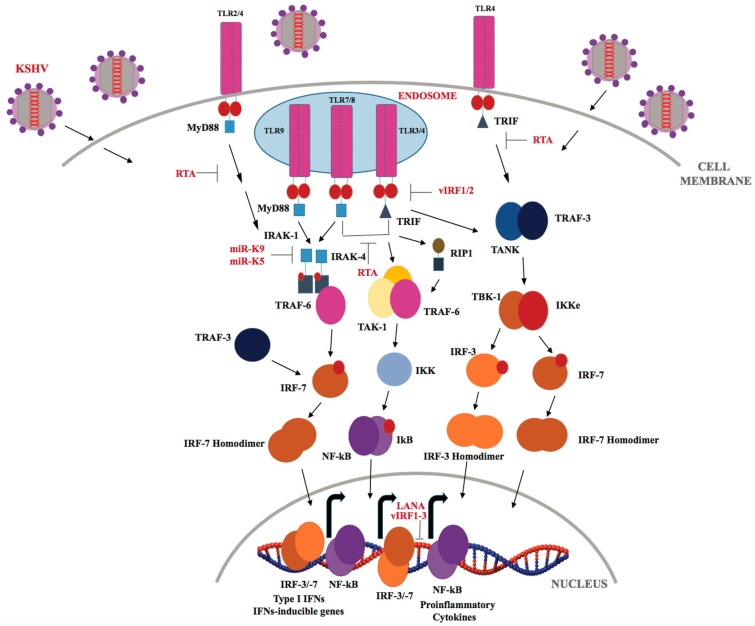
Kaposi's sarcoma-associated herpesvirus or Human herpesvirus-8 (KSHV/HHV-8), an oncogenic human herpesvirus and the leading cause of cancer in HIV-infected individuals, is a major public health concern with recurring reports of epidemics on a global level. The early detection of KSHV virus and subsequent activation of the antiviral immune response by the host's immune system are crucial to prevent KSHV infection. The host's immune system is an evolutionary conserved system that provides the most important line of defense against invading microbial pathogens, including viruses. Viruses are initially detected by the cells of the host innate immune system, which evoke concerted antiviral responses via the secretion of interferons (IFNs) and inflammatory cytokines/chemokines for elimination of the invaders. Type I IFN and cytokine gene expression are regulated by multiple intracellular signaling pathways that are activated by germline-encoded host sensors, i.e., pattern recognition receptors (PRRs) that recognize a conserved set of ligands, known as 'pathogen-associated molecular patterns (PAMPs)'. On the contrary, persistent and dysregulated signaling of PRRs promotes numerous tumor-causing inflammatory events in various human cancers. Being an integral component of the mammalian innate immune response and due to their constitutive activation in tumor cells, targeting PRRs appears to be an effective strategy for tumor prevention and/or treatment. Cellular PRRs are known to respond to KSHV infection, and KSHV has been shown to be armed with an array of strategies to selectively inhibit cellular PRR-based immune sensing to its benefit. In particular, KSHV has acquired specific immunomodulatory genes to effectively subvert PRR responses during the early stages of primary infection, lytic reactivation and latency, for a successful establishment of a life-long persistent infection. The current review aims to comprehensively summarize the latest advances in our knowledge of role of PRRs in KSHV infections.
卡波西肉瘤相关疱疹病毒或人类疱疹病毒8型(KSHV/HHV-8)是一种致癌性人类疱疹病毒,也是艾滋病毒感染者患癌的主要原因,它是一个重大的公共卫生问题,全球范围内不断有疫情复发的报道。早期检测KSHV病毒并随后由宿主免疫系统激活抗病毒免疫反应对于预防KSHV感染至关重要。宿主免疫系统是一个进化上保守的系统,是抵御包括病毒在内的入侵微生物病原体的最重要防线。病毒最初由宿主先天免疫系统的细胞检测到,这些细胞通过分泌干扰素(IFN)和炎性细胞因子/趋化因子引发协同抗病毒反应以清除入侵者。I型干扰素和细胞因子基因表达受多种细胞内信号通路调节,这些信号通路由种系编码的宿主传感器即模式识别受体(PRR)激活,PRR识别一组保守的配体,即“病原体相关分子模式(PAMP)”。相反,PRR的持续和失调信号传导在各种人类癌症中促进了许多致癌性炎症事件。作为哺乳动物先天免疫反应的一个组成部分,并且由于它们在肿瘤细胞中的组成性激活,靶向PRR似乎是肿瘤预防和/或治疗的有效策略。已知细胞PRR对KSHV感染有反应,并且已证明KSHV拥有一系列策略来选择性地抑制基于细胞PRR的免疫传感以使其受益。特别是,KSHV获得了特定的免疫调节基因,以在原发性感染、裂解再激活和潜伏的早期阶段有效颠覆PRR反应,从而成功建立终身持续感染。本综述旨在全面总结我们对PRR在KSHV感染中的作用的最新认识进展。