Pan Zhipeng, Chen Mengya, Hu Xingxing, Wang Hua, Yang Jiajia, Zhang Congjun, Pan Faming, Sun Guoping
Department of Medical Oncology, The First Affiliated Hospital of Anhui Medical University, Hefei, Anhui, 230032, China.
Department of Epidemiology and Biostatistics, School of Public Health, Anhui Medical University, Hefei, Anhui, 230032, China.
Oncotarget. 2018 Jan 4;9(16):13068-13076. doi: 10.18632/oncotarget.23964. eCollection 2018 Feb 27.
Recent studies have reported the associations between vitamin D receptor () polymorphisms and colorectal cancer (CRC), but the results were not always consistent. This meta-analysis aims to evaluate whether polymorphisms are associated with CRC susceptibility.
Studies on the associations between polymorphisms and CRC were retrieved from the Web of Science, PubMed, the Chinese Biomedical Database (CBM), Chinese National Knowledge Infrastructure (CNKI) and Wanfang (Chinese) databases. The odds ratio (OR) with 95% confidence intervals () was obtained.
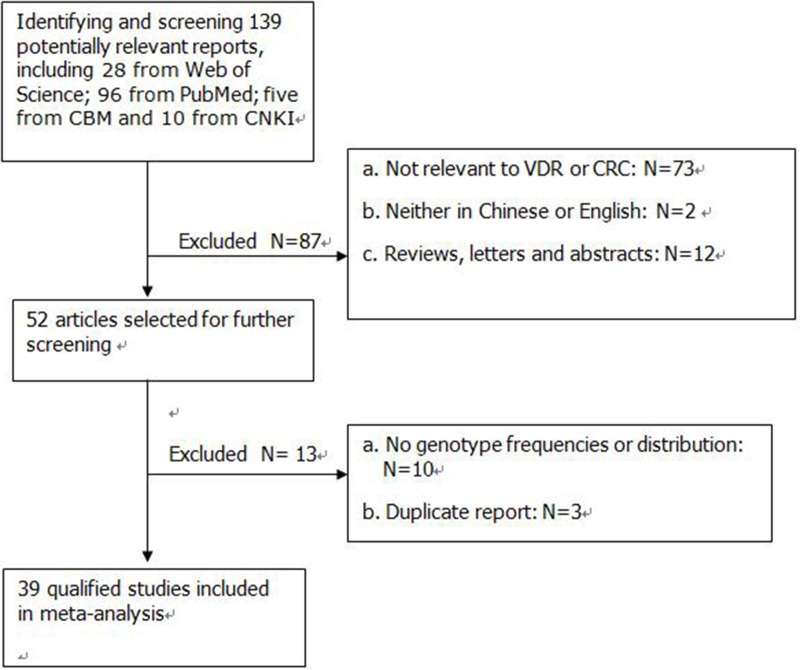
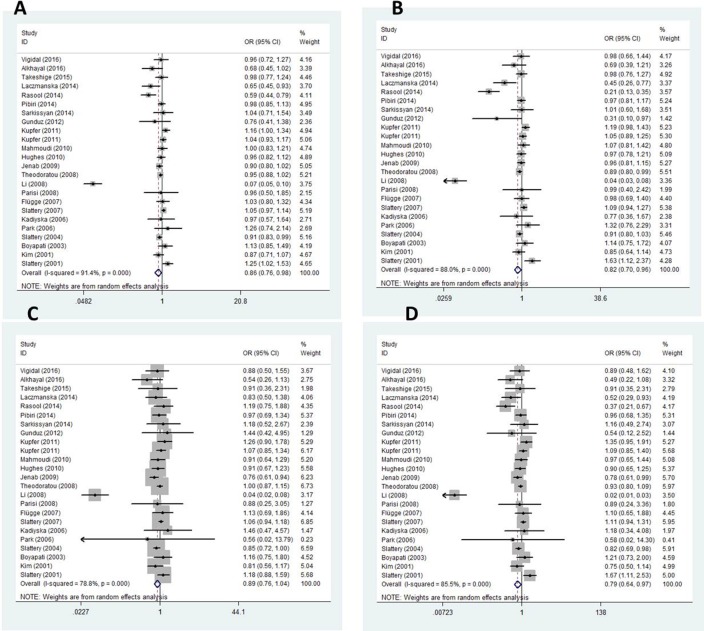
Thirty-nine articles met all inclusion criteria and were included in the meta-analysis including 22101 CRC cases and 23696 healthy controls. The 39 articles consisted of five gene polymorphisms including and . The results of meta-analysis showed that the polymorphism was on the fringe of statistically significant in the comparisons of F allele vs. f allele in fixed model (OR = 1.029, 95% CI = 0.999-1.059, P = 0.057, P = 0.057). Moreover, for the associations between polymorphism with CRC, We observed significant differences in allele frequencies, the homozygous model and the dominant model between CRC patients and healthy controls (B vs. b: OR = 0.862, 95% CI = 0.761-0.976, P = 0.019, P = 0.019; BB vs. bb: OR = 0.786, 95% CI = 0.636-0.972, Praw = 0.026, P = 0.039; BB + Bb vs. bb: OR = 0.934, 95% CI = 0.888-0.982, Praw = 0.008, P = 0.024, respectively).
This meta-analysis suggests that is associated with CRC risk and might be a risk factor for CRC. However, these associations with CRC need further studied.
近期研究报道了维生素D受体()基因多态性与结直肠癌(CRC)之间的关联,但结果并不总是一致。本荟萃分析旨在评估基因多态性是否与CRC易感性相关。
从Web of Science、PubMed、中国生物医学数据库(CBM)、中国知网(CNKI)和万方(中文)数据库中检索关于基因多态性与CRC关联的研究。获得比值比(OR)及95%置信区间()。
39篇文章符合所有纳入标准并纳入荟萃分析,包括22101例CRC病例和23696例健康对照。这39篇文章包含5种基因多态性,包括和。荟萃分析结果显示,在固定模型中,F等位基因与f等位基因比较时,基因多态性在统计学显著性边缘(OR = 1.029,95% CI = 0.999 - 1.059,P = 0.057,P = 0.057)。此外,对于基因多态性与CRC的关联,我们观察到CRC患者与健康对照在等位基因频率、纯合子模型和显性模型方面存在显著差异(B与b:OR = 0.862,95% CI = 0.761 - 0.976,P = 0.019,P = 0.019;BB与bb:OR = 0.786,95% CI = 0.636 - 0.972,Praw = 0.026,P = 0.039;BB + Bb与bb:OR = 0.934, 95% CI = 0.888 - 0.982,Praw = 0.008,P = 0.024)。
本荟萃分析表明与CRC风险相关,可能是CRC的一个风险因素。然而,这些与CRC的关联需要进一步研究。