Mashhadiabbas Fatemeh, Neamatzadeh Hossein, Nasiri Rezvan, Foroughi Elnaz, Farahnak Soudabeh, Piroozmand Parisa, Mazaheri Mahta, Zare-Shehneh Masoud
Department of Oral and Maxillofacial Pathology, Dental School, Shahid Beheshti University of Medical Sciences, Tehran, Iran.
Department of Medical Genetics, Shahid Sadoughi University of Medical Sciences, Yazd, Iran.
Dent Res J (Isfahan). 2018 May-Jun;15(3):155-165.
There has been increasing interest in the study of the association between Vitamin D receptor (VDR) gene polymorphisms and risk of chronic periodontitis. However, the results remain inconclusive. To better understand the roles of VDR polymorphisms (BsmI, TaqI, FokI, and ApaI) in chronic periodontitis susceptibility, we conducted this systematic review and meta-analysis.
The PubMed, Google Scholar, and Web of Science database were systemically searched to determine all the eligible studies about VDR polymorphisms and risk of chronic periodontitis up to April 2017. Odds ratio (OR) and 95% confidence interval (CI) were used to evaluate the associations between VDR polymorphisms and chronic periodontitis risk. All the statistical analyses were performed by Comprehensive Meta-Analysis. All values were two-tailed with a significant level at 0.05.
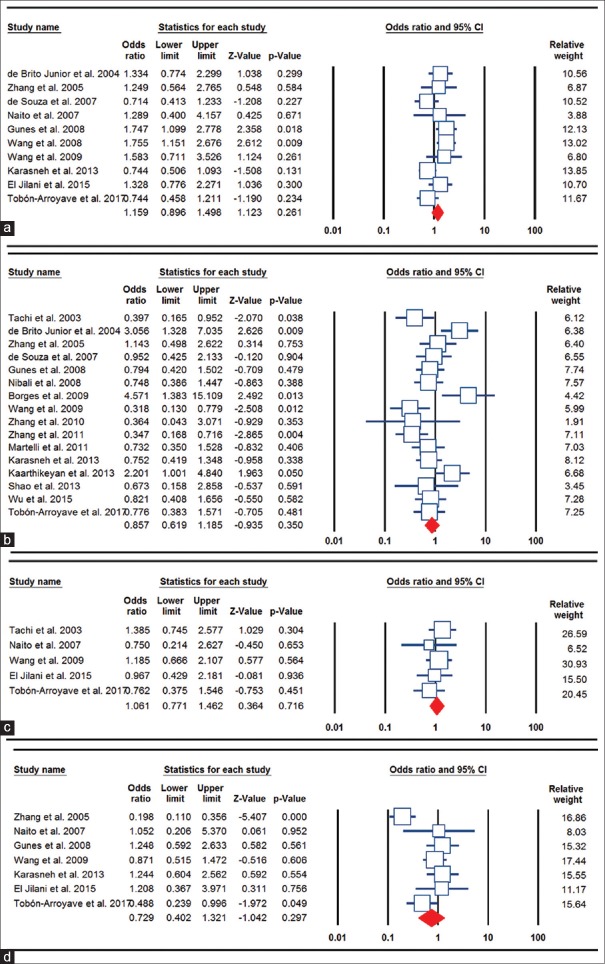
Finally, a total of 38 case-control studies in 19 publications were identified which met our inclusion criteria. There are ten studies with 866 chronic periodontitis cases and 786 controls for BsmI, 16 studies with 1570 chronic periodontitis cases and 1676 controls for TaqI, five studies with 374 chronic periodontitis cases and 382 controls for FokI, and seven studies with 632 chronic periodontitis cases and 604 controls for ApaI. Overall, no significant association was observed between VDR gene BsmI, TaqI, FokI, and ApaI polymorphisms and risk of chronic periodontitis in any genetic model. Subgroup analysis stratified by ethnicity suggested a significant association between BsmI polymorphism and chronic periodontitis risk in the Caucasian subgroup under allele model (A vs. G: OR = 1.747, 95% CI = 1.099-2.778, = 0.018). Further, no significant associations were observed when stratified by Hardy-Weinberg equilibrium status for BsmI, TaqI, and ApaI.
Our results suggest that BsmI, TaqI, FokI, and ApaI polymorphisms in the VDR gene might not be associated with risk of chronic periodontitis in overall population.
维生素D受体(VDR)基因多态性与慢性牙周炎风险之间关联的研究愈发受到关注。然而,结果仍无定论。为更好地了解VDR基因多态性(BsmI、TaqI、FokI和ApaI)在慢性牙周炎易感性中的作用,我们进行了这项系统评价和荟萃分析。
系统检索了PubMed、谷歌学术和科学网数据库,以确定截至2017年4月所有关于VDR基因多态性与慢性牙周炎风险的符合条件的研究。采用比值比(OR)和95%置信区间(CI)来评估VDR基因多态性与慢性牙周炎风险之间的关联。所有统计分析均通过综合荟萃分析软件完成。所有P值均为双侧检验,显著性水平设定为0.05。
最终,共纳入19篇文献中的38项病例对照研究,这些研究均符合我们的纳入标准。其中,有10项研究涉及866例慢性牙周炎病例和786例对照用于分析BsmI,16项研究涉及1570例慢性牙周炎病例和1676例对照用于分析TaqI,5项研究涉及374例慢性牙周炎病例和382例对照用于分析FokI,7项研究涉及632例慢性牙周炎病例和604例对照用于分析ApaI。总体而言,在任何遗传模型中,均未观察到VDR基因的BsmI、TaqI、FokI和ApaI多态性与慢性牙周炎风险之间存在显著关联。按种族分层的亚组分析表明,在等位基因模型下,白种人亚组中BsmI多态性与慢性牙周炎风险之间存在显著关联(A vs. G:OR = 1.747,95% CI = 1.099 - 2.778,P = 0.018)。此外,按BsmI、TaqI和ApaI的哈迪 - 温伯格平衡状态分层时,未观察到显著关联。
我们的结果表明,VDR基因中的BsmI、TaqI、FokI和ApaI多态性可能与总体人群的慢性牙周炎风险无关。