Chaubal Gouri, Sarkale Prasad, Kore Pravin, Yadav Pragya
Maximum Containment Laboratory, National Institute of Virology, Sus Road, Pashan, Pune, 410021, Maharashtra, India.
Heliyon. 2018 Mar 1;4(2):e00549. doi: 10.1016/j.heliyon.2018.e00549. eCollection 2018 Feb.
Kyasanur Forest Disease (KFD), a tick borne flavivirus, which was earlier endemic to Karnataka state, India, has been confirmed and detected from neighboring states of Tamil Nadu, Maharashtra, Goa and Kerala states in India. Increased human and vector surveillance therefore becomes essential for the identification of KFD affected regions and control of further spread of the disease. Currently, available KFD detection assays include realtime RT-PCR and nested RT-PCR assays. Here we describe the development of a sensitive single step RT-PCR assay for the detection of KFD viral RNA. This can be easily used in any BSL-2 laboratory for screening of KFD suspected cases or for differential diagnosis of viral hemorrhagic fever panel.
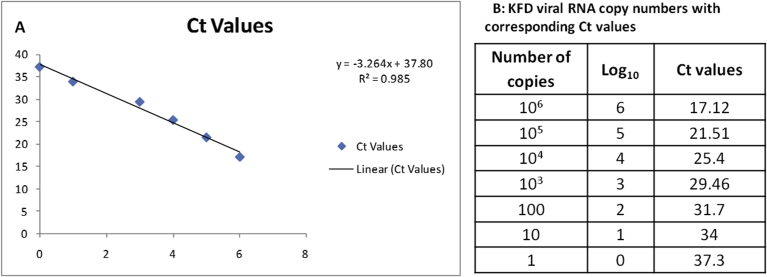
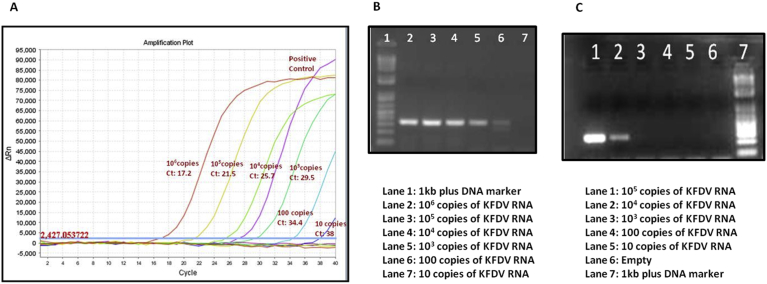
Three primer sets were designed and checked for sensitivity using known dilutions of KFD viral RNA (Ranging from 10 copies to 10 copies). The primer set (2) was found to be most sensitive was selected and tested for specificity for Kyasanur forest disease virus (KFDV) by testing against zika, dengue, chikungunya, crimean congo hemorrhagic fever (CCHF), yellow fever, japanese encephalitis (JE) and west nile viruses. A total of 104 samples (human, monkey and tick positive and negative samples) were tested using this assay.
No false positive or false negative results were seen for human, monkey or tick samples. The assay was specific for KFD and could detect upto 100 copies of KFD viral RNA.
The previously published sensitive real time RT-PCR assay requires higher cost in terms of reagents and machine setup and technical expertise has been the primary reason for development of this assay. A single step RT-PCR is relatively easy to perform and more cost effective than real time RT-PCR in smaller setups in the absence of Biosafety Level-3 facility. This study reports the development and optimization of single step RT-PCR assay which is more sensitive and less time-consuming than nested RT-PCR and cost effective for rapid diagnosis of KFD viral RNA.
基孔肯雅热森林病(KFD)是一种由蜱传播的黄病毒,此前在印度卡纳塔克邦流行,现已在印度邻国泰米尔纳德邦、马哈拉施特拉邦、果阿邦和喀拉拉邦得到确认和检测。因此,加强人类和病媒监测对于确定受KFD影响的地区以及控制该疾病的进一步传播至关重要。目前,可用的KFD检测方法包括实时RT-PCR和巢式RT-PCR检测。在此,我们描述了一种用于检测KFD病毒RNA的灵敏单步RT-PCR检测方法的开发。该方法可轻松用于任何二级生物安全实验室,用于筛查KFD疑似病例或对病毒性出血热样本进行鉴别诊断。
设计了三组引物,并使用已知稀释度的KFD病毒RNA(范围从10拷贝到10拷贝)检测其灵敏度。发现引物组(2)最灵敏,选择该引物组并通过针对寨卡病毒、登革热病毒、基孔肯雅病毒、克里米亚刚果出血热(CCHF)病毒、黄热病毒、日本脑炎(JE)病毒和西尼罗病毒进行检测,以检测其对基孔肯雅热森林病病毒(KFDV)的特异性。使用该检测方法对总共104个样本(人类、猴子和蜱的阳性和阴性样本)进行了检测。
人类、猴子或蜱样本均未出现假阳性或假阴性结果。该检测方法对KFD具有特异性,能够检测低至100拷贝的KFD病毒RNA。
先前发表的灵敏实时RT-PCR检测方法在试剂、仪器设置和技术专业知识方面成本较高,这是开发此检测方法的主要原因。在没有三级生物安全设施的较小实验室中,单步RT-PCR相对易于操作,且比实时RT-PCR更具成本效益。本研究报告了单步RT-PCR检测方法的开发和优化,该方法比巢式RT-PCR更灵敏、耗时更少,且对KFD病毒RNA的快速诊断具有成本效益。