Neurobiology Section and Center for Neural Circuits and Behavior, University of California, San Diego, La Jolla, CA 92093, USA.
Department of Psychological Sciences, University of San Diego, San Diego, CA 92110, USA.
Cell Rep. 2018 Mar 20;22(12):3152-3159. doi: 10.1016/j.celrep.2018.02.082.
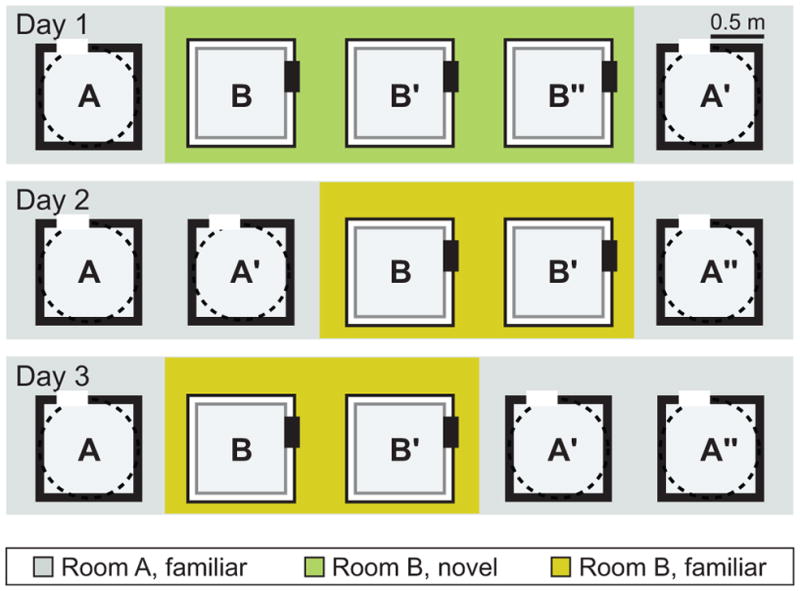
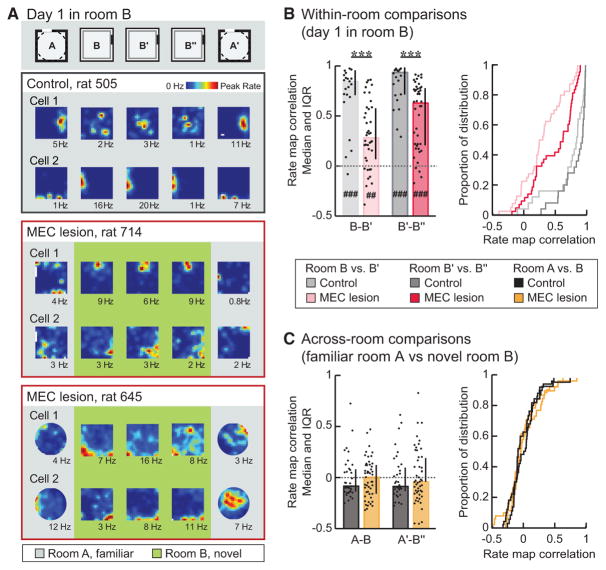
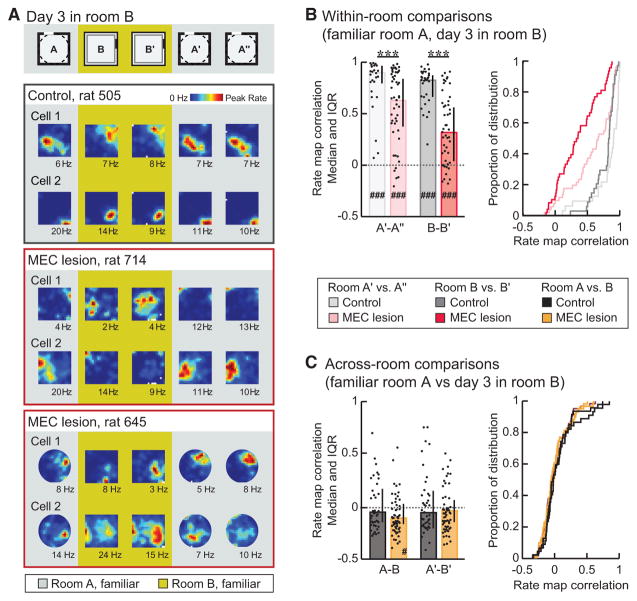
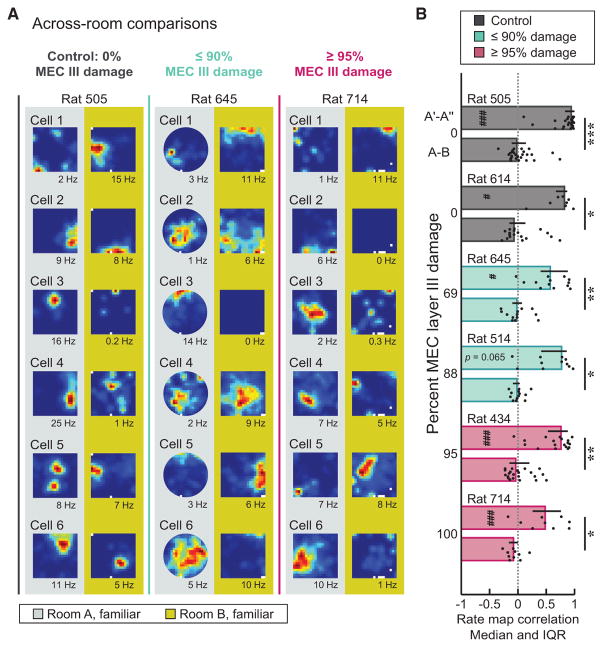
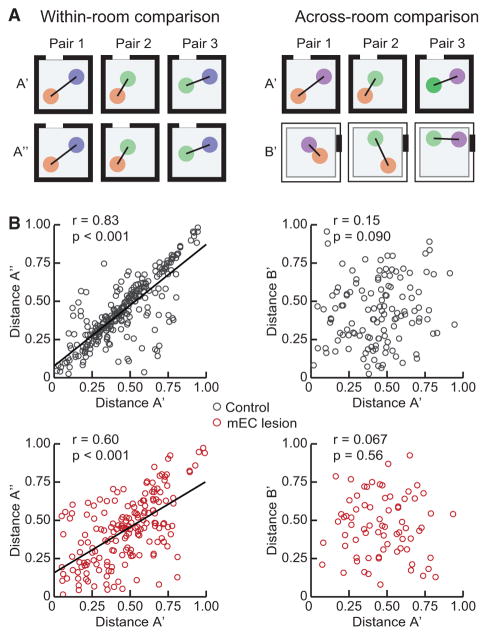
The high storage capacity of the episodic memory system relies on distinct representations for events that are separated in time and space. The spatial component of these computations includes the formation of independent maps by hippocampal place cells across environments, referred to as global remapping. Such remapping is thought to emerge by the switching of input patterns from specialized spatially selective cells in medial entorhinal cortex (mEC), such as grid and border cells. Although it has been shown that acute manipulations of mEC firing patterns are sufficient for inducing hippocampal remapping, it remains unknown whether specialized spatial mEC inputs are necessary for the reorganization of hippocampal spatial representations. Here, we examined remapping in rats without mEC input to the hippocampus and found that highly distinct spatial maps emerged rapidly in every individual rat. Our data suggest that hippocampal spatial computations do not depend on inputs from specialized cell types in mEC.
情景记忆系统的高存储容量依赖于时间和空间上分离的事件的独特表示。这些计算的空间成分包括海马体位置细胞在不同环境中形成独立的地图,称为全局重映射。这种重映射被认为是通过从中线内嗅皮层 (mEC) 的专门空间选择性细胞(如网格和边界细胞)输入模式的切换而产生的。尽管已经表明急性操纵 mEC 放电模式足以诱导海马体重映射,但仍不清楚专门的空间 mEC 输入是否对于海马体空间表示的重组是必要的。在这里,我们检查了没有 mEC 输入到海马体的大鼠的重映射,发现每个大鼠中都迅速出现了高度独特的空间图谱。我们的数据表明,海马体的空间计算不依赖于 mEC 中专门细胞类型的输入。