Institute of Bioprocess Engineering and Pharmaceutical Technology, University of Applied Sciences Mittelhessen, Wiesenstrasse 14, 35390 Giessen, Germany.
Mathematical Institute, Justus-Liebig University of Giessen, Arndtstrasse 2, 35392 Giessen, Germany.
Sensors (Basel). 2018 Mar 18;18(3):900. doi: 10.3390/s18030900.
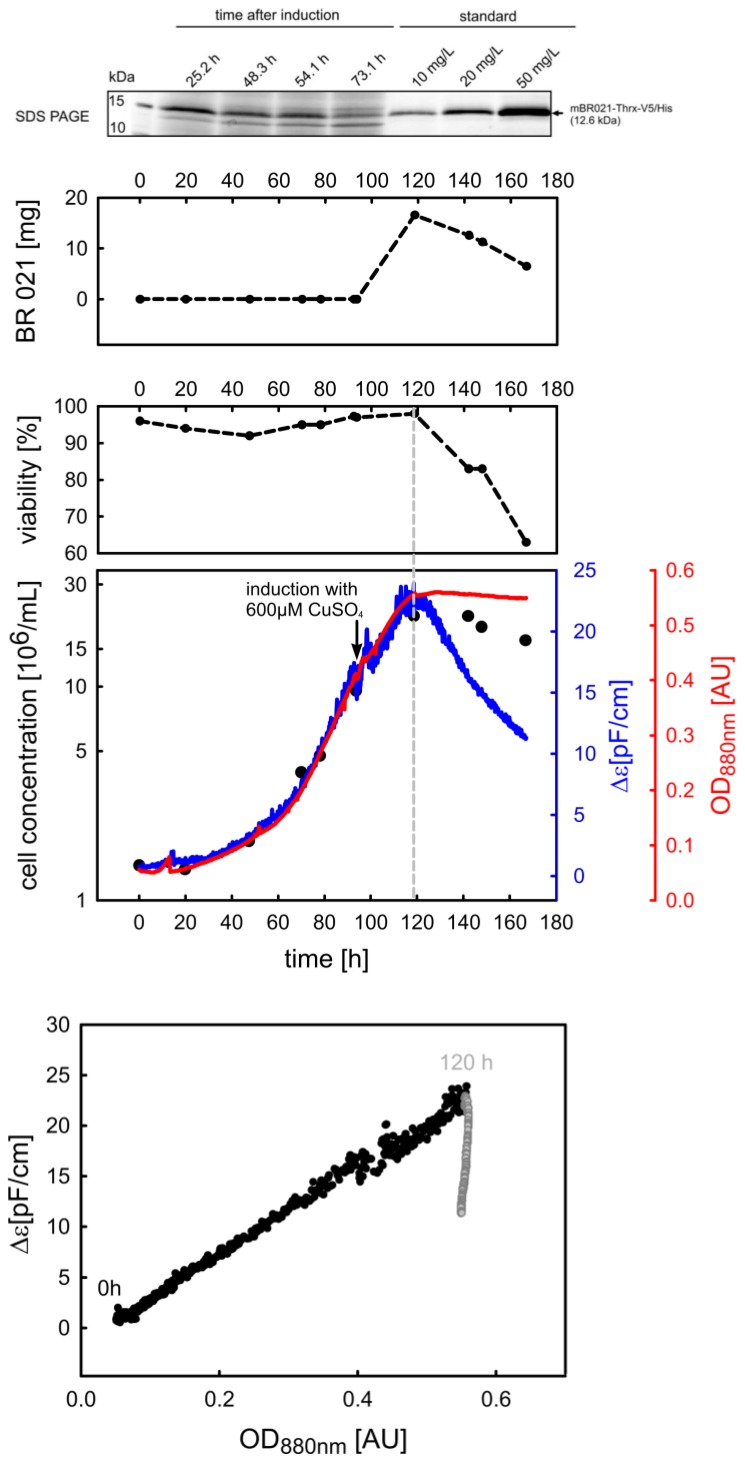
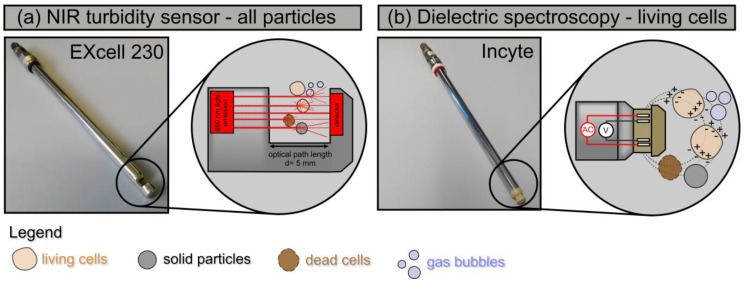
The production of recombinant proteins in bioreactors requires real-time process monitoring and control to increase process efficiency and to meet the requirements for a comprehensive audit trail. The combination of optical near-infrared turbidity sensors and dielectric spectroscopy provides diverse system information because different measurement principles are exploited. We used this combination of techniques to monitor and control the growth and protein production of stably transformed S2 cells expressing antimicrobial proteins. The in situ monitoring system was suitable in batch, fed-batch and perfusion modes, and was particularly useful for the online determination of cell concentration, specific growth rate () and cell viability. These data were used to pinpoint the optimal timing of the key transitional events (induction and harvest) during batch and fed-batch cultivation, achieving a total protein yield of ~25 mg at the 1-L scale. During cultivation in perfusion mode, the OD signal was used to control the bleed line in order to maintain a constant cell concentration of 5 × 10⁷ cells/mL, thus establishing a turbidostat/permittistat culture. With this setup, a five-fold increase in productivity was achieved and 130 mg of protein was recovered after 2 days of induced perfusion. Our results demonstrate that both sensors are suitable for advanced monitoring and integration into online control strategies.
在生物反应器中生产重组蛋白需要实时的过程监测和控制,以提高过程效率,并满足全面审核跟踪的要求。光学近红外浊度传感器和介电谱的组合提供了多样化的系统信息,因为利用了不同的测量原理。我们使用这种技术组合来监测和控制表达抗菌蛋白的稳定转化 S2 细胞的生长和蛋白质生产。该原位监测系统适用于批处理、补料分批和灌注模式,特别有助于在线确定细胞浓度、比生长速率()和细胞活力。这些数据用于确定批处理和补料分批培养过程中关键过渡事件(诱导和收获)的最佳时间,在 1L 规模下实现了约 25mg 的总蛋白质产量。在灌注模式下培养时,使用 OD 信号来控制放流线,以保持 5×10⁷个细胞/ml 的恒定细胞浓度,从而建立浊度计/恒化器培养。通过这种设置,可实现五倍的生产力提高,并在诱导灌注 2 天后回收 130mg 蛋白质。我们的结果表明,这两种传感器都适用于高级监测和集成到在线控制策略中。