Division of Psychiatry and Applied Psychology, School of Medicine, Institute of Mental Health, The University of Nottingham, Triumph Road, Nottingham, NG7 2TU, UK.
NIHR MindTech MedTech Co-operative, Institute of Mental Health, The University of Nottingham, Triumph Road, Nottingham, NG7 2TU, UK.
BMC Med Educ. 2018 Mar 21;18(1):45. doi: 10.1186/s12909-018-1154-x.
Medical students face many barriers to seeking out professional help for their mental health, including stigma relating to mental illness, and often prefer to seek support and advice from fellow students. Improving medical students' mental health literacy and abilities to support someone experiencing a mental health problem could reduce barriers to help seeking and improve mental health in this population. Mental Health First Aid (MHFA) is an evidence-based intervention designed to improve mental health literacy and ability to respond to someone with a mental health problem. This pilot randomised controlled trial aims to evaluate the MHFA eLearning course in UK medical students.
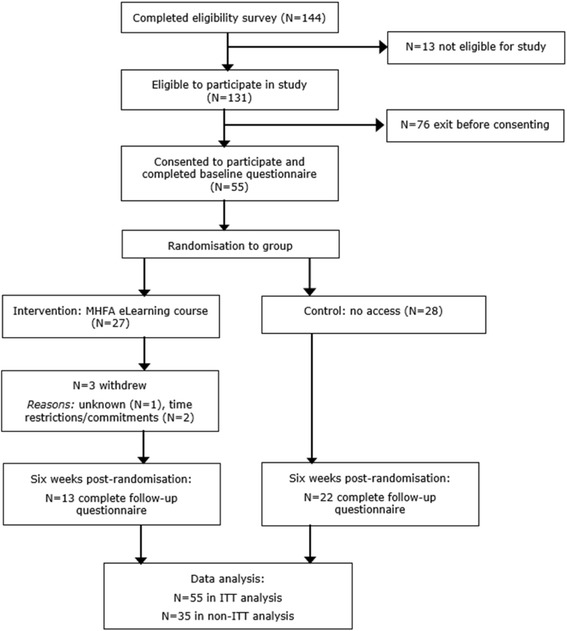
Fifty-five medical students were randomised to receive six weeks access to the MHFA eLearning course (n = 27) or to a no-access control group (n = 28). Both groups completed baseline (pre-randomisation) and follow-up (six weeks post-randomisation) online questionnaires measuring recognition of a mental health problem, mental health first aid intentions, confidence to help a friend experiencing a mental health problem, and stigmatising attitudes. Course feedback was gathered at follow-up.
More participants were lost follow-up in the MHFA group (51.9%) compared to control (21.4%). Both intention-to-treat (ITT) and non-ITT analyses showed that the MHFA intervention improved mental health first aid intentions (p = <.001) and decreased stigmatising attitudes towards people with mental health problems (p = .04). While ITT analysis found no significant Group x Time interaction for confidence to help a friend, the non-ITT analysis did show the intervention improved confidence to help a friend with mental health problems (p = <.001), and improved mental health knowledge (p = .003). Medical students in the intervention group reported a greater number of actual mental health first aid actions at follow-up (p = .006). Feedback about the MHFA course was generally positive, with participants stating it helped improve their knowledge and confidence to help someone.
This pilot study demonstrated the potential for the MHFA eLearning course to improve UK medical students' mental health first aid skills, confidence to help a friend and stigmatising attitudes. It could be useful in supporting their own and others' mental health while studying and in their future healthcare careers.
Retrospectively registered ( ISRCTN11219848 ).
医学生在寻求心理健康方面的专业帮助时面临许多障碍,包括与精神疾病相关的污名化,他们通常更愿意向同学寻求支持和建议。提高医学生的心理健康素养和支持经历心理健康问题的人的能力,可以减少寻求帮助的障碍,并改善这一人群的心理健康。心理健康急救(MHF)是一种循证干预措施,旨在提高心理健康素养和应对有心理健康问题的人的能力。这项试点随机对照试验旨在评估英国医学生的 MHF 网络课程。
55 名医学生被随机分配接受六周的 MHF 网络课程(n=27)或无访问控制组(n=28)。两组均在基线(随机前)和随访(随机后六周)时完成在线问卷,以衡量对心理健康问题的识别、心理健康急救意向、帮助有心理健康问题的朋友的信心和歧视态度。在随访时收集课程反馈。
与对照组(21.4%)相比,MHF 组有更多的参与者在随访中丢失(51.9%)。意向治疗(ITT)和非 ITT 分析均表明,MHF 干预提高了心理健康急救意向(p<0.001),降低了对有心理健康问题的人的歧视态度(p=0.04)。虽然 ITT 分析未发现组间时间交互作用对帮助朋友的信心有显著影响,但非 ITT 分析确实表明,干预提高了帮助有心理健康问题的朋友的信心(p<0.001),并提高了心理健康知识(p=0.003)。干预组的医学生在随访时报告了更多的实际心理健康急救行动(p=0.006)。关于 MHF 课程的反馈总体上是积极的,参与者表示它有助于提高他们的知识和帮助他人的信心。
这项试点研究表明,MHF 网络课程有可能提高英国医学生的心理健康急救技能、帮助朋友的信心和歧视态度。它可以在学习期间和未来的医疗保健职业中支持他们自己和他人的心理健康。
回顾性注册(ISRCTN81023248)。