Zeng Duan, He Shen, Yu Shunying, Li Guanjun, Ma Changlin, Wen Yi, Shen Yifeng, Yu Yimin, Li Huafang
Department of Psychiatry, Shanghai Mental Health Center, Shanghai Jiao Tong University School of Medicine, Shanghai, People's Republic of China.
Shanghai Jiading District Mental Health Center, Shanghai, People's Republic of China.
Neuropsychiatr Dis Treat. 2018 Mar 8;14:715-723. doi: 10.2147/NDT.S155076. eCollection 2018.
Increasing evidence has indicated that dysfunction of miR-124 and target gene regulator of G protein signaling 4 () may be involved in the etiology and treatment of major depressive disorder (MDD). However, the molecular mechanisms are not fully understood. This study aimed to investigate whether common genetic variations in these two genes are associated with MDD and therapeutic response to antidepressants in the Chinese population.
Three polymorphisms including rs531564 (a functional single-nucleotide polymorphism [SNP] in ), rs10759 (a microRNA-binding site SNP in ), and rs951436 (a promoter SNP in ) were genotyped in 225 Chinese MDD patients and 436 controls. Among the MDD patients, 147 accepted antidepressant treatment for 8 weeks with therapeutic evaluation at baseline, week 2, week 4, week 6, and week 8 using the 17-item Hamilton Rating Scale for Depression. Multifactor dimensionality reduction (MDR) was used to identify gene-gene interactions.
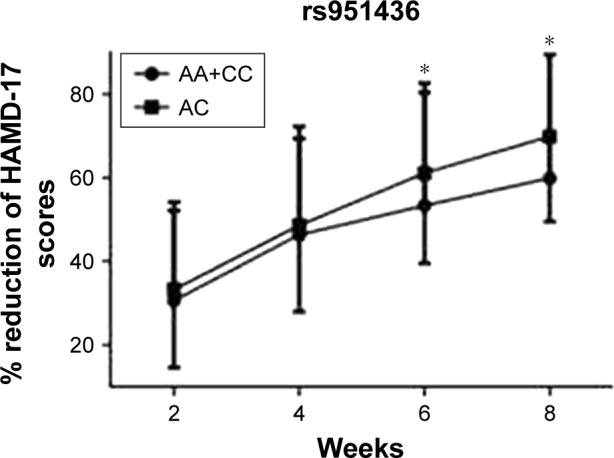
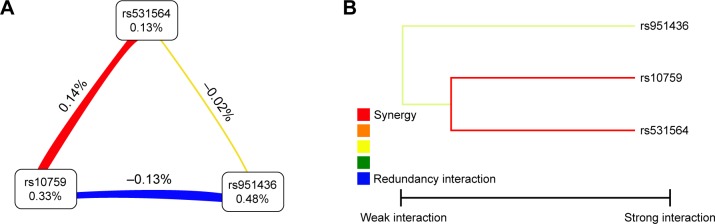
No significant association with MDD was discovered in single-SNP analyses. However, by MDR analysis, the three-locus model of gene-gene interaction was the best for predicting MDD risk. In pharmacogenetic study, a significant association was found in genotypic frequencies of rs951436 between the remitter and non-remitter groups (=0.026, correction =0.078). For further analysis, the rs951436 heterozygote carriers had threefold probabilities of achieving clinical complete remission (odds ratio =3.00, 95% confidence interval =1.33-6.76, =0.007, correction =0.021) as compared with rs951436 homozygotes (AA+CC) after 8 weeks of treatment.
An interaction effect of and polymorphisms may play a more important role than individual factors for MDD development. Moreover, gene polymorphisms may be associated with antidepressant response among the Han population.
越来越多的证据表明,微小RNA-124(miR-124)功能障碍和G蛋白信号转导调节因子4(RGS4)可能参与了重度抑郁症(MDD)的病因及治疗。然而,其分子机制尚未完全明确。本研究旨在探讨这两个基因的常见基因变异是否与中国人群的MDD及对抗抑郁药的治疗反应相关。
对225例中国MDD患者和436例对照进行基因分型,检测三个多态性位点,包括rs531564(RGS4中的一个功能性单核苷酸多态性[SNP])、rs10759(miR-124中的一个微小RNA结合位点SNP)和rs951436(RGS4启动子SNP)。在MDD患者中,147例接受了8周的抗抑郁治疗,并在基线、第2周、第4周、第6周和第8周使用17项汉密尔顿抑郁评定量表进行治疗评估。采用多因素降维法(MDR)确定基因-基因相互作用。
单核苷酸多态性分析未发现与MDD有显著关联。然而,通过MDR分析,基因-基因相互作用的三位点模型最能预测MDD风险。在药物遗传学研究中,缓解组和未缓解组之间rs951436的基因型频率存在显著关联(P = 0.026,校正P = 0.078)。进一步分析显示,治疗8周后,rs951436杂合子携带者实现临床完全缓解的概率是rs951436纯合子(AA + CC)的三倍(优势比 = 3.00,95%置信区间 = 1.33 - 6.76,P = 0.007,校正P = 0.021)。
RGS4和miR-124多态性的相互作用效应在MDD发生中可能比个体因素起更重要的作用。此外,RGS4基因多态性可能与汉族人群的抗抑郁反应相关。