Topp Stephanie M, Sharma Anjali, Moonga Clement N, Chileshe Chisele, Magwende George, Henostroza German
College of Public Health, Medical and Veterinary Sciences, James Cook University, Townsville, Queensland, Australia.
Centre for Infectious Disease Research in Zambia, Lusaka, Zambia.
BMJ Glob Health. 2018 Jan 30;3(1):e000614. doi: 10.1136/bmjgh-2017-000614. eCollection 2018.
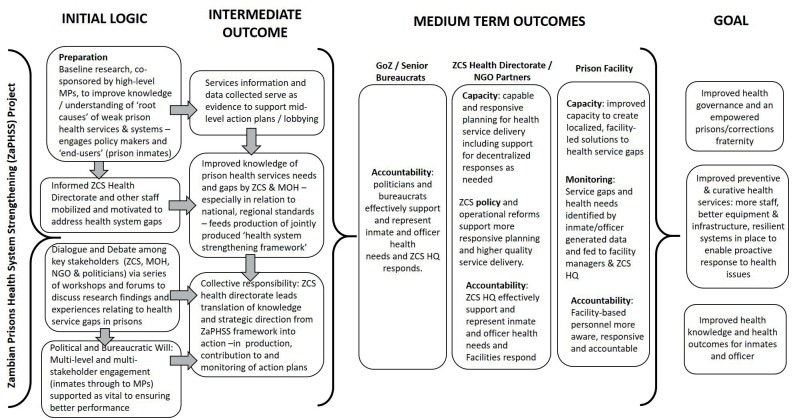
In 2013, the Zambian Correctional Service (ZCS) partnered with the Centre for Infectious Disease Research in Zambia on the Zambian Prisons Health System Strengthening project, seeking to tackle structural, organisational and cultural weaknesses within the prison health system. We present findings from a nested evaluation of the project impact on high, mid-level and facility-level health governance and health service arrangements in the Zambian Correctional Service.
Mixed methods were used, including document review, indepth interviews with ministry (11) and prison facility (6) officials, focus group discussions (12) with male and female inmates in six of the eleven intervention prisons, and participant observation during project workshops and meetings. Ethical clearance and verbal informed consent were obtained for all activities. Analysis incorporated deductive and iterative inductive coding.
: Improved knowledge of the prison health system strengthened political and bureaucratic will to materially address prison health needs. This found expression in a tripartite Memorandum of Understanding between the Ministry of Home Affairs, Ministry of Health (MOH) and Ministry of Community Development, and in the appointment of a permanent liaison between MOH and ZCS. Capacity-building workshops for ZCS Command resulted in strengthened health planning and management outcomes, including doubling ZCS health professional workforce (from 37 to78 between 2014 and 2016), new preservice basic health training for incoming ZCS officers and formation of facility-based prison health committees with a mandate for health promotion and protection. : continuous and facilitated communication among major stakeholders and the emergence of interorganisational trust were critical. Enabling included a permissive political environment, a shift within ZCS from a 'punitive' to 'correctional' organisational culture, and prevailing political and public health concerns about the spread of HIV and tuberculosis.
While not a panacea, findings demonstrate that a 'systems' approach to seemingly intractable prison health system problems yielded a number of short-term tactical and long-term strategic improvements in the Zambian setting. Context-sensitive application of such an approach to other settings may yield positive outcomes.
2013年,赞比亚惩教署(ZCS)与赞比亚传染病研究中心合作开展赞比亚监狱卫生系统强化项目,旨在解决监狱卫生系统在结构、组织和文化方面的薄弱环节。我们展示了对该项目对赞比亚惩教署高层、中层和设施层面卫生治理及卫生服务安排影响的嵌套式评估结果。
采用了混合方法,包括文件审查、对部委(11人)和监狱设施官员(6人)进行深入访谈、在11个干预监狱中的6个与男性和女性囚犯进行焦点小组讨论(12次),以及在项目研讨会和会议期间进行参与观察。所有活动均获得了伦理批准和口头知情同意。分析采用了演绎和迭代归纳编码。
对监狱卫生系统的了解得到改善,增强了从物质上满足监狱卫生需求的政治和官僚意愿。这体现在内政部、卫生部(MOH)和社区发展部之间的三方谅解备忘录中,以及卫生部与赞比亚惩教署之间任命了一名常设联络人。为赞比亚惩教署指挥部举办的能力建设研讨会带来了更强的卫生规划和管理成果,包括赞比亚惩教署卫生专业人员队伍翻倍(2014年至2016年期间从37人增至78人)、为新入职的赞比亚惩教署官员开展新的职前基本卫生培训,以及成立了负责促进和保护健康的监狱设施卫生委员会。主要利益相关者之间持续且便利的沟通以及组织间信任的出现至关重要。促成因素包括宽松的政治环境、赞比亚惩教署从 “惩罚性” 组织文化向 “矫正性” 组织文化的转变,以及政治和公共卫生领域对艾滋病毒和结核病传播的普遍关注。
虽然并非万灵药,但研究结果表明,对看似棘手的监狱卫生系统问题采用 “系统” 方法在赞比亚环境中带来了一些短期战术和长期战略改进。在其他环境中因地制宜地应用这种方法可能会产生积极成果。