Centre for Exercise, Nutrition and Health Sciences, School for Policy Studies, University of Bristol, 8 Priory Road, Bristol BS8 1TZ, UK.
Nutrients. 2018 Mar 22;10(4):388. doi: 10.3390/nu10040388.
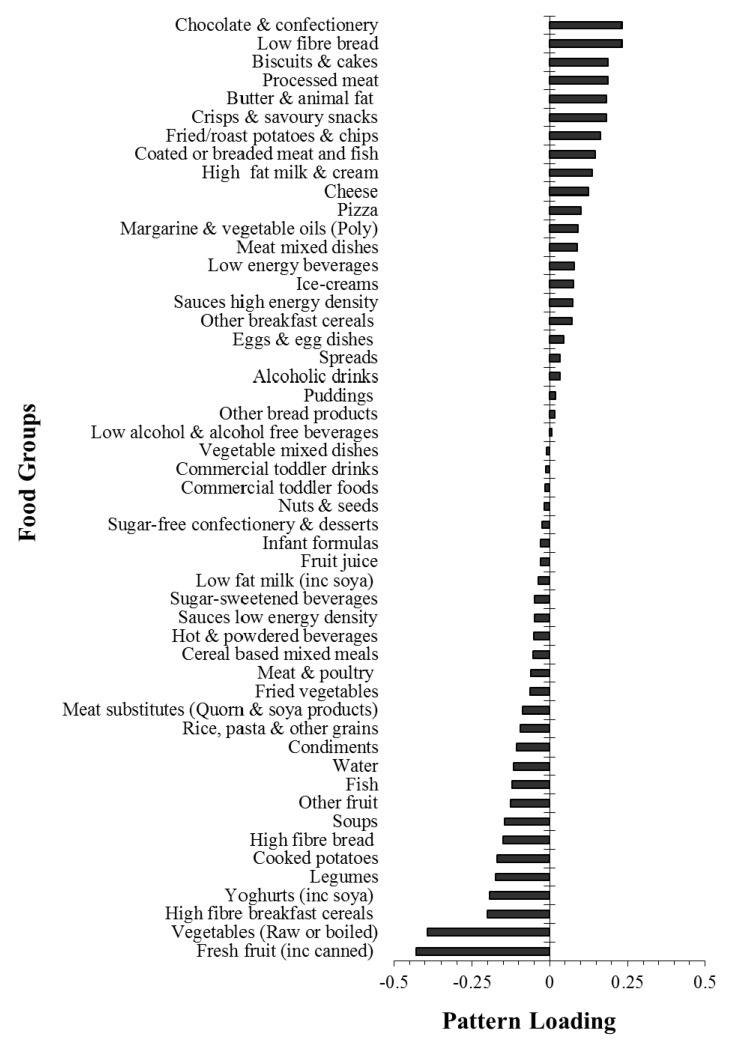
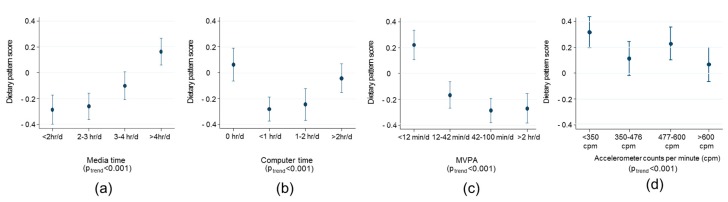
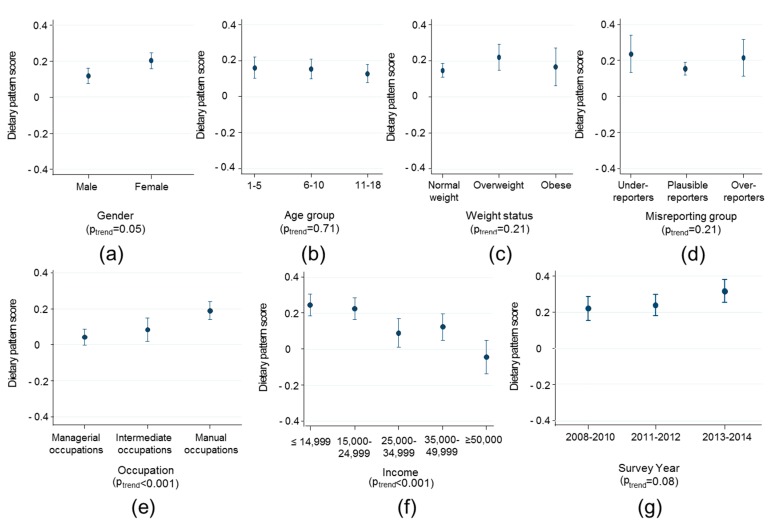
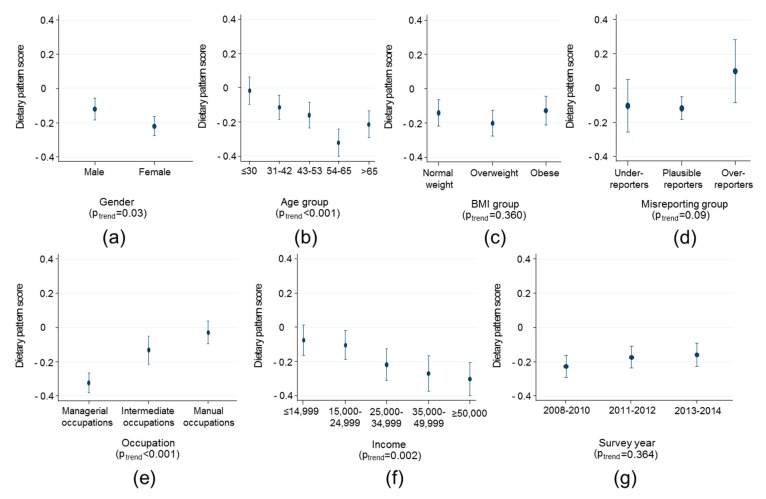
An energy-dense, high-fat, low-fibre dietary pattern has been prospectively associated with the development of obesity in childhood but is population-specific, which limits translating the pattern into interventions. We explored the generalisability and correlates of this obesogenic dietary pattern in the UK National Diet and Nutrition Survey (NDNS) for the first time. Data came from participants ( = 4636 children and = 4738 adults) with 4-day food diaries in NDNS 2008-2014. Reduced rank regression was applied to 51 food groups to explain variation in energy density, fibre and fat intake. Consistency of the pattern in population subgroups (according to sex, age, occupation and income) was compared with the whole sample pattern using coefficients of congruence (COC). Pattern correlates (sociodemographic, survey year, physical activity and eating related behaviours) were explored using multiple linear regression. Food group loadings were similar to the previously identified obesogenic dietary pattern and were generalisable across all sub-groups (COC: 0.93-0.99). An obesogenic diet was associated with eating takeaways, being omnivorous, a manual household occupation and lower household income in both adults and children ( < 0.0001). Dieting for weight loss, being older, more physically active and less sedentary was associated with a less obesogenic diet among adults ( < 0.0001). Future experimental studies should investigate if changes in this obesogenic pattern could be used to monitor the effectiveness of obesity prevention policies or develop personalised interventions.
一种高能量、高脂肪、低纤维的饮食模式与儿童肥胖的发展具有前瞻性关联,但这种模式具有特定的人群特征,这限制了将其转化为干预措施。我们首次在英国国家饮食与营养调查(NDNS)中探索了这种致肥胖饮食模式的普遍性及其相关性。数据来自于 2008-2014 年 NDNS 中 4 天食物日记的 4636 名儿童和 4738 名成年人参与者。应用降秩回归对 51 种食物组进行分析,以解释能量密度、纤维和脂肪摄入的变化。使用一致性系数(COC)比较人群亚组(根据性别、年龄、职业和收入)中模式的一致性与全样本模式的一致性。使用多元线性回归探索模式相关性(社会人口统计学、调查年份、身体活动和饮食相关行为)。食物组的加载与先前确定的致肥胖饮食模式相似,并且在所有亚组中都具有普遍性(COC:0.93-0.99)。致肥胖饮食与在成年人和儿童中吃外卖、杂食、体力劳动家庭职业和较低家庭收入有关(<0.0001)。减肥、年龄较大、身体活动更多和久坐时间较少与成年人中不那么致肥胖的饮食有关(<0.0001)。未来的实验研究应调查这种致肥胖模式的变化是否可用于监测肥胖预防政策的有效性或开发个性化干预措施。