
谨慎积极型和快餐久坐型膳食生活方式:与波兰青少年肥胖、营养知识和社会人口因素的关联——健康饮食项目的 ABC。
Prudent-Active and Fast-Food-Sedentary Dietary-Lifestyle Patterns: The Association with Adiposity, Nutrition Knowledge and Sociodemographic Factors in Polish Teenagers-The ABC of Healthy Eating Project.
机构信息
Department of Human Nutrition, Faculty of Food Science, University of Warmia and Mazury in Olsztyn, Pl. Cieszynski 1, 10-718 Olsztyn, Poland.
Department of Human Nutrition, Faculty of Human Nutrition and Consumer Sciences, Warsaw University of Life Science (SGGW-WULS), 159C Nowoursynowska Street, 02-787 Warsaw, Poland.
出版信息
Nutrients. 2018 Dec 15;10(12):1988. doi: 10.3390/nu10121988.
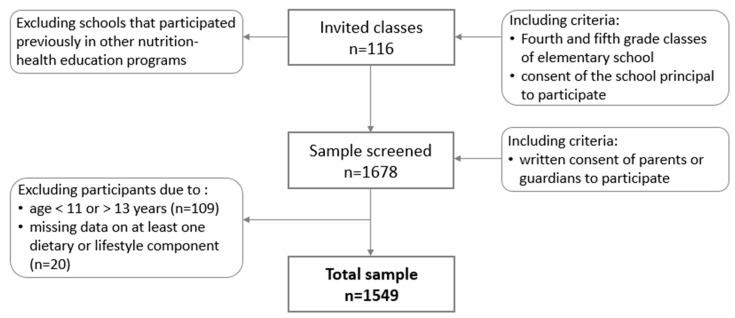
A holistic approach to understanding the relationship between diet, lifestyle and obesity is a better approach than studying single factors. This study presents the clustering of dietary and lifestyle behaviours to determine the association of these dietary-lifestyle patterns (DLPs) with adiposity, nutrition knowledge, gender and sociodemographic factors in teenagers. The research was designed as a cross-sectional study with convenience sampling. The sample consisted of 1549 Polish students aged 11⁻13 years. DLPs were identified with cluster analysis. Logistic regression modelling with adjustment for confounders was applied. Three dietary-lifestyle patterns were identified: Prudent-Active (29.3% of the sample), Fast-food-Sedentary (13.8%) and notPrudent-notFast-food-lowActive (56.9%). Adherence to Prudent-Active pattern (reference: notPrudent-notFast-food-lowActive) was 29% or 49% lower in 12-year-old or 13-year-old teenagers than in 11-year-old teenagers, respectively, and higher by 57% or 2.4 times in the middle or the upper tertile than the bottom tertile of the nutrition knowledge score. To the contrary, adherence to Fast-food-Sedentary (reference: notPrudent-notFast-food-lowActive) was lower by 41% or 58% in the middle or the upper tertile than the bottom tertile of the nutrition knowledge score, respectively. In Prudent-Active, the chance of central obesity (waist-to-height ratio ≥0.5) was lower by 47% and overweight/obesity was lower by 38% or 33% (depending on which standard was used: International Obesity Task Force, 2012: BMI (body mass index)-for-age ≥ 25 kg/m² or Polish standards, 2010: BMI-for-age ≥ 85th percentile) when compared with the notPrudent-notFast-food-lowActive pattern. In Fast-food-Sedentary, the chance of central obesity was 2.22 times higher than the Prudent-Active pattern. The study identified a set of characteristics that decreased the risk of general and central adiposity in teenagers, which includes health-promoting behaviours related to food, meal consumption and lifestyle. Avoiding high-energy dense foods is insufficient to prevent obesity, if physical activity and the consumption frequency of health-promoting foods are low and breakfast and a school meal are frequently skipped. The results highlight the importance of the nutrition knowledge of teenagers in shaping their health-promoting dietary habits and active lifestyle to decrease adiposity risk and negative aspects of lower family affluence which promotes unhealthy behaviours, both related to diet and lifestyle.
采用整体方法来理解饮食、生活方式和肥胖之间的关系,优于研究单一因素。本研究通过聚类分析饮食和生活方式行为,以确定这些饮食-生活方式模式(DLPs)与青少年肥胖、营养知识、性别和社会人口因素的相关性。该研究设计为横断面研究,采用便利抽样。样本包括 1549 名 11⁻13 岁的波兰学生。通过聚类分析确定 DLP。应用调整混杂因素的逻辑回归模型。确定了三种饮食-生活方式模式:谨慎-活跃(样本的 29.3%)、快餐-久坐(13.8%)和不谨慎-不快餐-低活跃(56.9%)。与不谨慎-不快餐-低活跃模式相比,12 岁或 13 岁青少年中遵循谨慎-活跃模式(参考:不谨慎-不快餐-低活跃)的比例分别低 29%或 49%,而在营养知识得分的中值或高值三分位的比例分别高 57%或 2.4 倍。相反,在快餐-久坐模式中,与营养知识得分的低值三分位相比,中值或高值三分位的比例分别低 41%或 58%。在谨慎-活跃模式中,中心性肥胖(腰高比≥0.5)的几率降低 47%,超重/肥胖的几率降低 38%或 33%(取决于使用的标准:国际肥胖工作组,2012:BMI(体重指数)-年龄≥25kg/m²或波兰标准,2010:BMI-年龄≥85%百分位),与不谨慎-不快餐-低活跃模式相比。在快餐-久坐模式中,中心性肥胖的几率是谨慎-活跃模式的 2.22 倍。该研究确定了一组特征,降低了青少年一般和中心性肥胖的风险,这些特征包括与食物、餐食摄入和生活方式相关的促进健康的行为。如果体力活动和健康促进食品的消费频率较低,且经常不吃早餐和学校餐,那么避免高能量密度的食物不足以预防肥胖。研究结果强调了青少年营养知识在塑造其促进健康的饮食习惯和积极生活方式以降低肥胖风险和降低较低家庭富裕程度的不利方面的重要性,这两个方面都与饮食和生活方式有关。
 Zotero 插件