Luo Ji-An, Pan Si-Wei, Peng Dong-Liang, Wang Zhi, Li Yan-Jun
Key Lab for IOT and Information Fusion Technology of Zhejiang, Hangzhou Dianzi University, Hangzhou 310018, China.
The State Key Laboratory of Industrial Control Technology, Zhejiang University, Hangzhou 310027, China.
Sensors (Basel). 2018 Mar 22;18(4):937. doi: 10.3390/s18040937.
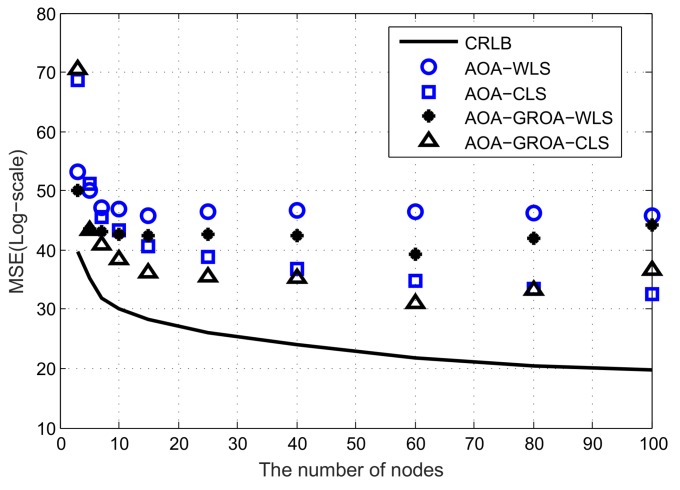
A constrained least-squares (CLS) 3D source localization method is presented for acoustic sensor networks with sensor position errors. The proposed approach uses angles of arrivals (AOAs) and gain ratios of arrival (GROAs) measured simultaneously at each node to estimate the source position jointly. Compared to AOA-only localization methods, the GROAs can be used in conjunction with AOA measurements so as to get more accurate results by exploiting the geometrical relationship between these two measurements. Compared to time difference of arrival localization methods, the proposed algorithm does not require accurate time synchronization over different nodes. The theoretical mean-square error matrices of the proposed approach are derived and they are exactly equal to the Cramér-Rao bound for Gaussian noise under the small error condition. Simulations validate the performance of the proposed estimator.
针对存在传感器位置误差的声学传感器网络,提出了一种约束最小二乘(CLS)三维源定位方法。该方法利用每个节点同时测量的到达角(AOA)和到达增益比(GROA)来联合估计源位置。与仅使用AOA的定位方法相比,GROA可与AOA测量结合使用,通过利用这两种测量之间的几何关系获得更准确的结果。与到达时间差定位方法相比,该算法不需要在不同节点间进行精确的时间同步。推导了该方法的理论均方误差矩阵,在小误差条件下,它们与高斯噪声下的克拉美罗界完全相等。仿真验证了所提估计器的性能。