Center for Bio-based Chemistry, Korea Research Institute of Chemical Technology (KRICT), Jongga-ro, Jung-gu, Ulsan, Republic of Korea.
Intelligent Sustainable Materials R&D Group, Research Institute of Sustainable Manufacturing System, Korea Institute of Industrial Technology (KITECH), Yandaegiro-gil, Ipjang-myeon, Seobuk-gu, Cheonan-si, Chungcheongnam-do, Republic of Korea.
PLoS One. 2018 Mar 22;13(3):e0194954. doi: 10.1371/journal.pone.0194954. eCollection 2018.
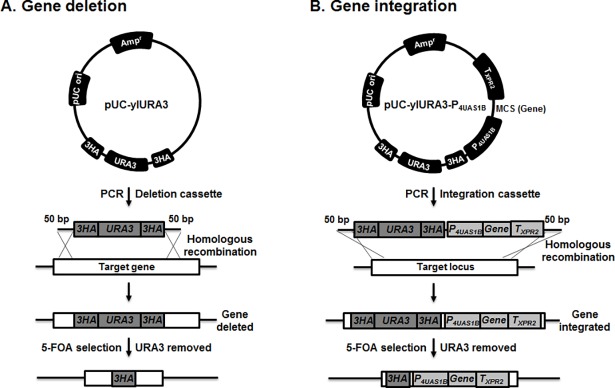
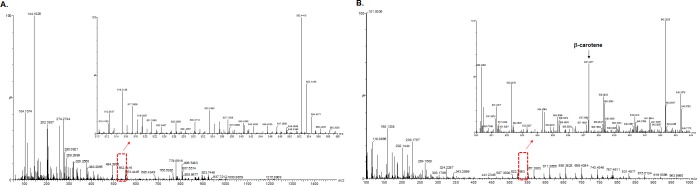
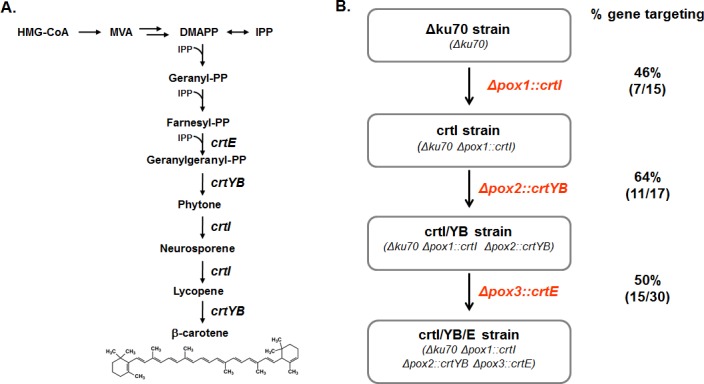
Gene targeting is a challenge in Yarrowia lipolytica (Y. lipolytica) where non-homologous end-joining (NHEJ) is predominant over homologous recombination (HR). To improve the frequency and efficiency of HR in Y. lipolytica, the ku70 gene responsible for a double stand break (DSB) repair in the NHEJ pathway was disrupted, and the cell cycle was synchronized to the S-phase with hydroxyurea, respectively. Consequently, the HR frequency was over 46% with very short homology regions (50 bp): the pex10 gene was accurately deleted at a frequency of 60% and the β-carotene biosynthetic genes were integrated at the correct locus at an average frequency of 53%. For repeated use, the URA3 marker gene was also excised and deleted at a frequency of 100% by HR between the 100 bp homology regions flanking the URA3 gene. It was shown that appropriate combination of these chemical and biological approaches was very effective to promote HR and construct genetically modified Y. lipolytica strains for biotechnological applications.
基因打靶是解脂耶氏酵母(Yarrowia lipolytica)中的一个挑战,其中非同源末端连接(NHEJ)优于同源重组(HR)。为了提高 HR 在 Y. lipolytica 中的频率和效率,分别敲除了负责 NHEJ 途径中双链断裂(DSB)修复的 ku70 基因,并使用羟基脲将细胞周期同步到 S 期。结果,同源重组频率超过 46%,且同源区域非常短(50bp):pex10 基因的准确缺失频率为 60%,β-胡萝卜素生物合成基因在正确的位置以平均频率 53%整合。为了重复使用,URA3 标记基因也通过侧翼 URA3 基因的 100bp 同源区域之间的 HR 以 100%的频率被切除和删除。事实证明,这些化学和生物学方法的适当组合对于促进 HR 和构建用于生物技术应用的遗传修饰的解脂耶氏酵母菌株非常有效。