Lohitesh K, Chowdhury Rajdeep, Mukherjee Sudeshna
Department of Biological-Sciences, Birla Institute of Technology and Sciences (BITS), Campus, VidyaVihar, Pilani, Rajasthan 333031 India.
Cancer Cell Int. 2018 Mar 20;18:44. doi: 10.1186/s12935-018-0538-7. eCollection 2018.
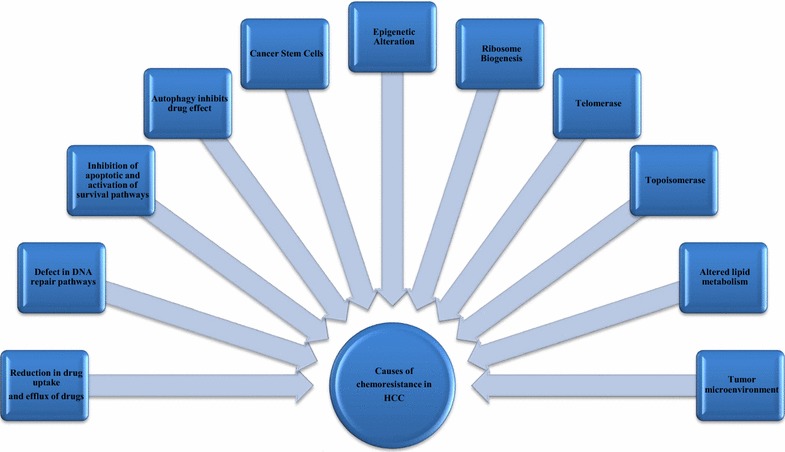
Hepatocellular carcinoma (HCC) is one of the leading causes of cancer mortality, accounting for almost 90% of total liver cancer burden. Surgical resection followed by adjuvant and systemic chemotherapy are the most meticulously followed treatment procedures but the complex etiology and high metastatic potential of the disease renders surgical treatment futile in majority of the cases. Another hindrance to the scenario is the acquired resistance to drugs resulting in relapse of the disease. Hence, to provide insights into development of novel therapeutic targets and diagnostic biomarkers, this review focuses on the various molecular mechanisms underlying chemoresistance in HCC. We have provided a comprehensive summary of the various strategies adopted by HCC cells, extending from apoptosis evasion, autophagy activation, drug expulsion to epigenetic transformation as modes of therapy resistance. The role of stem cells in imparting chemoresistance is also discussed. Furthermore, the review also focuses on how this knowledge might be exploited for the development of an effective, prospective therapy against HCC.
肝细胞癌(HCC)是导致癌症死亡的主要原因之一,几乎占肝癌总负担的90%。手术切除后辅以辅助化疗和全身化疗是最严格遵循的治疗程序,但该疾病复杂的病因和高转移潜能使得手术治疗在大多数情况下徒劳无功。这种情况的另一个障碍是对药物产生获得性耐药,导致疾病复发。因此,为了深入了解新型治疗靶点和诊断生物标志物的开发,本综述聚焦于HCC中化疗耐药的各种分子机制。我们全面总结了HCC细胞采用的各种策略,从逃避凋亡、激活自噬、药物外排到表观遗传转化作为治疗耐药的模式。还讨论了干细胞在赋予化疗耐药性方面的作用。此外,本综述还关注如何利用这些知识开发针对HCC的有效、前瞻性治疗方法。