Eadie Laura N, Saunders Verity A, Branford Susan, White Deborah L, Hughes Timothy P
Cancer Theme, South Australian Health and Medical Research Institute (SAHMRI), Adelaide, South Australia.
School of Medicine, University of Adelaide, Adelaide, South Australia.
Oncotarget. 2018 Feb 3;9(17):13423-13437. doi: 10.18632/oncotarget.24393. eCollection 2018 Mar 2.
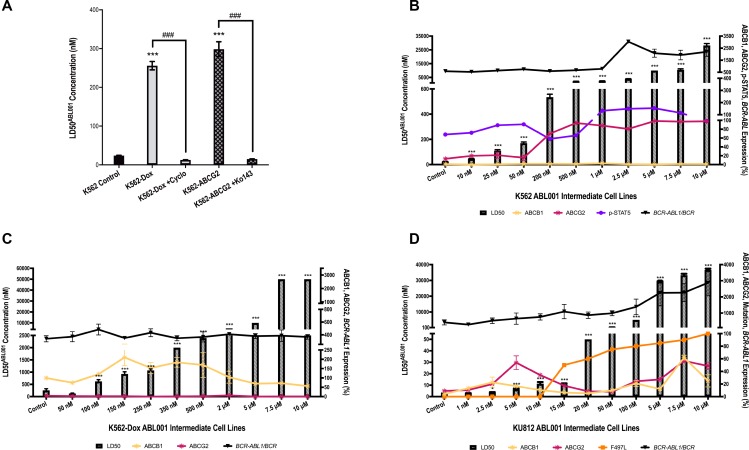
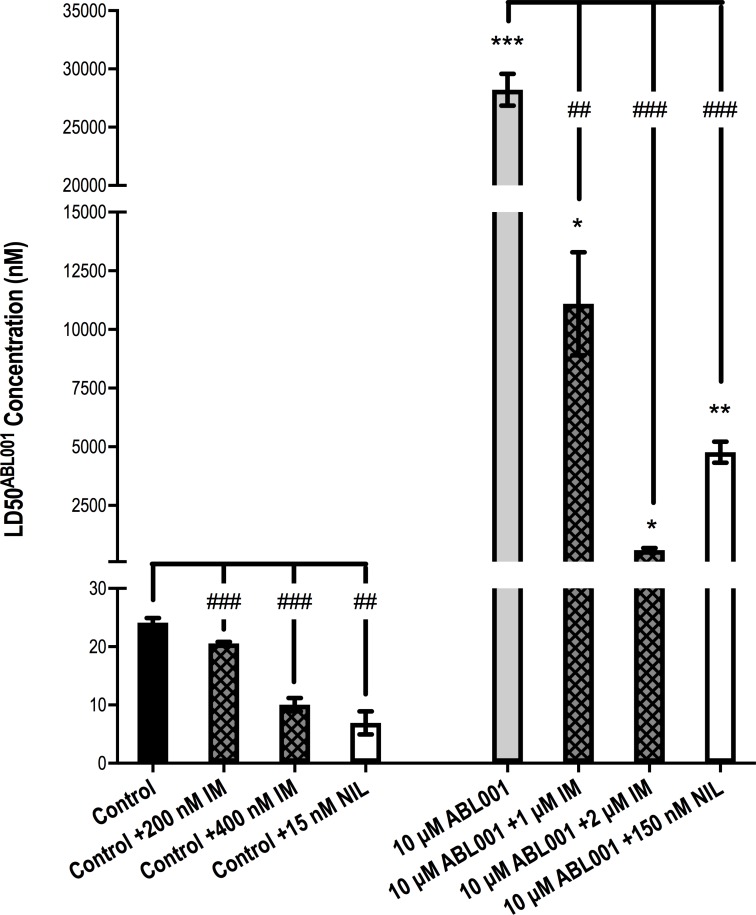
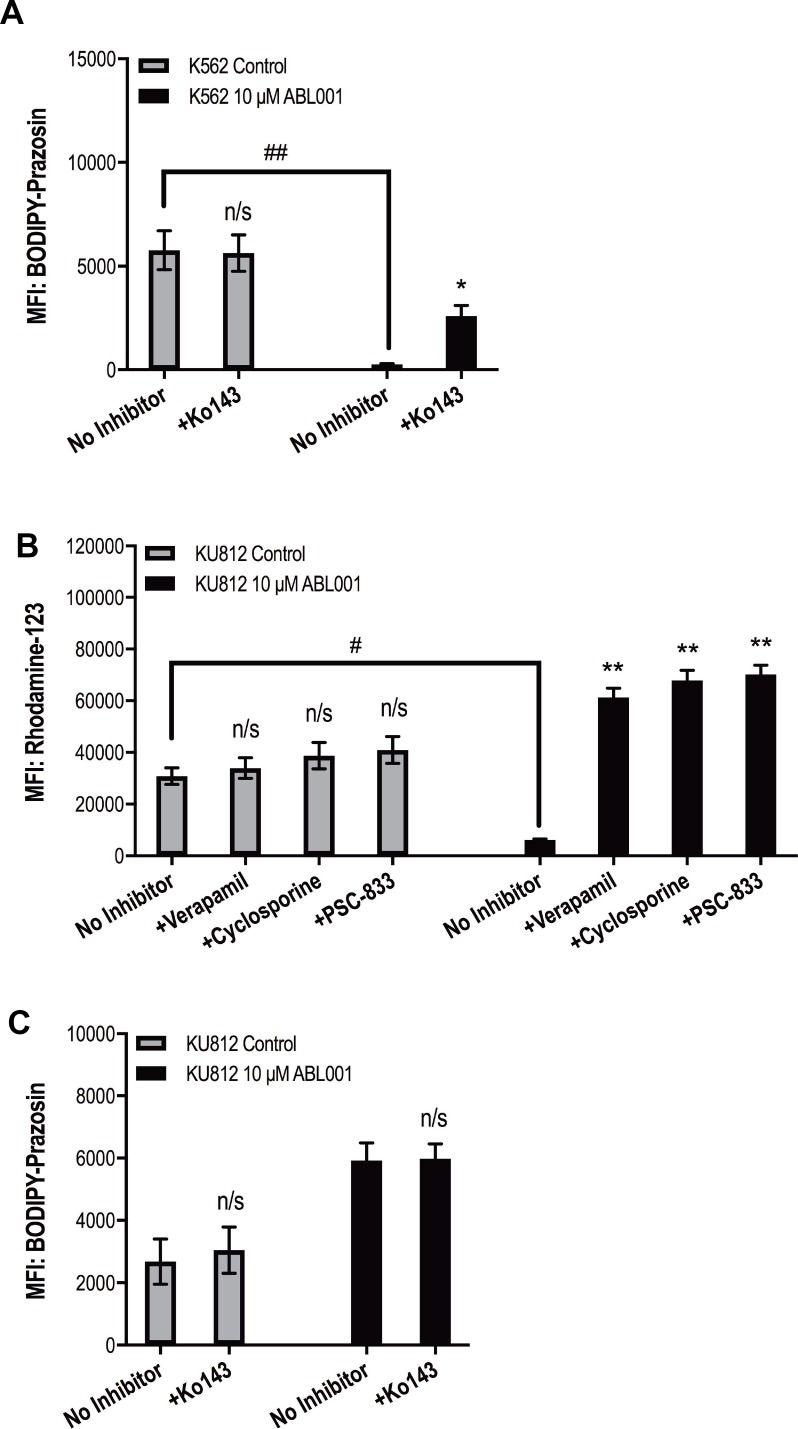
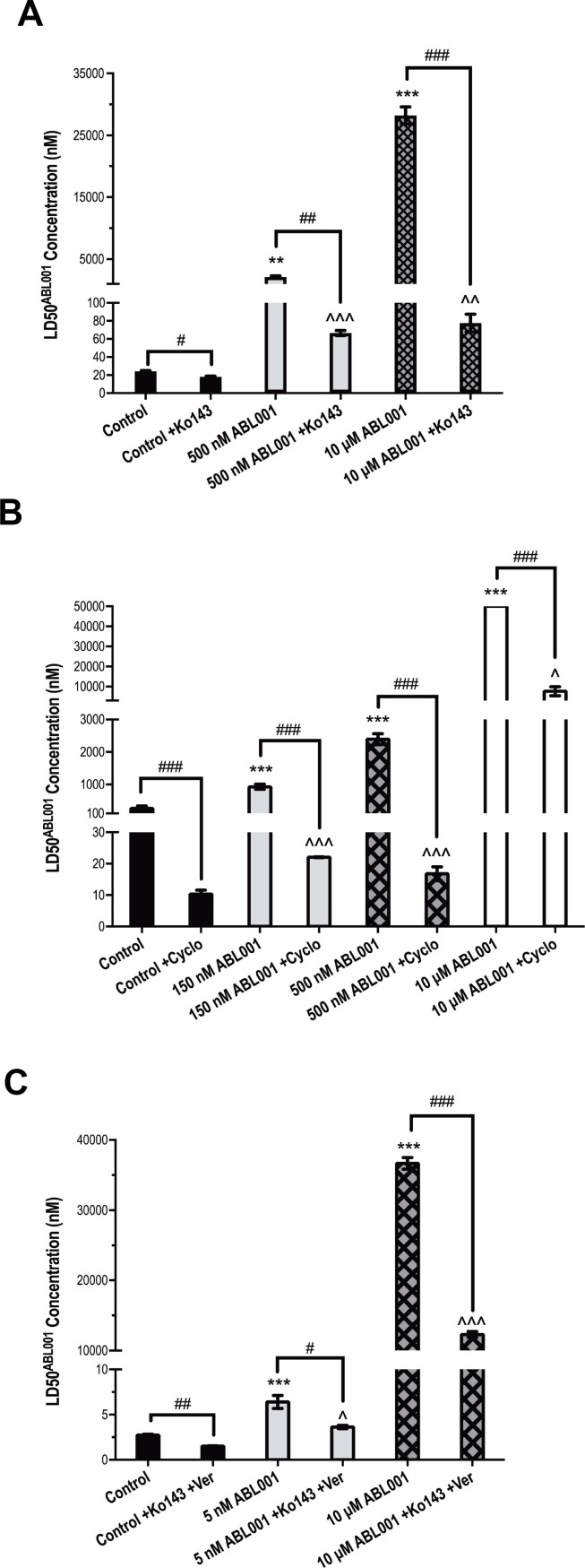
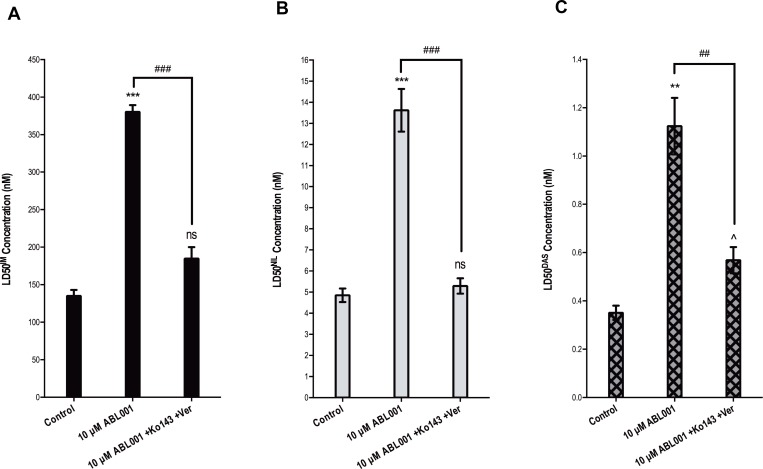
Asciminib (previously ABL001), which binds the myristate-binding pocket of the Bcr-Abl kinase domain, is in phase I clinical trials as monotherapy and in combination with imatinib, nilotinib and dasatinib for the treatment of patients with refractory CML or Ph+ ALL. Asciminib sensitivity was evaluated in asciminib naïve cell lines K562 (negligible ABCB1/ABCG2 expression), K562-Dox (ABCB1-overexpressing through doxorubicin exposure) and K562-ABCG2 (ABCG2 overexpression via transduction) with results demonstrating asciminib efflux by both ABCB1 and ABCG2 transporters. K562-Dox and K562-ABCG2 cells demonstrated increased LD50 vs K562 control cells: 256 and 299 nM respectively vs 24 nM, 0.001. Sensitivity was completely restored with specific inhibitors cyclosporine (ABCB1) and Ko143 (ABCG2): K562-Dox LD50 = 13 nM, K562-ABCG2 LD50 = 15 nM ( < 0.001). When asciminib resistance was modelled , ABCB1 and ABCG2 overexpression was integral in the development of asciminib resistance. In K562 asciminib-resistant cells, ABCG2 expression increased prior to overexpression and remained high (up to 7.6-fold greater levels in resistant vs control cells, 0.001). K562-Dox asciminib-resistant cells had increased ABCB1 expression (2.1-fold vs control cells = 0.0033). KU812 asciminib-resistant cells overexpressed ABCB1 (5.4-fold increase, 0.001) and ABCG2 (6-fold increase, 0.001) before emergence of a novel myristate-binding pocket mutation (F497L). In all three cell lines, asciminib resistance was reversible upon chemical inhibition of ABCB1, ABCG2 or both ( 0.001). When K562 asciminib-resistant cells were treated with asciminib in combination with clinically achievable doses of either imatinib or nilotinib, reversal of the resistance phenotype was also observed ( 0.01). Overexpression of efflux transporters will likely be an important pathway for asciminib resistance in the clinical setting. Given the lack of evidence for ABCG2-mediated transport of nilotinib or imatinib at clinically relevant concentrations, our data provide an additional rationale for using asciminib in combination with either TKI.
阿西替尼(曾用名ABL001)可结合Bcr-Abl激酶结构域的肉豆蔻酸结合口袋,目前正处于I期临床试验阶段,作为单一疗法以及与伊马替尼、尼洛替尼和达沙替尼联合使用,用于治疗难治性慢性粒细胞白血病(CML)或Ph+急性淋巴细胞白血病(ALL)患者。在未接触过阿西替尼的细胞系K562(ABCB1/ABCG2表达可忽略不计)、K562-Dox(通过阿霉素暴露使ABCB1过表达)和K562-ABCG2(通过转导使ABCG2过表达)中评估了阿西替尼敏感性,结果表明ABCB1和ABCG2转运蛋白均可使阿西替尼外排。与K562对照细胞相比,K562-Dox和K562-ABCG2细胞的半数致死剂量(LD50)增加:分别为256 nM和299 nM,而K562对照细胞为24 nM,P<0.001。使用特异性抑制剂环孢素(ABCB1)和Ko143(ABCG2)后敏感性完全恢复:K562-Dox的LD50 = 13 nM,K562-ABCG2的LD50 = 15 nM(P<0.001)。在模拟阿西替尼耐药性时,ABCB1和ABCG2过表达是阿西替尼耐药性产生的重要因素。在K562阿西替尼耐药细胞中,ABCG2表达在过表达之前就已增加,并保持在较高水平(耐药细胞与对照细胞相比,水平高达7.6倍,P<0.001)。K562-Dox阿西替尼耐药细胞的ABCB1表达增加(与对照细胞相比增加2.1倍,P = 0.0033)。KU812阿西替尼耐药细胞在出现新的肉豆蔻酸结合口袋突变(F497L)之前,ABCB1(增加5.4倍,P<0.001)和ABCG2(增加6倍,P<0.001)就已过表达。在所有三种细胞系中,化学抑制ABCB1、ABCG2或两者后,阿西替尼耐药性均可逆转(P<0.001)。当用阿西替尼联合临床可达到剂量的伊马替尼或尼洛替尼处理K562阿西替尼耐药细胞时,也观察到耐药表型的逆转(P<0.01)。在临床环境中,外排转运蛋白的过表达可能是阿西替尼耐药的重要途径。鉴于在临床相关浓度下缺乏ABCG2介导尼洛替尼或伊马替尼转运的证据,我们的数据为阿西替尼与任一酪氨酸激酶抑制剂(TKI)联合使用提供了额外的理论依据。