Steicke Michelle, Yang Guang, Dinh Tam Nguyen, Dunster-Jones Matthew, Sargisson Owen, Ahmady Farah, Golledge Jonathan, Wang Yutang
Federation University Australia, School of Applied and Biomedical Science.
Eur J Histochem. 2018 Feb 7;62(1):2880. doi: 10.4081/ejh.2018.2880.
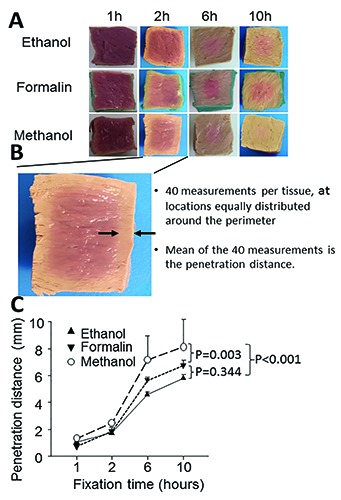
Methanol, ethanol and formalin are commonly used as fixatives to preserve biological tissues from decay in the preparation of histological sections. Fixation of the inner layers of the tissue depends on the ability of the fixative to diffuse into the tissue. It is unknown whether methanol penetrates tissues at similar rates to other fixatives. This study aimed to compare the penetration rates of methanol, ethanol and formalin into bovine heart and liver tissues. The penetration distance and tissue shrinkage or expansion were measured by analysing the digital images of tissue before and after immersion in different fixatives for 1, 2, 6 or 10 h. Data were analysed using two-way ANOVA, followed by Bonferroni's post-hoc test. The penetration distance of methanol was significantly greater in both heart and liver tissues compared with that of ethanol (N=4, P<0.001). Methanol or ethanol immersion led to similar shrinkage of both tissues (P>0.05). The penetration rate of formalin was similar to that of ethanol in both tissues however it was significantly slower than methanol (N=4, P<0.005 in the heart; P<0.001 in the liver). The mean penetration coefficients of methanol, formalin and ethanol in the heart tissue were 2.609, 1.994 and 1.801, respectively, and 3.012, 2.153 and 2.113, respectively, in the liver tissue. The penetration coefficient of methanol was significantly greater than that of ethanol or formalin in both tissues (P<0.001 for each comparison). In conclusion, methanol penetrates tissue significantly faster than ethanol and formalin.
甲醇、乙醇和福尔马林通常用作固定剂,以便在组织学切片制备过程中保存生物组织不发生腐烂。组织内层的固定取决于固定剂扩散到组织中的能力。甲醇穿透组织的速率是否与其他固定剂相似尚不清楚。本研究旨在比较甲醇、乙醇和福尔马林在牛心脏和肝脏组织中的穿透速率。通过分析组织在不同固定剂中浸泡1、2、6或10小时前后的数字图像,测量穿透距离和组织收缩或膨胀情况。数据采用双向方差分析,随后进行Bonferroni事后检验。与乙醇相比,甲醇在心脏和肝脏组织中的穿透距离均显著更大(N = 4,P < 0.001)。甲醇或乙醇浸泡导致两种组织的收缩情况相似(P > 0.05)。福尔马林在两种组织中的穿透速率与乙醇相似,但其显著慢于甲醇(心脏组织中N = 4,P < 0.005;肝脏组织中P < 0.001)。甲醇、福尔马林和乙醇在心脏组织中的平均穿透系数分别为2.609、1.994和1.801,在肝脏组织中分别为3.012、2.153和2.113。甲醇的穿透系数在两种组织中均显著大于乙醇或福尔马林(每次比较P < 0.001)。总之,甲醇穿透组织的速度显著快于乙醇和福尔马林。