Emory University, Atlanta, GA, USA.
Bristol-Myers Squibb, Lawrenceville, NJ, USA.
Am J Transplant. 2018 Jul;18(7):1774-1782. doi: 10.1111/ajt.14738. Epub 2018 Apr 17.
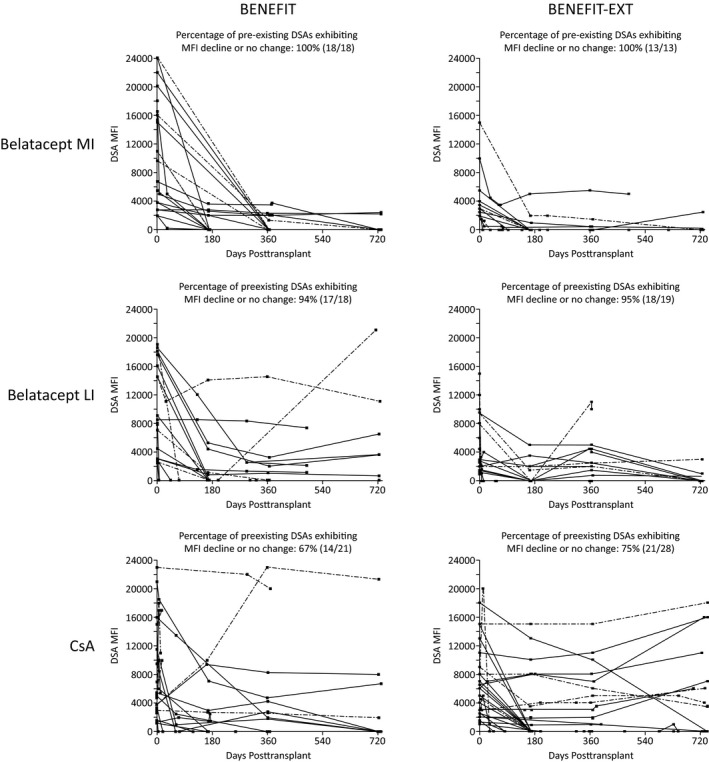
BENEFIT and BENEFIT-EXT were phase III studies of cytotoxic T-cell crossmatch-negative kidney transplant recipients randomized to belatacept more intense (MI)-based, belatacept less intense (LI)-based, or cyclosporine-based immunosuppression. Following study completion, presence/absence of HLA-specific antibodies was determined centrally via solid-phase flow cytometry screening. Stored sera from anti-HLA-positive patients were further tested with a single-antigen bead assay to determine antibody specificities, presence/absence of donor-specific antibodies (DSAs), and mean fluorescent intensity (MFI) of any DSAs present. The effect of belatacept-based and cyclosporine-based immunosuppression on MFI was explored post hoc in patients with preexisting DSAs enrolled to BENEFIT and BENEFIT-EXT. In BENEFIT, preexisting DSAs were detected in 4.6%, 4.9%, and 6.3% of belatacept MI-treated, belatacept LI-treated, and cyclosporine-treated patients, respectively. The corresponding values in BENEFIT-EXT were 6.0%, 5.7%, and 9.2%. In both studies, most preexisting DSAs were of class I specificity. Over the first 24 months posttransplant, a greater proportion of preexisting DSAs in belatacept-treated versus cyclosporine-treated patients exhibited decreases or no change in MFI. MFI decline was more apparent with belatacept MI-based versus belatacept LI-based immunosuppression in both studies and more pronounced in BENEFIT-EXT versus BENEFIT. Although derived post hoc, these data suggest that belatacept-based immunosuppression decreases preexisting DSAs more effectively than cyclosporine-based immunosuppression.
BENEFIT 和 BENEFIT-EXT 是针对细胞毒性 T 细胞交叉匹配阴性肾移植受者的 III 期研究,这些受者被随机分配接受贝利尤单抗更强化(MI)、贝利尤单抗更轻化(LI)或环孢素为基础的免疫抑制治疗。研究完成后,通过固相流式细胞术筛选在中心确定 HLA 特异性抗体的存在/缺失。来自抗 HLA 阳性患者的储存血清进一步用单抗原珠测定法进行测试,以确定抗体特异性、供体特异性抗体 (DSA) 的存在/缺失以及任何存在的 DSA 的平均荧光强度 (MFI)。在 BENEFIT 和 BENEFIT-EXT 中招募了存在预先存在的 DSA 的患者,事后探讨了贝利尤单抗和环孢素为基础的免疫抑制对 MFI 的影响。在 BENEFIT 中,分别有 4.6%、4.9%和 6.3%的贝利尤单抗 MI 治疗、贝利尤单抗 LI 治疗和环孢素治疗患者检测到预先存在的 DSA。BENEFIT-EXT 的相应值分别为 6.0%、5.7%和 9.2%。在两项研究中,大多数预先存在的 DSA 具有 I 类特异性。在移植后 24 个月内,与环孢素治疗相比,贝利尤单抗治疗的患者中更多比例的预先存在的 DSA 的 MFI 下降或没有变化。在两项研究中,与贝利尤单抗 LI 为基础的免疫抑制相比,贝利尤单抗 MI 为基础的免疫抑制更明显地显示 MFI 下降,在 BENEFIT-EXT 中比在 BENEFIT 中更为明显。尽管是事后得出的数据,但这些数据表明,与环孢素为基础的免疫抑制相比,贝利尤单抗为基础的免疫抑制更有效地降低预先存在的 DSA。