Zhang Youran, Chen Gang, Zhang Qi, Lu Jun, Yu Huijiong
Department of Health Law and Health Inspection, School of Public Health, Fudan University, Shanghai, China.
China Research Center on Disability Issues at Fudan University, Shanghai, China.
PeerJ. 2018 Mar 13;6:e4505. doi: 10.7717/peerj.4505. eCollection 2018.
Non-communicable disease (NCD) risk factors can co-exist with disability and cause a greater burden on the health status of adults with disabilities. A lack of egalitarian social policies in China may result in gender disparities in the NCD risk factors of adults with disabilities. However, little is known about the gender disparities in the association between socio-demographics and NCD risk factors among adults with disabilities in China; consequently, we examined this association among adults with disabilities in Shanghai, China.
We used the health examination data of 44,896 adults with disabilities in Shanghai in 2014. Descriptive analyses and logistic regression models were conducted to estimate gender disparities in the association between socio-demographics, disability characteristics, and four selected NCD risk factors among adults with disabilities-including high blood pressure, high blood glucose, high blood lipids, and being overweight. We estimated marginal effects (MEs) on NCD risk factors between gender and other confounders.
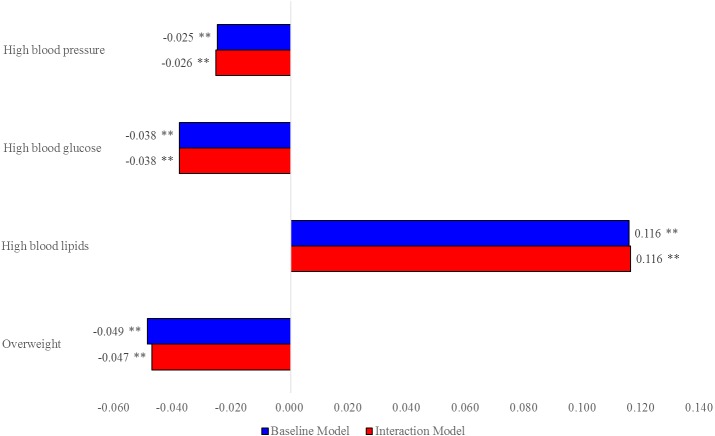
Women with disabilities were about 11.6 percentage points more likely to suffer from high blood lipids and less likely to develop the other three risk factors than men were. The association of age group, residence permit, education level, marital status, and disability type with health outcomes varied by gender among adults with disabilities. The difference in age effects between men and women was more pronounced in older age groups. Urban residence was associated with less risk of high blood pressure risk among women (Δ = - 0.035, < 0.01), but no significant difference in other NCD risk factors. Education remained a major protective factor against high blood pressure, high blood glucose and being overweight among women with disabilities ( < 0, < 0.05); however, this did not hold for men. The difference in marriage effects between men and women was observed in high blood lipids (Δ = - 0.048 for the married group and -0.054 for the divorced or widowed group) and overweight individuals (Δ = - 0.091 for the married group and -0.114 for the divorced or widowed group). Women with intellectual disabilities or mental disabilities reported worse health conditions than men did.
Preventive strategies and interventions on NCD risk factors for adults with disabilities should take into account gender disparities in these socio-demographic effects. Rural women or poorly educated women with disabilities can be a vulnerable population that requires more health education and promotion strategies. Health education for caregivers of women with intellectual or mental disabilities may also play a vital role in preventing their NCD risk factors.
非传染性疾病(NCD)风险因素可能与残疾并存,并给成年残疾人的健康状况带来更大负担。中国缺乏平等主义社会政策可能导致成年残疾人在非传染性疾病风险因素方面存在性别差异。然而,对于中国成年残疾人社会人口统计学与非传染性疾病风险因素之间关联的性别差异知之甚少;因此,我们研究了中国上海成年残疾人中的这种关联。
我们使用了2014年上海44896名成年残疾人的健康检查数据。进行描述性分析和逻辑回归模型,以估计成年残疾人社会人口统计学、残疾特征与四个选定的非传染性疾病风险因素(包括高血压、高血糖、高血脂和超重)之间关联的性别差异。我们估计了性别与其他混杂因素对非传染性疾病风险因素的边际效应(MEs)。
残疾女性患高血脂的可能性比男性高约11.6个百分点,而患其他三种风险因素的可能性比男性低。在成年残疾人中,年龄组、居住证、教育水平、婚姻状况和残疾类型与健康结果的关联因性别而异。男女年龄效应的差异在老年组中更为明显。城市居住与女性患高血压风险较低相关(Δ = -0.035,<0.01),但在其他非传染性疾病风险因素方面无显著差异。教育仍然是残疾女性预防高血压、高血糖和超重的主要保护因素(<0,<0.05);然而,男性并非如此。在高血脂(已婚组Δ = -0.048,离婚或丧偶组Δ = -0.054)和超重个体(已婚组Δ = -0.091,离婚或丧偶组Δ = -0.114)中观察到男女婚姻效应的差异。患有智力残疾或精神残疾的女性报告的健康状况比男性差。
针对成年残疾人非传染性疾病风险因素的预防策略和干预措施应考虑这些社会人口学效应中的性别差异。农村残疾女性或受教育程度低的残疾女性可能是一个弱势群体,需要更多的健康教育和促进策略。对患有智力或精神残疾女性的照顾者进行健康教育在预防她们的非传染性疾病风险因素方面也可能发挥重要作用。