BioMediTech Institute and Faculty of Medicine and Life Sciences, University of Tampere, PL 100, 33014, Tampere, Finland.
BioMediTech Institute and Faculty of Biomedical Sciences and Engineering, Tampere University of Technology, University of Tampere, PL 100, 33014, Tampere, Finland.
BMC Cancer. 2018 Mar 27;18(1):325. doi: 10.1186/s12885-018-4261-5.
Nucleocytoplasmic transport is a tightly regulated process carried out by specific transport machinery, the defects of which may lead to a number of diseases including cancer. Karyopherin alpha 7 (KPNA7), the newest member of the karyopherin alpha nuclear importer family, is expressed at a high level during embryogenesis, reduced to very low or absent levels in most adult tissues but re-expressed in cancer cells.
We used siRNA-based knock-down of KPNA7 in cancer cell lines, followed by functional assays (proliferation and cell cycle) and immunofluorescent stainings to determine the role of KPNA7 in regulation of cancer cell growth, proper mitosis and nuclear morphology.
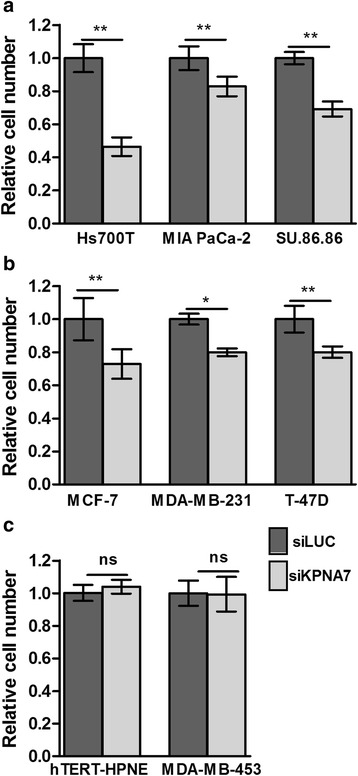
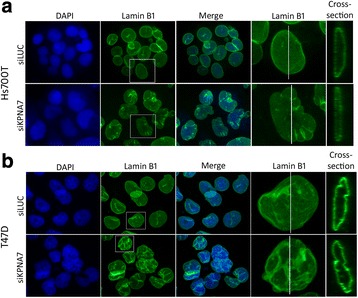
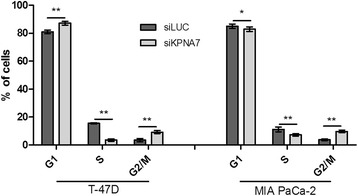
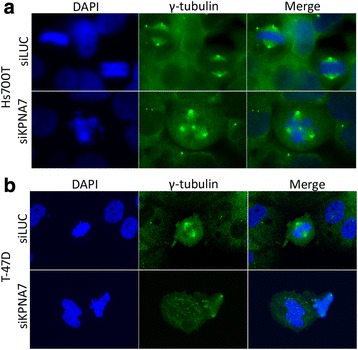
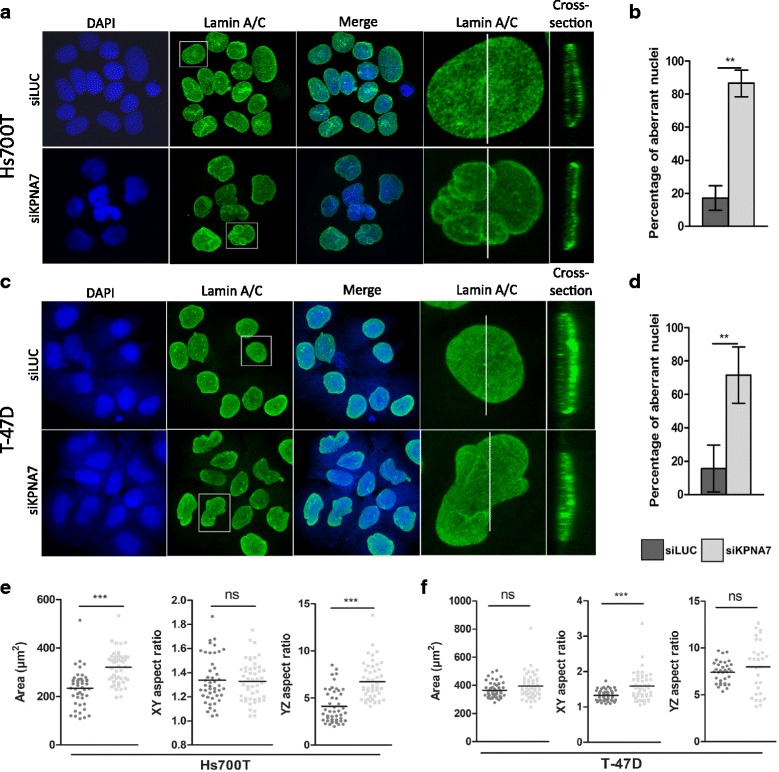
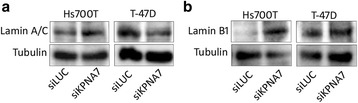
In the present study, we show that the silencing of KPNA7 results in a dramatic reduction in pancreatic and breast cancer cell growth, irrespective of the endogenous KPNA7 expression level. This growth inhibition is accompanied by a decrease in the fraction of S-phase cells as well as aberrant number of centrosomes and severe distortion of the mitotic spindles. In addition, KPNA7 depletion leads to reorganization of lamin A/C and B1, the main nuclear lamina proteins, and drastic alterations in nuclear morphology with lobulated and elongated nuclei.
Taken together, our data provide new important evidence on the contribution of KPNA7 to the regulation of cancer cell growth and the maintenance of nuclear envelope environment, and thus deepens our understanding on the impact of nuclear transfer proteins in cancer pathogenesis.
核质转运是一个由特定转运机制严格调控的过程,其缺陷可能导致多种疾病,包括癌症。核输入蛋白α 7(KPNA7)是核输入蛋白α家族的最新成员,在胚胎发生过程中高表达,在大多数成年组织中降低至非常低或缺失水平,但在癌细胞中重新表达。
我们使用 siRNA 敲低癌症细胞系中的 KPNA7,然后进行功能测定(增殖和细胞周期)和免疫荧光染色,以确定 KPNA7 在调节癌细胞生长、正常有丝分裂和核形态中的作用。
在本研究中,我们表明 KPNA7 的沉默导致胰腺和乳腺癌细胞生长明显减少,而与内源性 KPNA7 表达水平无关。这种生长抑制伴随着 S 期细胞比例的降低以及中心体数量异常和有丝分裂纺锤体严重扭曲。此外,KPNA7 耗竭导致核纤层 A/C 和 B1 的重组,核纤层蛋白的主要核层蛋白,并导致核形态发生剧烈变化,出现分叶状和拉长的核。
总之,我们的数据为 KPNA7 对调节癌细胞生长和维持核膜环境的贡献提供了新的重要证据,从而加深了我们对核转运蛋白在癌症发病机制中的影响的理解。