Hundeshagen Gabriel, Herndon David N, Clayton Robert P, Wurzer Paul, McQuitty Alexis, Jennings Kristofer, Branski Ludwik, Collins Vanessa N, Marques Nicole Ribeiro, Finnerty Celeste C, Suman Oscar E, Kinsky Michael P
Department of Surgery, University of Texas Medical Branch, 301 University Blvd, Galveston, TX 77555.
Shriners Hospitals for Children, Galveston, 815 Market St, Galveston, TX 77555.
Lancet Child Adolesc Health. 2017 Dec;1(4):293-301. doi: 10.1016/S2352-4642(17)30122-0. Epub 2017 Oct 20.
Sepsis, trauma, and burn injury acutely depress systolic and diastolic cardiac function; data on long-term cardiac sequelae of pediatric critical illness are sparse. This study evaluated long-term systolic and diastolic function, myocardial fibrosis, and exercise tolerance in survivors of severe pediatric burn injury.
Subjects at least 5 years after severe burn (post-burn:PB) and age-matched healthy controls (HC) underwent echocardiography to quantify systolic function (ejection fraction[EF%]), diastolic function (E/e'), and myocardial fibrosis (calibrated integrated backscatter) of the left ventricle. Exercise tolerance was quantified by oxygen consumption (VO) and heart rate at rest and peak exercise. Demographic information, clinical data, and biomarker expression were used to predict long-term cardiac dysfunction and fibrosis.
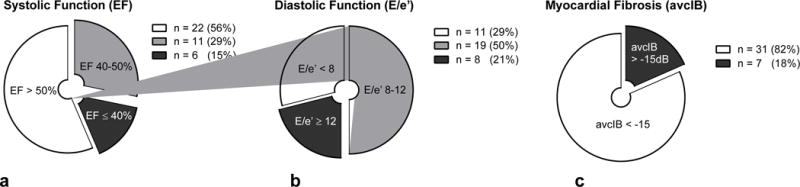
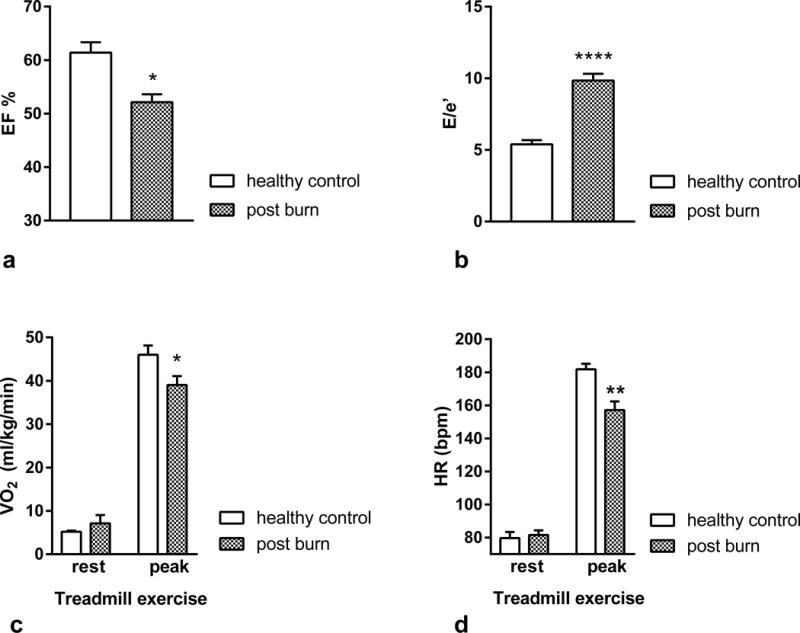
Sixty-five subjects (PB:40;HC:25) were evaluated. At study date, PB subjects were 19±5 years, were at 12±4 years postburn, and had burns over 59±19% of total body surface area, sustained at 8±5 years of age. The PB group had lower EF% (PB:52±9%;HC:61±6%; p=0.004), E/e' (PB:9.8±2.9;HC: 5.4±0.9;p<0.0001), VO (PB:37.9±12;HC: 46±8.32 ml/min/kg; p=0.029), and peak heart rate (PB:161±26;HC:182±13bpm;p=0.007). The PB group had moderate (28%) or severe (15%) systolic dysfunction, moderate (50%) or severe diastolic dysfunction (21%), and myocardial fibrosis (18%). Biomarkers and clinical parameters predicted myocardial fibrosis, systolic dysfunction, and diastolic dysfunction.
Severe pediatric burn injury may have lasting impact on cardiac function into young adulthood and is associated with myocardial fibrosis and reduced exercise tolerance. Given the strong predictive value of systolic and diastolic dysfunction, these patients might be at increased risk for early heart failure, associated morbidity, and mortality.
Conflicts of Interest and Sources of Funding: The authors do not have any conflicts of interest to declare. This work was supported by NIH (P50 GM060338, R01 GM056687, R01 HD049471, R01 GM112936, R01-GM56687 and T32 GM008256), NIDILRR (H133A120091, 90DP00430100), Shriners Hospitals for Children (84080, 79141, 79135, 71009, 80100, 71008, 87300 and 71000), FAER (MRTG CON14876), and the Department of Defense (W81XWH-14-2-0162 and W81XWH1420162). It was also made possible with the support of UTMB's Institute for Translational Sciences, supported in part by a Clinical and Translational Science Award (UL1TR000071) from the National Center for Advancing Translational Sciences (NIH).
脓毒症、创伤和烧伤会急性抑制心脏的收缩和舒张功能;关于儿科危重症长期心脏后遗症的数据较少。本研究评估了严重儿科烧伤幸存者的长期收缩和舒张功能、心肌纤维化及运动耐量。
严重烧伤后至少5年的受试者(烧伤后:PB)和年龄匹配的健康对照者(HC)接受超声心动图检查,以量化左心室的收缩功能(射血分数[EF%])、舒张功能(E/e')和心肌纤维化(校正的背向散射积分)。通过静息和运动峰值时的耗氧量(VO)及心率来量化运动耐量。使用人口统计学信息、临床数据和生物标志物表达来预测长期心脏功能障碍和纤维化。
评估了65名受试者(PB组40名;HC组25名)。在研究时,PB组受试者年龄为19±5岁,烧伤后12±4年,烧伤面积占体表面积的59±19%,烧伤发生于8±5岁时。PB组的EF%较低(PB组:52±9%;HC组:6l±6%;p = 0.004),E/e'较低(PB组:9.8±2.9;HC组:5.4±0.9;p<0.0001),VO较低(PB组:37.9±12;HC组:46±8.32 ml/min/kg;p = 0.029),运动峰值心率较低(PB组:161±26;HC组:182±13次/分;p = 0.007)。PB组有中度(28%)或重度(15%)收缩功能障碍、中度(50%)或重度舒张功能障碍(21%)及心肌纤维化(18%)。生物标志物和临床参数可预测心肌纤维化、收缩功能障碍和舒张功能障碍。
严重儿科烧伤可能对年轻成年期的心脏功能产生持久影响,并与心肌纤维化和运动耐量降低有关。鉴于收缩和舒张功能障碍的强大预测价值,这些患者发生早期心力衰竭、相关发病率和死亡率的风险可能会增加。
利益冲突和资金来源:作者声明无任何利益冲突。本研究得到了美国国立卫生研究院(P50 GM060338、R01 GM056687、R01 HD®49471、R01 GM112936、R01 - GM56687和T32 GM008256)、美国国立残疾与康复研究所(H133A120091、90DP00430100)、施莱宁儿童医院(84080、79141、79135、71009、80100、71008、87300和71000)、美国烧伤协会教育与研究基金会(MRTG CON14876)以及美国国防部(W81XWH - 14 - 2 - 0162和W81XWH1420162)的支持。本研究还得到了德克萨斯大学医学分部转化科学研究所的支持,该研究所部分由美国国立转化医学推进中心(美国国立卫生研究院)的临床和转化科学奖(UL1TR000071)资助。