Social, Genetic and Developmental Psychiatry Centre, Institute of Psychiatry, Psychology and Neuroscience, King's College London, London, UK.
Department of Child and Adolescent Psychiatry, Institute of Psychiatry, Psychology and Neuroscience, King's College London, London, UK.
J Child Psychol Psychiatry. 2019 Jan;60(1):102-110. doi: 10.1111/jcpp.12886. Epub 2018 Mar 26.
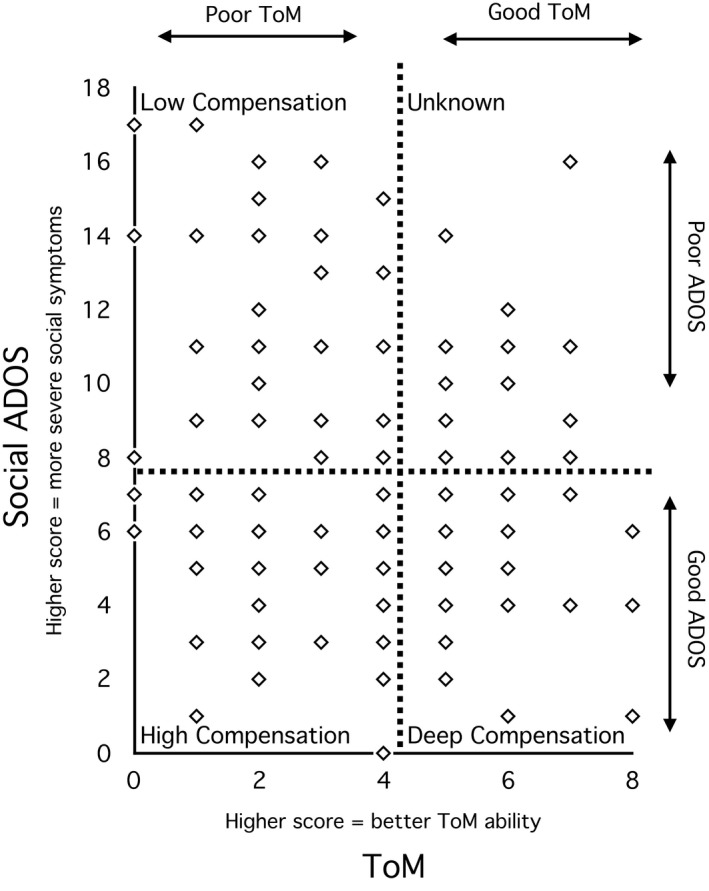
It is proposed that some individuals with Autism Spectrum Disorder (ASD) can 'compensate' for their underlying difficulties (e.g. in theory of mind; ToM), thus demonstrating relatively few behavioural symptoms, despite continued core cognitive deficits. The mechanisms underpinning compensation are largely unexplored, as is its potential impact on mental health. This study aimed to estimate compensation patterns in ASD, by contrasting overt social behaviour with ToM task performance, in order to compare the characteristics of 'Low' and 'High' Compensators.
A total of 136 autistic adolescents, from the ongoing Social Relationships Study, completed a range of cognitive tasks, the Autistic Diagnostic Observation Schedule (ADOS) and a self-report anxiety questionnaire. Participants were assigned compensation group status; High Compensators demonstrated good ADOS scores despite poor ToM performance, while Low Compensators demonstrated similarly poor ToM, accompanied by poor ADOS scores.
High Compensators demonstrated better IQ and executive function (EF), but greater self-reported anxiety, compared with Low Compensators. Such differences were not found when comparing individuals who had good versus poor ADOS scores, when ToM performance was good. Other core autistic characteristics (weak central coherence, nonsocial symptoms) did not differentiate the High and Low Compensators.
IQ, EF and anxiety appear to be implicated in the processes by which certain autistic young people can compensate for their underlying ToM difficulties. This tendency to compensate does not appear to reflect the severity of 'hit' for ASD per se, suggesting that well-compensated individuals are not experiencing a milder form of ASD. The construct of compensation in ASD has implications for research and clinical practice.
有人提出,一些自闭症谱系障碍(ASD)患者可以“补偿”其潜在的困难(例如在心理理论;ToM),从而表现出相对较少的行为症状,尽管仍然存在核心认知缺陷。补偿的机制在很大程度上尚未得到探索,其对心理健康的潜在影响也是如此。本研究旨在通过对比明显的社交行为和 ToM 任务表现来估计 ASD 中的补偿模式,以便比较“低”和“高”补偿者的特征。
共有 136 名自闭症青少年参加了正在进行的社会关系研究,他们完成了一系列认知任务、自闭症诊断观察量表(ADOS)和自我报告焦虑问卷。参与者被分配补偿组的地位;高补偿者尽管 ToM 表现不佳,但 ADOS 评分良好,而低补偿者则表现出类似的 ToM 较差,同时 ADOS 评分也较差。
与低补偿者相比,高补偿者表现出更好的智商和执行功能(EF),但自我报告的焦虑程度更高。当比较 ADOS 评分良好的个体与 ToM 表现良好的个体时,没有发现这些差异。其他核心自闭症特征(弱中心连贯性、非社交症状)没有区分高补偿者和低补偿者。
智商、EF 和焦虑似乎与某些自闭症年轻人能够补偿其潜在的 ToM 困难的过程有关。这种补偿的倾向似乎并不反映 ASD 的“打击”的严重程度本身,这表明补偿良好的个体并不经历一种较轻的 ASD 形式。ASD 中的补偿概念对研究和临床实践具有重要意义。