Vanderbilt University Medical Center, Nashville, Tennessee, USA.
Stony Brook University, New York, New York, USA.
Autism Res. 2021 Jan;14(1):127-142. doi: 10.1002/aur.2440. Epub 2020 Nov 21.
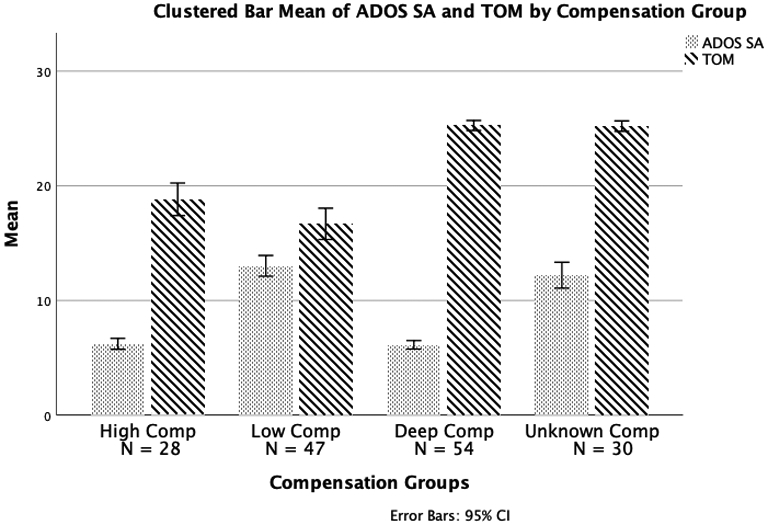
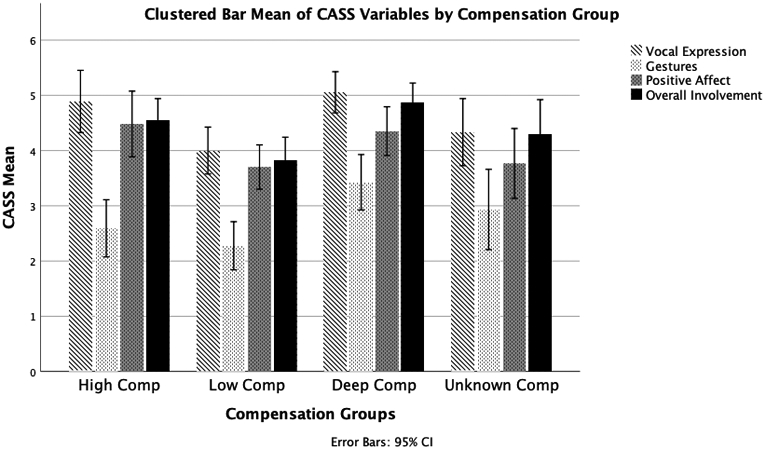
Camouflaging refers to behavioral adaptations that individuals with autism spectrum disorder (ASD), especially females, use to mask symptoms during social situations. Compensation is a component of camouflaging in which an individual's observed behavior is considerably better than actual ability. The study explored diagnostic, sex-based, and compensatory differences using the Contextual Assessment of Social Skills (CASS). The sample included 161 youth 10:0-to-16:11 years (115 males, 46 females). T-tests were performed based on sex (female, male) or High (good ADOS + poor Theory of Mind (TOM)) compared to Low (poor ADOS + poor TOM) Compensation groups. Comparisons were examined for Social Affect (SA), Restricted Repetitive Behavior, (RRB), IQ, social behavior (Positive Affect, Overall Involvement) and communication (Vocal Expression, Gestures). Females exhibited fewer RRB t(158) = 3.05, P = 0.003, d = 0.54. For the CASS, females evidenced more Vocal Expressiveness t(157) = -2.03, P = 0.05, d = 0.35, which corroborates sex-based differences in the literature. Compensation group differences indicated the High compared to Low group showed stronger Social and Communication behaviors on the CASS for Vocal Expression t(72) = 2.56, P = 0.01, d = 0.62, and overall rapport t(72) = 2.36, P = 0.02, d = 0.56. Several differences were observed when the groups were stratified based on level of compensation, with the High compensation participants showing stronger social engagement and communication behaviors. Findings may inform efforts to understand camouflaging, compensation, and clinical practices for male and female adolescents with ASD. A more nuanced consideration of camouflaging alongside compensation models reveals subtle differences in cognition, behavior, and affect that may reflect underlying profiles of challenge and strength in youth with ASD. LAY SUMMARY: Camouflaging refers to ways individuals with autism spectrum disorder (ASD), especially females, mask symptoms. Compensation occurs when a person's observed behavior appears more typical than what would be expected based on underlying ability and symptoms. The study explored camouflaging and compensation differences in 161 youth with ASD. Findings suggest sex-based differences with females showing better vocal expression. However, several compensation differences were observed with the High compensators showing stronger social communication and rapport. A more nuanced consideration of camouflaging using compensation models reveal subtle differences in underlying challenge and strength.
伪装是指自闭症谱系障碍(ASD)患者,尤其是女性,在社交场合中用来掩盖症状的行为适应。补偿是伪装的一个组成部分,其中个体的观察行为明显好于实际能力。本研究使用情境评估社交技能(CASS)探讨了诊断、性别和补偿差异。样本包括 161 名 10 至 16 岁 11 个月的青少年(115 名男性,46 名女性)。根据性别(女性、男性)或高(良好的自闭症诊断观察量表(ADOS)+较差的心理理论(TOM))与低(较差的 ADOS+较差的 TOM)补偿组进行 T 检验。比较了社交情感(SA)、受限重复行为(RRB)、智商、社交行为(积极情感、整体参与度)和沟通(发声表达、手势)。女性的 RRB 较少 t(158)=3.05,P=0.003,d=0.54。对于 CASS,女性的发声表达更明显 t(157)=-2.03,P=0.05,d=0.35,这与文献中的性别差异相符。补偿组差异表明,与低补偿组相比,高补偿组在 CASS 上的社交和沟通行为更强,发声表达 t(72)=2.56,P=0.01,d=0.62,整体融洽度 t(72)=2.36,P=0.02,d=0.56。当根据补偿水平对组进行分层时,观察到了几个差异,高补偿组参与者表现出更强的社交参与和沟通行为。这些发现可能有助于理解男性和女性青少年 ASD 患者的伪装、补偿和临床实践。伪装与补偿模型一起更细致地考虑,揭示了认知、行为和情感方面的微妙差异,这些差异可能反映了 ASD 青少年潜在的挑战和优势特征。
注意:此译文仅供参考,如果你需要更加准确的翻译,请提供更多的文本信息。