Institute of Anthropology, Johannes Gutenberg University, Mainz, Germany.
Curt-Engelhorn-Centre for Archaeometry gGmbH, Mannheim, Germany.
PLoS One. 2018 Mar 27;13(3):e0194862. doi: 10.1371/journal.pone.0194862. eCollection 2018.
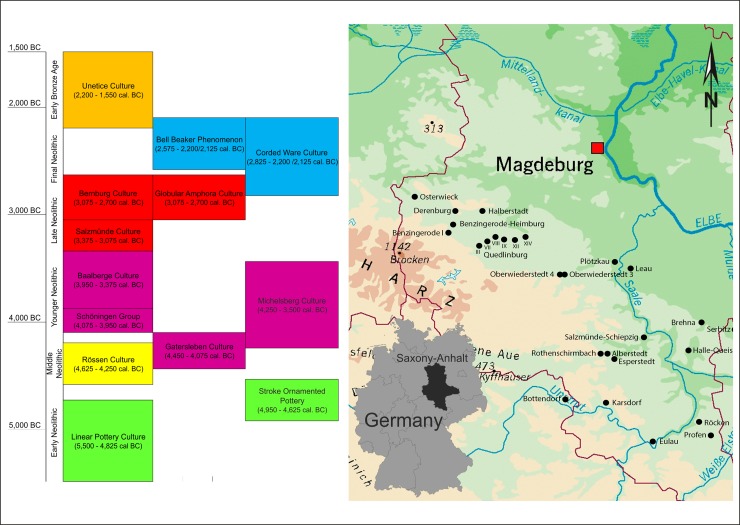
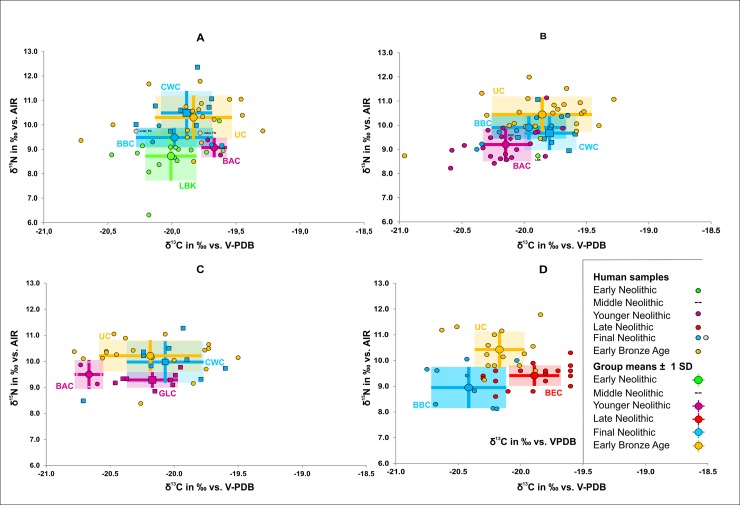
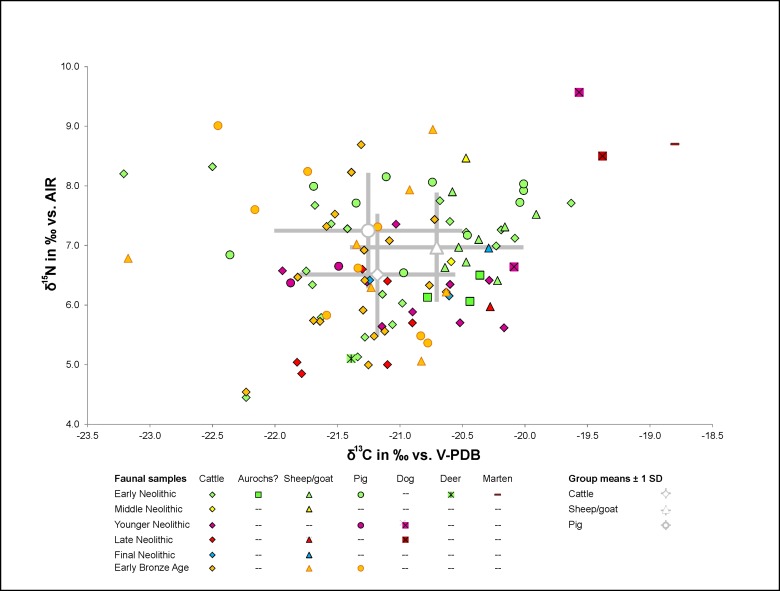
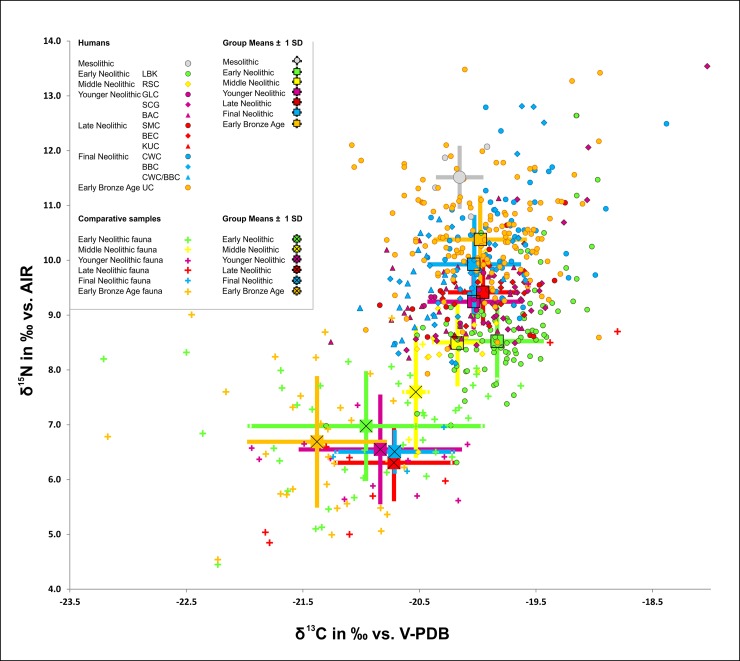
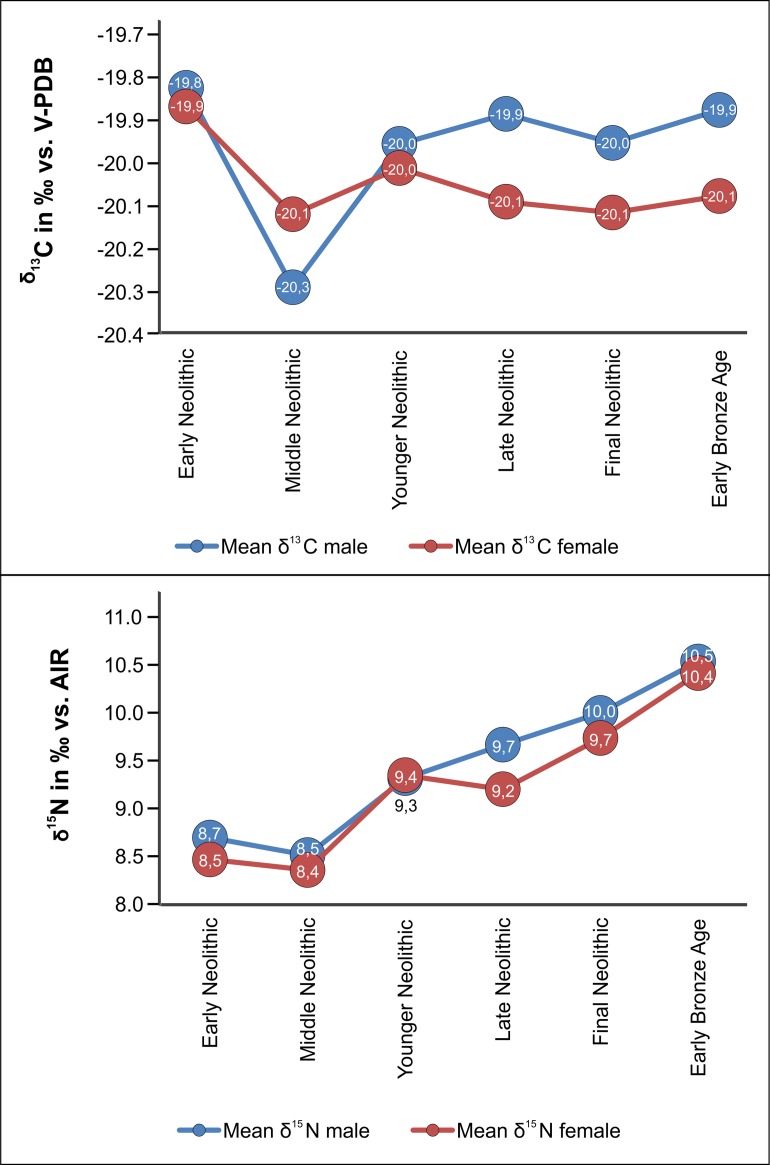
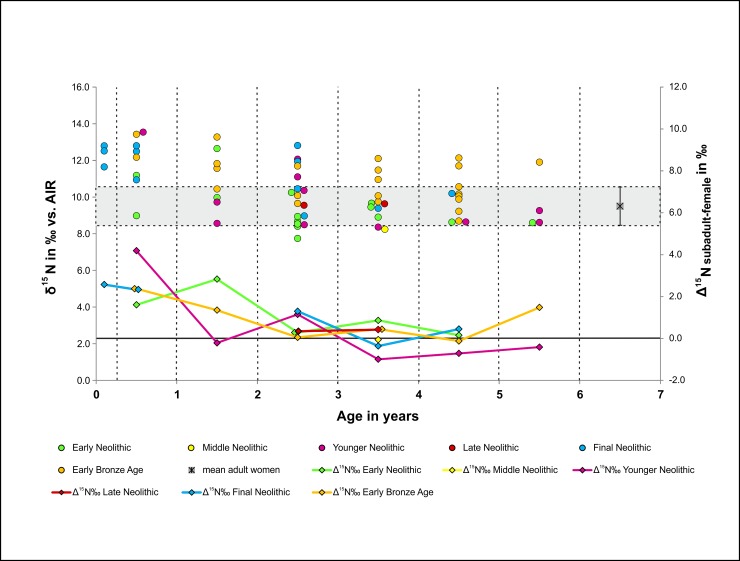
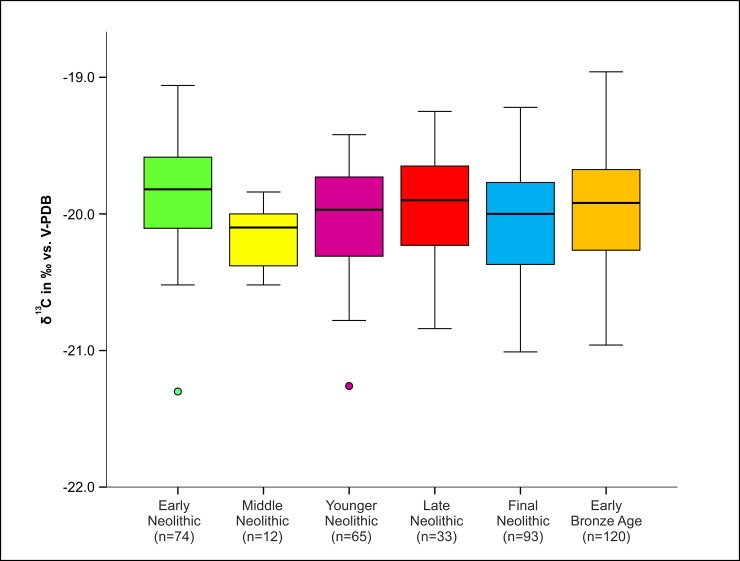
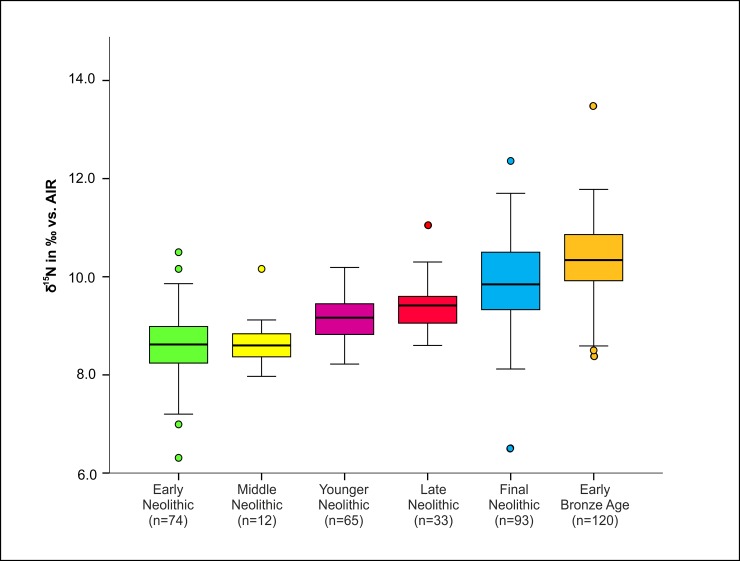
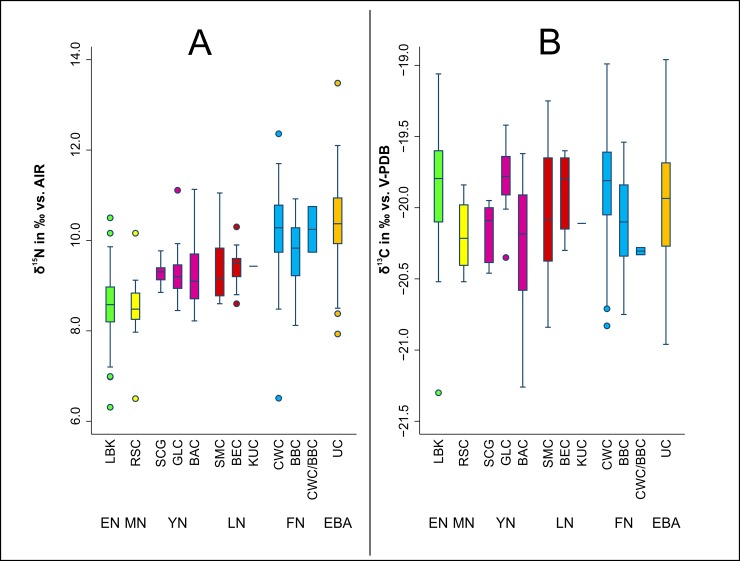
Investigation of human diet during the Neolithic has often been limited to a few archaeological cultures or single sites. In order to provide insight into the development of human food consumption and husbandry strategies, our study explores bone collagen carbon and nitrogen isotope data from 466 human and 105 faunal individuals from 26 sites in central Germany. It is the most extensive data set to date from an enclosed geographic microregion, covering 4,000 years of agricultural history from the Early Neolithic to the Early Bronze Age. The animal data show that a variety of pastures and dietary resources were explored, but that these changed remarkably little over time. In the human δ15N however we found a significant increase with time across the different archaeological cultures. This trend could be observed in all time periods and archaeological cultures (Bell Beaker phenomenon excluded), even on continuously populated sites. Since there was no such trend in faunal isotope values, we were able largely to exclude manuring as the cause of this effect. Based on the rich interdisciplinary data from this region and archaeological period we can argue that meat consumption increased with the increasing duration of farming subsistence. In δ13C, we could not observe any clear increasing or decreasing trends during the archaeological time periods, either for humans or for animals, which would have suggested significant changes in the environment and landscape use. We discovered sex-related dietary differences, with males of all archaeological periods having higher δ15N values than females, and an age-related increasing consumption of animal protein. An initial decrease of δ15N-values at the age of 1-2 years reveals partial weaning, while complete weaning took place at the age of 3-4 years.
对新石器时代人类饮食的研究通常局限于少数考古文化或单个遗址。为了深入了解人类食物消费和畜牧业策略的发展,我们的研究从德国中部的 26 个地点的 466 个人类和 105 个动物个体中探索了骨胶原碳和氮同位素数据。这是迄今为止来自一个封闭地理微区域的最广泛数据集,涵盖了从新石器时代早期到青铜时代早期的 4000 年农业历史。动物数据表明,人们探索了各种牧场和饮食资源,但这些资源随着时间的推移变化很小。然而,在人类的 δ15N 中,我们发现随着不同考古文化的时间推移,它呈显著增加的趋势。这种趋势在所有时期和考古文化中都可以观察到(排除了喇叭形杯文化现象),甚至在持续有人居住的遗址上也是如此。由于动物同位素值没有这种趋势,我们可以很大程度上排除施肥是造成这种影响的原因。基于该地区和考古时期的丰富跨学科数据,我们可以论证肉类消费随着农业生计的持续时间的增加而增加。在 δ13C 中,我们在考古时期都没有观察到任何明显的增加或减少趋势,无论是对人类还是对动物,这表明环境和景观利用发生了重大变化。我们发现了与性别有关的饮食差异,所有考古时期的男性的 δ15N 值都高于女性,而且随着年龄的增长,动物蛋白的摄入量也在增加。1-2 岁时 δ15N 值的初步下降表明部分断奶,而完全断奶发生在 3-4 岁时。