Faculty of Health Sciences, University of Stirling, Room E9, Pathfoot, Stirling, FK9 4LA, Scotland.
Ministry for Health, Cancer Care Pathways Directorate, Sir Anthony Mamo Oncology Centre, Level -1, Dun Karm Psaila Street, Msida, MSD, 2090, Malta.
BMC Cancer. 2018 Mar 27;18(1):346. doi: 10.1186/s12885-018-4278-9.
Routine mammography improves survival. To achieve health benefits, women must attend breast screening regularly at recommended time intervals. Maltese women are routinely invited to undergo mammography at three-year intervals at an organized breast screening programme (MBSP) or can opt to attend a private clinic. Previous research shows that health beliefs, particularly perceived barriers, were the most significant predictors of uptake to the first MBSP invitation. Whether these beliefs and other factors are predictive of adherence with recommended time intervals for mammography at organized or private screening in Malta is unknown. For the first time, this paper explores the predictors for Maltese women screened within or exceeding the recommended three-year frequency in organized or private screening in Malta.
Information was obtained from a cross-sectional survey of 404 women, aged 50 to 60 years at the time of their first MBSP invitation, where women's characteristics, knowledge, health beliefs and illness perceptions were compared. The main variable of interest was women's mammography attendance within a three-year interval (ADHERENT) or exceeding three years (NON-ADHERENT). Data were analysed using descriptive statistics, chi-square test, Mann Whitney test, Independent Samples t-test and Shapiro Wilk test.
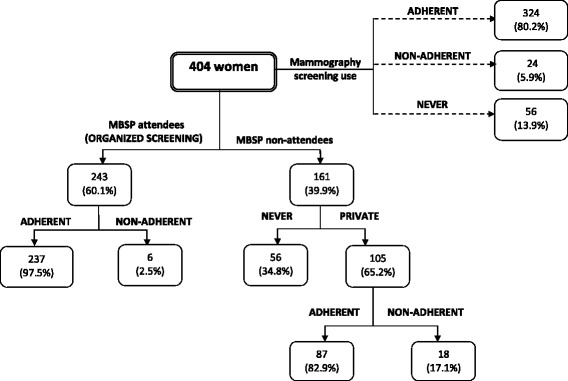
At the time of the survey, 80.2% (n = 324) had been screened within three years (ADHERENT), 5.9% (n = 24) had exceeded the three-year frequency (NON-ADHERENT) while 13.9% (n = 56) never had a mammogram. No significant associations were found between ADHERENT or NON-ADHERENT women in relation to sociodemographic or health status variables (p > 0.05). Knowledge of screening frequency was significantly associated with women's mammography adherence (χ2 = 5.5, p = 0.020). Health beliefs were the strongest significant predictors to describe the variance between ADHERENT and NON-ADHERENT screeners. When Mann Whitney test and Independent Samples t-test were applied on mammography adherence, perceived barriers and cues to action were found to be the most important predictors (p = 0.000, p = 0.039 respectively).
To increase routine and timely mammography practices, women who are non-adherent to recommended time frequency guidelines should be targeted, together with their health beliefs, predominantly perceived barriers and cues to action.
常规乳房 X 光检查可提高生存率。为了获得健康益处,女性必须按建议的时间间隔定期进行乳房筛查。马耳他妇女通常被邀请参加有组织的乳房筛查计划(MBSP),每三年进行一次乳房 X 光检查,或者选择去私人诊所。先前的研究表明,健康信念,尤其是感知障碍,是接受首次 MBSP 邀请的最重要预测因素。在马耳他,这些信念和其他因素是否可以预测在有组织或私人筛查中是否遵守推荐的每三年一次的乳房 X 光检查时间尚不清楚。本文首次探讨了在马耳他有组织或私人筛查中,在推荐的每三年一次的频率范围内或超过该频率的女性的预测因素。
本研究通过对 404 名年龄在 50 至 60 岁之间的首次 MBSP 邀请女性的横断面调查获得信息,比较了女性的特征、知识、健康信念和疾病认知。主要观察变量是女性在三年内(ADHERENT)或超过三年(NON-ADHERENT)接受乳房 X 光检查的情况。数据采用描述性统计、卡方检验、Mann-Whitney 检验、独立样本 t 检验和 Shapiro-Wilk 检验进行分析。
在调查时,80.2%(n=324)的女性在三年内(ADHERENT)接受了筛查,5.9%(n=24)的女性超过了三年一次的频率(NON-ADHERENT),而 13.9%(n=56)的女性从未接受过乳房 X 光检查。ADHERENT 或 NON-ADHERENT 女性在社会人口统计学或健康状况变量方面无显著相关性(p>0.05)。对筛查频率的了解与女性的乳房 X 光检查依从性显著相关(χ2=5.5,p=0.020)。健康信念是描述 ADHERENT 和 NON-ADHERENT 筛查者之间差异的最强有力的显著预测因素。当 Mann-Whitney 检验和独立样本 t 检验应用于乳房 X 光检查依从性时,发现感知障碍和行动线索是最重要的预测因素(p=0.000,p=0.039)。
为了增加常规和及时的乳房 X 光检查,应针对不符合推荐时间频率指南的女性,并针对她们的健康信念、主要是感知障碍和行动线索进行干预。