Department of Internal Medicine, Seoul National University Bundang Hospital, Seoul National University College of Medicine, Seongnam, Korea.
Department of Internal Medicine, Soonchunhyang University Bucheon Hospital, Soonchunhyang University College of Medicine, Bucheon, Korea.
Gut Liver. 2018 Jul 15;12(4):440-448. doi: 10.5009/gnl17322.
BACKGROUND/AIMS: This study aimed to describe the health-related quality of life (HRQoL) outcomes for Korean chronic hepatitis C patients and to investigate the impact of patient and virus-related factors on HRQoL.
HRQoL was assessed in 235 hepatitis C virus (HCV)-infected patients from seven nationwide tertiary hospital, including those with liver cirrhosis and hepatocellular carcinoma (HCC), using the Shor-Form 36 (SF-36) version 2 and the European quality of life questionnaire-5 dimensions (EQ-5D-3L).
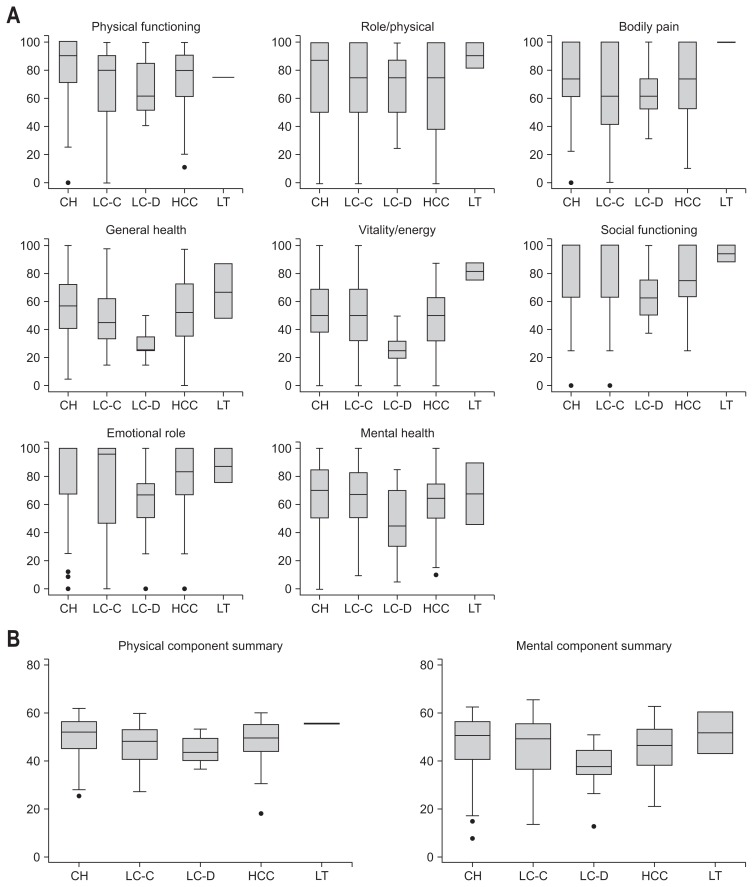
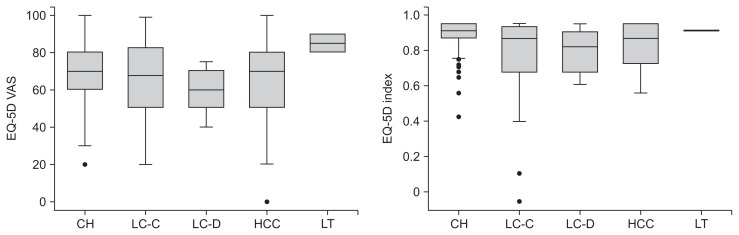
The SF-36 physical (48.8±8.3) and mental (46.2±11.7) component summary scores of the HCV-infected patients were below normal limits. Of the eight domains, general health, vitality, and mental health tended to show low scores. Patients with decompensated cirrhosis had the lowest HRQoL, while HCC and chronic hepatitis patients had similar HRQoL results. The EQ-5D index was low (0.848±0.145) in the HCV infected patients. Multivariable analysis showed age ≤65 years, high monthly family income (>$2,641), low comorbidity score, and sustained virologic response (SVR) were independently associated with favorable HRQoL.
HRQoL in Korean patients with chronic HCV infection was low and was affected by cirrhosis severity, SVR, and comorbidity as well as income, which had the strongest effect. Therefore, HRQoL may be improved by antiviral therapy with reasonable costs to prevent cirrhosis progression.
背景/目的:本研究旨在描述韩国慢性丙型肝炎患者的健康相关生活质量(HRQoL)结局,并探讨患者和病毒相关因素对 HRQoL 的影响。
使用 Shor-Form 36(SF-36)版本 2 和欧洲生活质量问卷-5 维度(EQ-5D-3L)评估了来自七家全国性三级医院的 235 名丙型肝炎病毒(HCV)感染患者的 HRQoL,包括肝硬化和肝细胞癌(HCC)患者。
HCV 感染患者的 SF-36 生理(48.8±8.3)和心理(46.2±11.7)成分综合评分低于正常范围。在八个领域中,一般健康、活力和心理健康往往得分较低。失代偿性肝硬化患者的 HRQoL 最低,而 HCC 和慢性肝炎患者的 HRQoL 结果相似。HCV 感染患者的 EQ-5D 指数较低(0.848±0.145)。多变量分析显示,年龄≤65 岁、高月家庭收入(>$2,641)、低合并症评分和持续病毒学应答(SVR)与良好的 HRQoL 独立相关。
韩国慢性丙型肝炎感染患者的 HRQoL 较低,受肝硬化严重程度、SVR 和合并症以及收入的影响,其中收入的影响最大。因此,通过合理成本的抗病毒治疗预防肝硬化进展可能会改善 HRQoL。