Institute of Epidemiology and Medical Biometry, Ulm University, Helmholtzstraße 22, 89081, Ulm, Germany.
University Center of Orthopaedics and Traumatology, University Medicine Carl Gustav Carus Dresden, TU Dresden, Dresden, Germany.
Sci Rep. 2018 Mar 27;8(1):5253. doi: 10.1038/s41598-018-23573-2.
Osteoarthritis (OA) is a common musculoskeletal disorder and occur in different patterns. However, its impact on long-term all-cause-mortality is inconclusive.
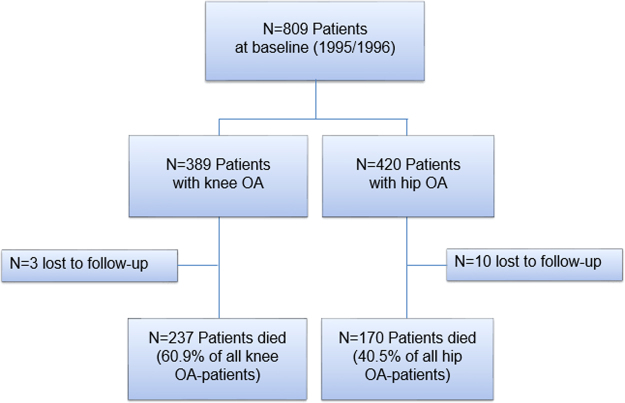
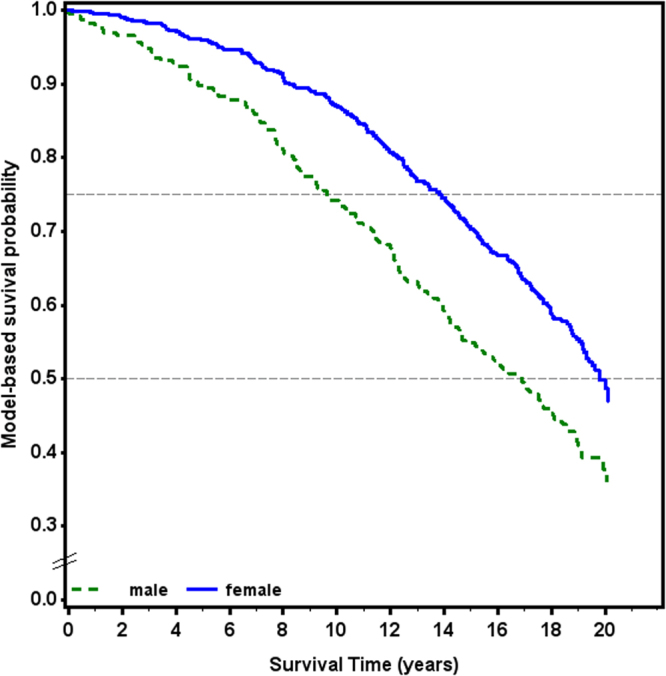
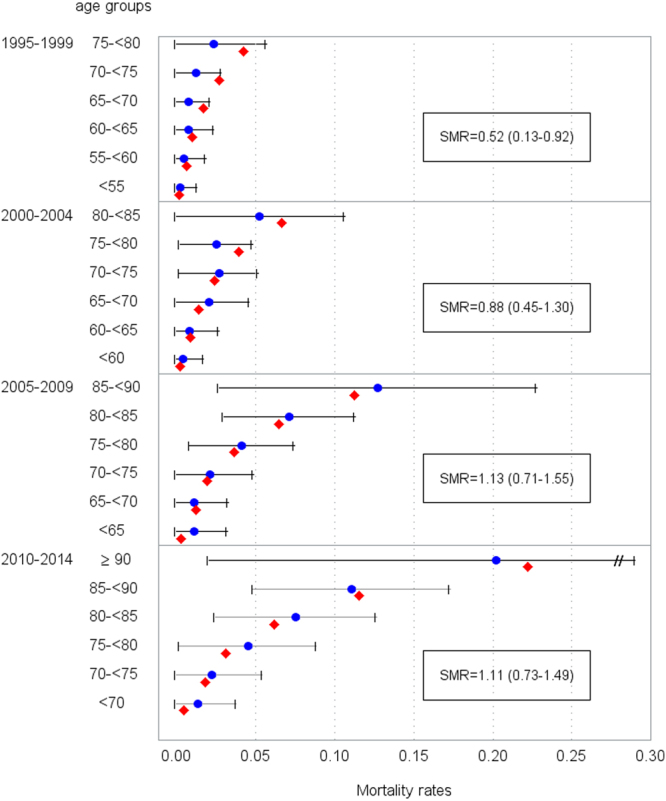
Investigate 20-year all-cause-mortality in patients with hip/knee arthroplasty (recruited 1995/1996, N = 809) from the Ulm Osteoarthritis Study-cohort, in comparison to general population. Furthermore, to enlighten the triangle between baseline life-style and cardio-metabolic risk factors, phenotypic OA-patterns (laterality, generalization, cause) and all-cause-mortality. Mortality was assessed during 20 years follow-up. Standardized mortality ratios (SMR), adjusted odds ratios and hazard ratios (aHR) were calculated. After five years cohort-mortality was reduced compared to the general population, however 20 years later assimilated (SMR = 1.11; 95%-CI 0.73-1.49). OA-patterns were associated with age, cholesterol, and overweight/obesity. In comparison to primary OA decreased mortality was observed for patients with secondary OA (aHR = 0.76; 95%-CI 0.61-0.95) adjusted for age, smoking, overweight/obesity, diabetes, hypertension, cardiac insufficiency, uric acid, and lower cholesterol. There was no increased mortality in patients after 20 years follow-up compared to general population. Significantly decreased mortality in secondary compared to primary OA suggests a subtype-specific involvement of systemic co-factors in determination of all-cause-mortality. Because cardio-metabolic risk factors were associated with increased risk of bilateral OA and lower long-term survival, those risk factors should be consequently targeted in OA-patients.
骨关节炎(OA)是一种常见的肌肉骨骼疾病,表现出不同的模式。然而,其对长期全因死亡率的影响尚无定论。
调查来自乌尔姆骨关节炎研究队列的髋/膝关节置换术患者(1995/1996 年招募,N=809)的 20 年全因死亡率,并与普通人群进行比较。此外,阐明基线生活方式与心血管代谢危险因素、表型 OA 模式(侧别、泛化、病因)和全因死亡率之间的关系。在 20 年的随访期间评估死亡率。计算标准化死亡率比(SMR)、调整后的优势比和风险比(aHR)。与普通人群相比,五年后队列死亡率降低,但 20 年后趋于一致(SMR=1.11;95%CI 0.73-1.49)。OA 模式与年龄、胆固醇和超重/肥胖有关。与原发性 OA 相比,继发性 OA 患者的死亡率降低(aHR=0.76;95%CI 0.61-0.95),调整因素包括年龄、吸烟、超重/肥胖、糖尿病、高血压、心功能不全、尿酸和胆固醇水平降低。与普通人群相比,在 20 年的随访后,患者的死亡率没有增加。与原发性 OA 相比,继发性 OA 的死亡率显著降低,这表明系统合并症在全因死亡率的决定中具有亚型特异性作用。由于心血管代谢危险因素与双侧 OA 风险增加和较低的长期生存率相关,因此应在 OA 患者中针对性地治疗这些危险因素。