Isaac Augusta, de Paula Jéssica, Viana Carlos Martins, Henriques Andréia Bicalho, Malachias Angelo, Montoro Luciano A
1Department of Metallurgical and Materials Engineering, Universidade Federal de Minas Gerais, Belo Horizonte, 31270-901 Brazil.
2Microscopy Center, Universidade Federal de Minas Gerais, Belo Horizonte, 31270-901 Brazil.
Biotechnol Biofuels. 2018 Mar 22;11:73. doi: 10.1186/s13068-018-1071-6. eCollection 2018.
To date, great strides have been made in elucidating the role of thermochemical pretreatments in the chemical and structural features of plant cell walls; however, there is no clear picture of the plant recalcitrance and its relationship to deconstruction. Previous studies precluded full answers due to the challenge of multiscale features of plant cell wall organization. Complementing the previous efforts, we undertook a systematic, multiscale, and integrated approach to track the effect of microwave-assisted HSO and NaOH treatments on the hierarchical structure of plants, i.e., from a nano- to micrometer scale. We focused on the investigation of the highly recalcitrant sclerenchyma cell walls from sugarcane bagasse.
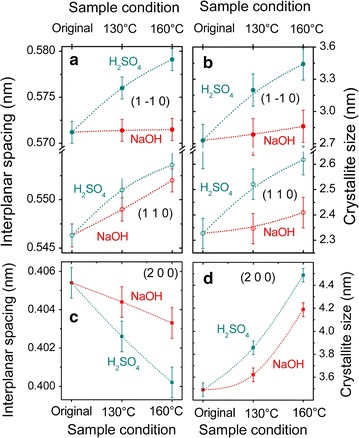
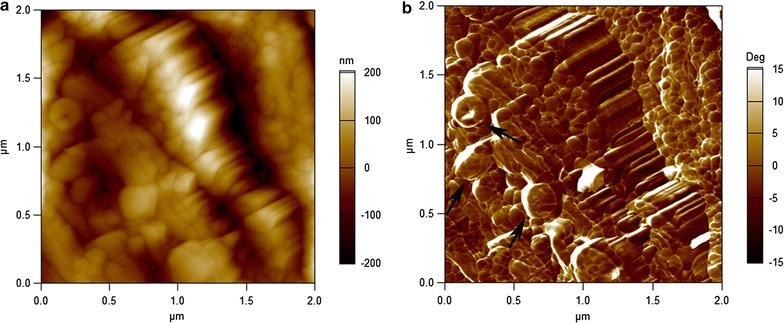
Through atomic force microscopy and X-ray diffraction analyses, remarkable details of the assembly of cellulose microfibrils not previously seen were revealed. Following the HSO treatment, we observed that cellulose microfibrils were almost double the width of the alkali pretreated sample at the temperature of 160 °C. Such enlargement led to a greater contact between cellulose chains, with a subsequent molecule alignment, as indicated by the X-ray diffraction (XRD) results with the conspicuous expansion of the average crystallite size. The delignification process had little effect on the local nanometer-sized arrangement of cellulose molecules. However, the rigidity and parallel alignment of cellulose microfibrils were partially degraded. The XRD analysis also agrees with these findings as evidenced by large momentum transfer vectors ( > 20 nm), interpreted as indicators of the long-range order of cell wall components, which were similar for all the studied samples except with application of the NaOH treatment at 160 °C. These changes were followed by the eventual swelling of the fiber cell walls.
Based on an integrated approach, we presented multidimensional architectural models of cell wall deconstruction resulting from microwave-assisted pretreatments. We provided direct evidence supporting the idea that hemicellulose is the main barrier for the swelling of cellulose microfibrils, whereas lignin adds rigidity to cell walls. Our findings shed light on the design of more efficient strategies, not only for the conversion of biomass to fuels but also for the production of nanocellulose, which has great potential for several applications such as composites, rheology modifiers, and pharmaceuticals.
迄今为止,在阐明热化学预处理对植物细胞壁化学和结构特征的作用方面已经取得了很大进展;然而,对于植物的难降解性及其与解构的关系尚无清晰的认识。由于植物细胞壁组织的多尺度特征带来的挑战,先前的研究无法给出完整答案。作为对先前工作的补充,我们采用了一种系统、多尺度且综合的方法来追踪微波辅助硫酸氢盐(HSO)和氢氧化钠(NaOH)处理对植物从纳米到微米尺度层次结构的影响。我们重点研究了甘蔗渣中高度难降解的厚壁组织细胞壁。
通过原子力显微镜和X射线衍射分析,揭示了纤维素微纤丝组装的显著细节,这些细节是以前未曾见过的。经过硫酸氢盐处理后,我们观察到在160°C温度下,纤维素微纤丝的宽度几乎是碱预处理样品的两倍。这种增宽导致纤维素链之间有更大的接触,随后分子发生排列,X射线衍射(XRD)结果显示平均微晶尺寸明显增大,表明了这一点。脱木质素过程对纤维素分子的局部纳米级排列影响不大。然而,纤维素微纤丝的刚性和平行排列部分降解。XRD分析也与这些发现一致,大动量转移矢量(>20纳米)证明了这一点,该矢量被解释为细胞壁成分长程有序的指标,除了在160°C进行氢氧化钠处理的样品外,所有研究样品的该指标都相似。这些变化随后导致纤维细胞壁最终肿胀。
基于综合方法,我们展示了微波辅助预处理导致的细胞壁解构的多维结构模型。我们提供了直接证据支持半纤维素是纤维素微纤丝肿胀的主要障碍这一观点,而木质素增加了细胞壁的刚性。我们的研究结果为设计更有效的策略提供了思路,不仅用于将生物质转化为燃料,还用于生产纳米纤维素,纳米纤维素在复合材料、流变改性剂和药物等多种应用中具有巨大潜力。