Nelson Kristin N, Grijalva Carlos G, Chochua Sopio, Hawkins Paulina A, Gil Ana I, Lanata Claudio F, Griffin Marie R, Edwards Kathryn M, Klugman Keith P, Vidal Jorge E
Department of Epidemiology, Emory University Rollins School of Public Health, Atlanta, Georgia.
Vanderbilt University School of Medicine, Vanderbilt University, Nashville, Tennessee.
Open Forum Infect Dis. 2018 Feb 17;5(3):ofy039. doi: 10.1093/ofid/ofy039. eCollection 2018 Mar.
Although asymptomatic carriage of () is common, acquisition of the bacteria is the first step in disease pathogenesis. We examined the effect of introduction of the 7-valent pneumococcal vaccine on carriage patterns in a cohort of Peruvian children.
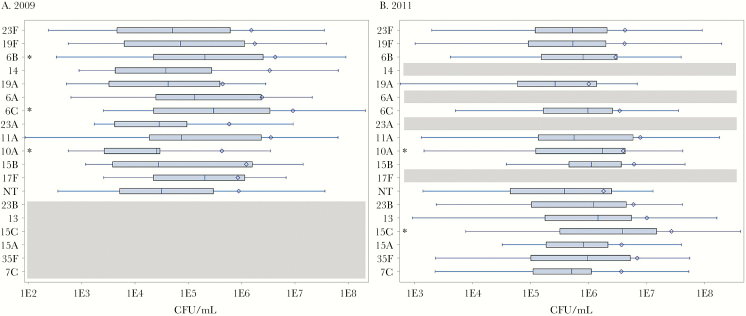
We used data from a prospective cohort study that collected monthly nasopharyngeal samples from children under 3 years of age. isolates were serotyped using Quellung reactions, and bacterial density was determined by quantitative polymerase chain reaction. Changes in carriage patterns, including the rate of carriage and number and density of serotypes carried over time, were evaluated before (2009) and after widespread vaccination with PCV7 (2011). Using all pneumococcal detections from each child and year, we identified serotypes that were present both at first and last detection as "persisters" and serotypes that replaced a different earlier type and were detected last as "recolonizers."
Ninety-two percent (467/506) of children in 2009 and 89% (451/509) in 2011 carried at least once. In 2009 and 2011, rates of carriage were 9.03 and 9.04 detections per person-year, respectively. In 2009, 23F, a serotype included in PCV7, was the only type identified as a persister and 6A, 15B, and 19A were identified as recolonizer serotypes. In 2011, 6B and 7C were persister serotypes and 13 was a frequent recolonizer serotype.
Overall carriage among children under 3 in Peru was similar before and after introduction of PCV7; however, serotype-specific rates and longitudinal carriage patterns have shifted.
虽然肺炎链球菌无症状携带很常见,但细菌的获得是疾病发病机制的第一步。我们研究了引入7价肺炎球菌疫苗对一组秘鲁儿童肺炎链球菌携带模式的影响。
我们使用了一项前瞻性队列研究的数据,该研究每月收集3岁以下儿童的鼻咽样本。肺炎链球菌分离株通过荚膜肿胀反应进行血清分型,细菌密度通过定量聚合酶链反应测定。在广泛接种PCV7(2011年)之前(2009年)和之后,评估肺炎链球菌携带模式的变化,包括携带率以及随时间推移携带的血清型数量和密度。利用每个儿童每年所有的肺炎球菌检测结果,我们将首次和最后一次检测时均存在的血清型确定为“持续存在型”,将取代另一种早期血清型并在最后一次检测时被发现的血清型确定为“重新定植型”。
2009年92%(467/506)的儿童和2011年89%(4,51/509)的儿童至少有一次肺炎链球菌携带。2009年和2011年,携带率分别为每人每年9.03次和9.04次检测。2009年,PCV7中包含的血清型23F是唯一被确定为持续存在型的血清型,血清型6A、15B和19A被确定为重新定植型血清型。2011年,血清型6B和7C是持续存在型血清型,血清型13是常见的重新定植型血清型。
在秘鲁,引入PCV7前后,3岁以下儿童的总体肺炎链球菌携带情况相似;然而,血清型特异性携带率和纵向携带模式已经发生了变化。