UK Centre for Tobacco and Alcohol Studies, School of Experimental Psychology, University of Bristol, Bristol, United Kingdom.
MRC Integrative Epidemiology Unit (IEU), School of Experimental Psychology, University of Bristol, Bristol, United Kingdom.
Nicotine Tob Res. 2019 May 21;21(6):739-746. doi: 10.1093/ntr/nty057.
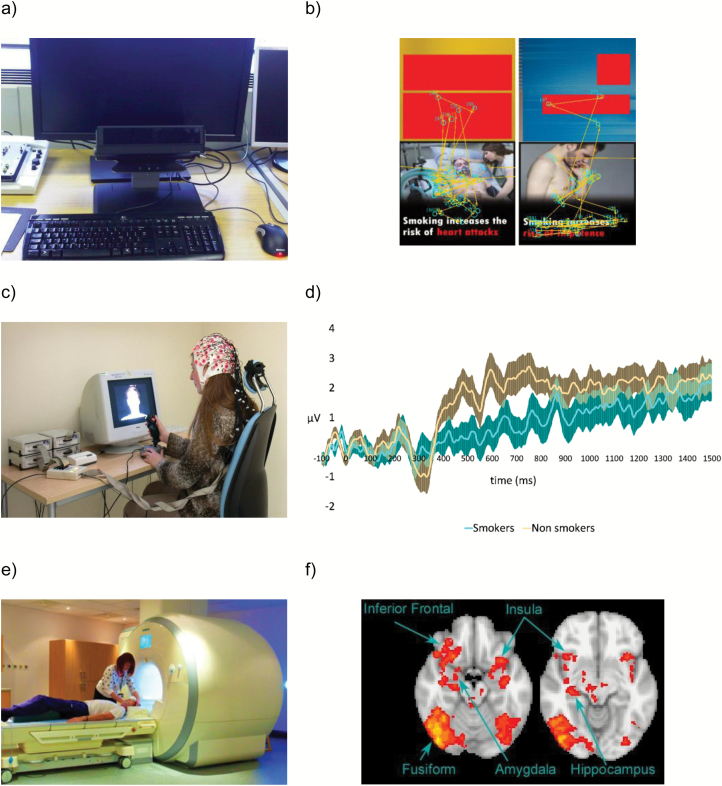
Techniques employed in the field of neuroscience, such as eye tracking, electroencephalography, and functional magnetic resonance imaging, have been important in informing our understanding of the cognitive mechanisms underlying tobacco smoking. These techniques are now increasingly being used to investigate the likely impact of tobacco control policies.
In this narrative review, we outline the value of these methodological approaches in answering policy-relevant tobacco control research questions, with a particular focus on their use in examining the impact of standardized cigarette packaging and health warnings. We also examine the limitations of these methodologies and provide examples of how they can be used to answer other policy-relevant questions.
We argue that neuroscience techniques can provide more objective evidence of the impacts of policy measures, allow investigation where it is not possible to conduct behavioral manipulations, and facilitate a deeper understanding of the cognitive mechanisms underlying the impacts of tobacco control policies such as standardized packaging, health warnings, point-of-sale displays, and mass media campaigns.
Rather than replacing more traditional methods of examining tobacco control measures, such as observational experiments, surveys, and questionnaires, neuroscience techniques can complement and extend these methods.
Neuroscience techniques facilitate objective examination of the mechanisms underlying the impacts of tobacco control measures. These techniques can therefore complement and extend other methodologies typically used in this field, such as observational experiments, surveys, and questionnaires.
神经科学领域采用的技术,如眼动追踪、脑电图和功能磁共振成像,对于我们理解吸烟的认知机制非常重要。这些技术现在越来越多地被用于研究烟草控制政策可能产生的影响。
在这篇叙述性综述中,我们概述了这些方法在回答与政策相关的烟草控制研究问题方面的价值,特别关注它们在检验标准化卷烟包装和健康警语的影响方面的应用。我们还研究了这些方法的局限性,并提供了如何将它们用于回答其他与政策相关问题的示例。
我们认为,神经科学技术可以提供政策措施影响的更客观证据,允许在无法进行行为干预的情况下进行调查,并有助于更深入地了解标准化包装、健康警语、销售点展示和大众媒体宣传等烟草控制政策影响背后的认知机制。
神经科学技术并非取代更传统的烟草控制措施研究方法,如观察性实验、调查和问卷调查,而是可以补充和扩展这些方法。
神经科学技术有助于客观地检验烟草控制措施影响的机制。因此,这些技术可以补充和扩展该领域通常使用的其他方法,如观察性实验、调查和问卷调查。