Wang Wei, Zhang Zheng-Zhu, Wu Yan, Wang Ru-Qing, Chen Jin-Wu, Chen Jing, Zhang Yan, Chen Ya-Jun, Geng Ming, Xu Zhong-Dong, Dai Min, Li Jin-Hua, Pan Li-Long
School of Life Sciences, Hefei Normal University, Hefei, China.
State Key Laboratory of Tea Plant Biology and Utilization, Anhui Agricultural University, Hefei, China.
Front Pharmacol. 2018 Mar 9;9:195. doi: 10.3389/fphar.2018.00195. eCollection 2018.
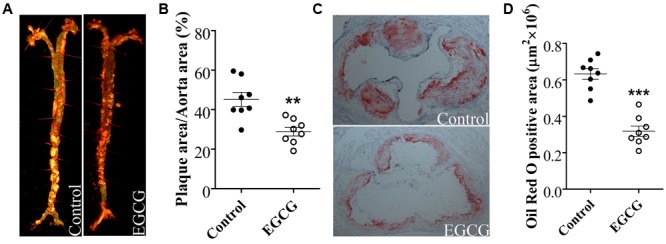
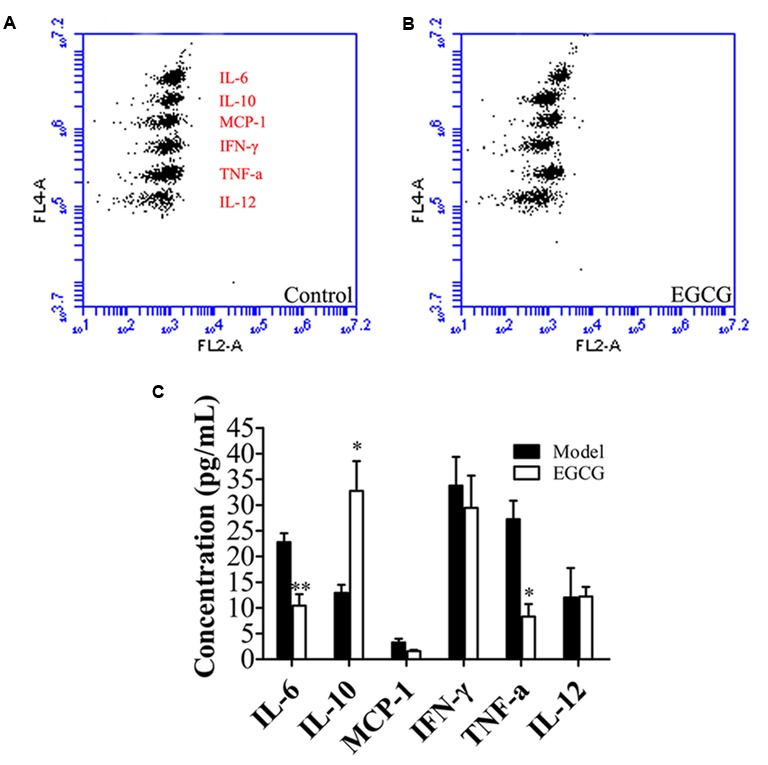
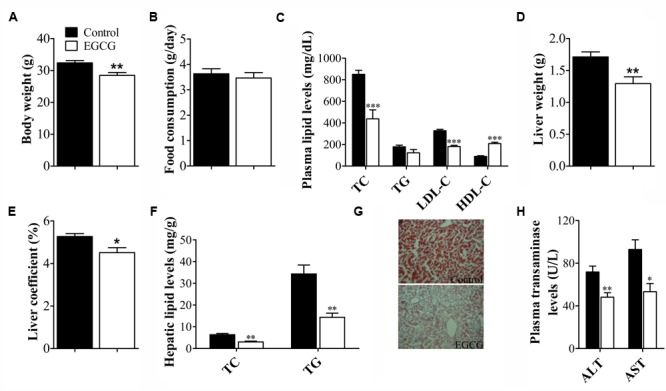
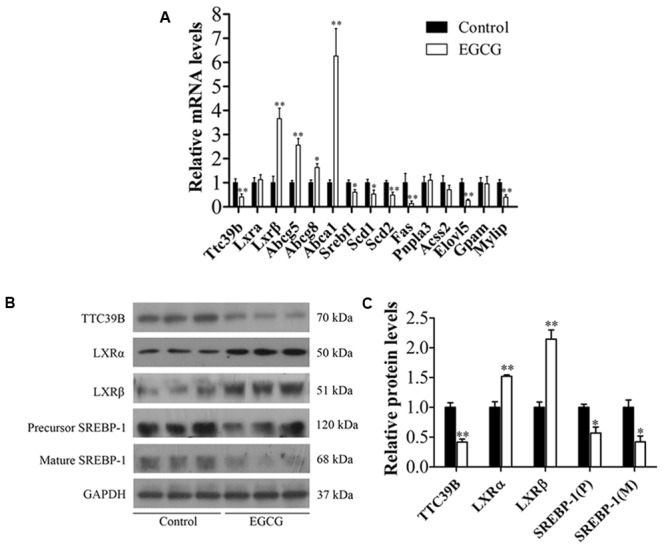
Aberrant chronic inflammation and excess accumulation of lipids play a pivotal role in the occurrence and progression of atherosclerosis. (-)-Epigallocatechin-3-gallate (EGCG), the major catechins in green tea, displayed anti-atherosclerotic properties and . However, the effects and underlying mechanism of EGCG on atherosclerosis remain unclear. Male apolipoprotein E-knockout (ApoE) mice (7 weeks old) fed with high-fat diet (HFD) were treated with normal saline or EGCG (40 mg/kg/d, i.g.) for 18 weeks. Atherosclerotic plaque and liver lipid accumulation were measured by Oil Red staining. Plasma lipids and cytokines were detected using commercial kits. The expression of protein and mRNA was analyzed by western blot and quantitative real-time reverse transcription-polymerase chain reaction, respectively. EGCG administration markedly attenuated atherosclerotic plaque formation in HFD-fed ApoE mice, which were accompanied by increased plasma interleukin-10 (IL-10) level and decreased plasma IL-6 and tumor necrosis factor-α (TNF-α) levels. In addition, EGCG modulated high-fat-induced dyslipidemia, evidencing by decreased total cholesterol (TC) and low-density lipoprotein levels and increased high-density lipoprotein level. Meanwhile, EGCG treatment alleviated high-fat-mediated liver lipid accumulation and decreased liver TC and triglyceride. Mechanistically, EGCG significantly modulated high-fat-induced hepatic tetratricopeptide repeat domain protein 39B (TTC39B) expression and its related genes () expression in liver from ApoE mice. Notably, EGCG remarkably induced hepatic liver X receptor α (LXRα) and LXRβ expression and inhibited both precursor and mature sterol regulatory element binding transcription factor-1 (SREBP-1) expression. Taken together, our data for the first time suggested that TTC39B was involved in EGCG-mediated anti-atherosclerotic effects through modulation of LXR/SREBP-1 pathway.
异常的慢性炎症和脂质的过度积累在动脉粥样硬化的发生和发展中起关键作用。(-)-表没食子儿茶素-3-没食子酸酯(EGCG)是绿茶中的主要儿茶素,具有抗动脉粥样硬化特性。然而,EGCG对动脉粥样硬化的作用及其潜在机制仍不清楚。将雄性载脂蛋白E基因敲除(ApoE)小鼠(7周龄)喂食高脂饮食(HFD),并用生理盐水或EGCG(40mg/kg/d,灌胃)处理18周。通过油红染色测量动脉粥样硬化斑块和肝脏脂质积累。使用商业试剂盒检测血浆脂质和细胞因子。分别通过蛋白质印迹和定量实时逆转录-聚合酶链反应分析蛋白质和mRNA的表达。给予EGCG显著减轻了喂食HFD的ApoE小鼠的动脉粥样硬化斑块形成,同时血浆白细胞介素-10(IL-10)水平升高,血浆IL-6和肿瘤坏死因子-α(TNF-α)水平降低。此外,EGCG调节高脂诱导的血脂异常,表现为总胆固醇(TC)和低密度脂蛋白水平降低,高密度脂蛋白水平升高。同时,EGCG处理减轻了高脂介导的肝脏脂质积累,并降低了肝脏TC和甘油三酯。机制上,EGCG显著调节高脂诱导的ApoE小鼠肝脏中四肽重复结构域蛋白39B(TTC39B)及其相关基因()的表达。值得注意的是,EGCG显著诱导肝脏肝脏X受体α(LXRα)和LXRβ的表达,并抑制前体和成熟固醇调节元件结合转录因子-1(SREBP-1)的表达。综上所述,我们的数据首次表明TTC39B通过调节LXR/SREBP-1途径参与EGCG介导的抗动脉粥样硬化作用。