Lecronier Marie, Valade Sandrine, Bigé Naike, de Prost Nicolas, Roux Damien, Lebeaux David, Maury Eric, Azoulay Elie, Demoule Alexandre, Dres Martin
Service de Pneumologie et Réanimation Médicale (Département "R3S"), Groupe Hospitalier Pitié-Salpêtrière Charles Foix, Assistance Publique-Hôpitaux de Paris, 75013, Paris, France.
Service de Réanimation médicale, Groupe Hospitalier Saint-Louis - Lariboisière - Fernand-Widal, Assistance Publique-Hôpitaux de Paris, Paris, France.
Ann Intensive Care. 2018 Mar 27;8(1):41. doi: 10.1186/s13613-018-0383-9.
While no data support this practice, international guidelines recommend the removal of totally implanted venous access ports (TIVAPs) in patients with suspicion of TIVAP-related bloodstream infection admitted in the intensive care unit (ICU) for a life-threatening sepsis.
During this multicenter, retrospective and observational study, we included all patients admitted in five ICU for a life-threatening sepsis in whom a TIVAP was removed between January 2012 and December 2014. We aimed (1) at determining the proportion of confirmed TIVAP-related infections and (2) at assessing short- and long-term survival of patients with and without TIVAP-related infections.
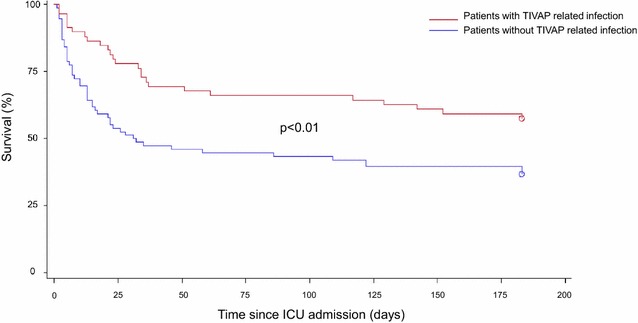
One hundred and fifty-one patients (58 ± 14 years, 62% males) were included between 2012 and 2014. TIVAP-related infections were confirmed in 68 patients (45%). Demographic characteristics were similar between patients with and without TIVAP-related infections. SOFA score on admission per point increase [odd ratio (OR), 0.86 interval confidence (IC) 95% (0.8-0.9), p < 0.01] and local signs of infection [OR 4.0, IC 95% (1.1-15.6), p = 0.04] were significantly associated with TIVAP-related infection. Patients with TIVAP-related infection had lower ICU and 6-month mortality as compared to their counterparts (9 vs. 40%, respectively, p < 0.01; and 50 vs. 66%, respectively, p = 0.04). TIVAP-related infection was significantly associated with ICU survival [OR 0.2, IC 95% (0.05-0.5), p < 0.01].
TIVAP-related infection was confirmed in nearly one out of two cases of life-threatening sepsis in patients in whom it has been removed. TIVAP-related infection was associated with a good prognosis, as compared to patients with other causes of infection.
尽管没有数据支持这种做法,但国际指南建议,对于因危及生命的脓毒症而入住重症监护病房(ICU)且怀疑发生与全植入式静脉通路端口(TIVAP)相关的血流感染的患者,应移除TIVAP。
在这项多中心回顾性观察研究中,我们纳入了2012年1月至2014年12月期间在5个ICU因危及生命的脓毒症而移除TIVAP的所有患者。我们旨在(1)确定确诊的与TIVAP相关感染的比例,以及(2)评估有无与TIVAP相关感染的患者的短期和长期生存率。
2012年至2014年期间纳入了151例患者(年龄58±14岁,62%为男性)。68例患者(45%)确诊为与TIVAP相关的感染。有无与TIVAP相关感染的患者的人口统计学特征相似。入院时序贯器官衰竭评估(SOFA)评分每增加1分[比值比(OR),0.86,95%置信区间(IC)(0.8 - 0.9),p < 0.01]以及感染的局部体征[OR 4.0,IC 95%(1.1 - 15.6),p = 0.04]与与TIVAP相关的感染显著相关。与无TIVAP相关感染的患者相比,有TIVAP相关感染的患者的ICU死亡率和6个月死亡率更低(分别为9%对40%,p < 0.01;以及50%对66%,p = 0.04)。与TIVAP相关的感染与ICU生存率显著相关[OR 0.2,IC 95%(0.05 - 0.5),p < 0.01]。
在因危及生命的脓毒症而移除TIVAP的患者中,近一半病例确诊为与TIVAP相关的感染。与其他感染原因的患者相比,与TIVAP相关的感染预后良好。