Feng Hong, Wang Minghui, Wu Changshun, Yu Jinyu, Wang Dan, Ma Jian, Han Junqing
Department of Cancer Center Department of Orthopedics, Shandong Provincial Hospital affiliated to Shandong University, Jinan, Shandong Key Laboratory of Carcinogenesis and Translational Research (Ministry of Education), Department of Renal Cancer and Melanoma, Peking University Cancer Hospital and Institute, Beijing Central Laboratory, Shandong Provincial Hospital affiliated to Shandong University, 544 Jingsi Road, Jinan Department of General Surgery, Yangxin County People's Hospital, Yangxin, Shandong, China.
Medicine (Baltimore). 2018 Mar;97(13):e0203. doi: 10.1097/MD.0000000000010203.
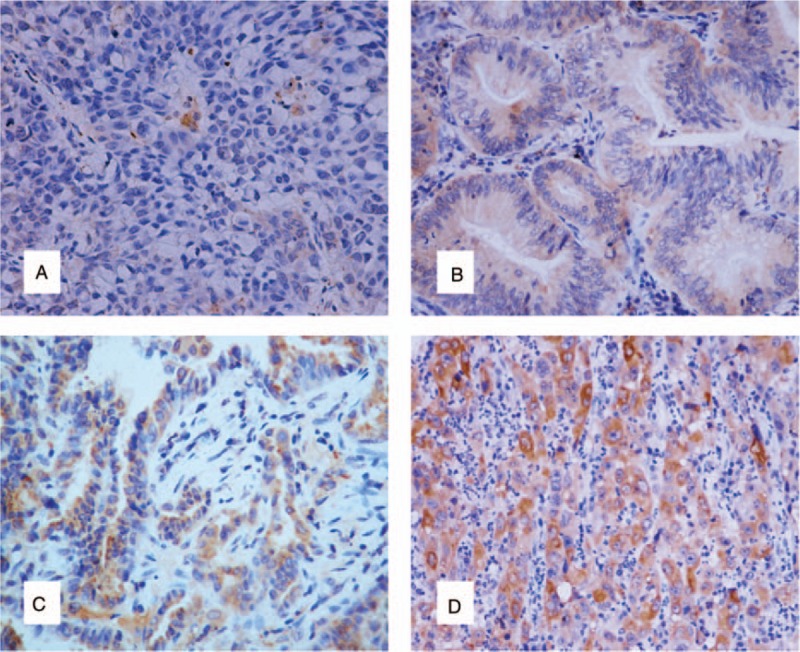
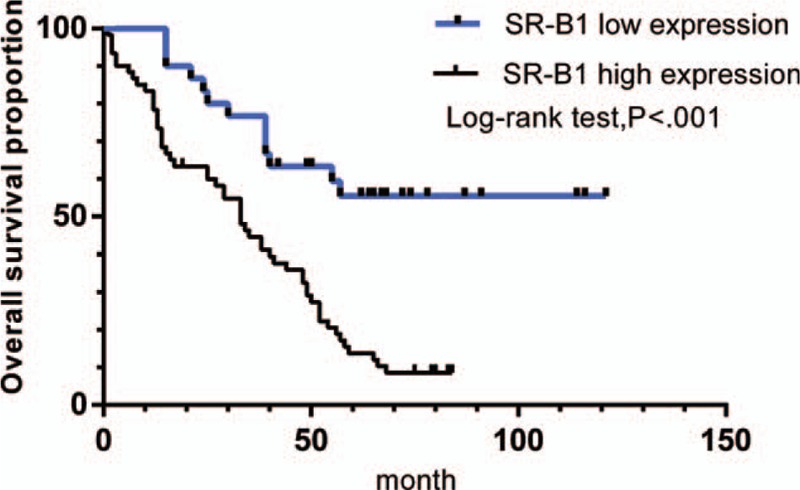
Scavenger receptor class B type I (SR-B1) is highly expressed in a variety of cancers, including prostate, breast and ovarian. However, the relationship between SR-B1 and lung adenocarcinoma is unknown. We analyzed the expression of SR-B1 in a well-characterized lung adenocarcinoma tissue microarray by immunohistochemistry, in 90 cancerous and 90 adjacent normal lung tissues. Results showed that the positive expression rate of SR-B1 in cancer tissues (86/90, 96%) was significantly higher than that of adjacent tissues (50/90, 56%) (P < .001). And SR-B1 overexpression in lung adenocarcinoma tissue was significantly higher than that of adjacent normal tissue (P < .001), accounting for 67% of cases. This elevated SR-B1 expression was associated with AJCC stage (P < .001), T stage (P = .012), N stage (P = .002), and lymph node positivity (P < .001). The Kaplan-Meier survival analysis indicated that patients with high SR-B1 expression had a shorter overall survival (P < .001). On the multivariate analysis, SR-B1 was an independent prognostic factor for outcomes after adjustment for other prognostic factors (P = .038). In conclusion, high SR-B1 expression is associated with conventional pathologic parameters that represent tumor aggressiveness and may purport a poor clinical prognosis in lung adenocarcinoma.
I型B类清道夫受体(SR-B1)在包括前列腺癌、乳腺癌和卵巢癌在内的多种癌症中高表达。然而,SR-B1与肺腺癌之间的关系尚不清楚。我们通过免疫组织化学分析了90例癌组织和90例相邻正常肺组织的特征明确的肺腺癌组织芯片中SR-B1的表达情况。结果显示,癌组织中SR-B1的阳性表达率(86/90,96%)显著高于相邻组织(50/90,56%)(P<0.001)。肺腺癌组织中SR-B1的过表达显著高于相邻正常组织(P<0.001),占病例的67%。SR-B1表达的升高与美国癌症联合委员会(AJCC)分期(P<0.001)、T分期(P=0.012)、N分期(P=0.002)及淋巴结阳性(P<0.001)相关。Kaplan-Meier生存分析表明,SR-B1高表达的患者总生存期较短(P<0.001)。多因素分析显示,在调整其他预后因素后,SR-B1是预后的独立预测因素(P=0.038)。总之,SR-B1高表达与代表肿瘤侵袭性的传统病理参数相关,可能预示肺腺癌患者临床预后不良。