Ohlsson Bodil, Darwiche Gassan, Roth Bodil, Höglund Peter
Department of Internal Medicine, Skåne University Hospital, Lund University, Malmö, Sweden.
Department of Clinical Chemistry and Pharmacology, Skåne University Hospital, Lund University, Lund, Sweden.
Food Nutr Res. 2018 Mar 14;62. doi: 10.29219/fnr.v62.1328. eCollection 2018.
An Okinawa-based Nordic diet with moderately low carbohydrate content and high fat and protein content has been shown to improve anthropometry and metabolism in type 2 diabetes.
The objectives of this study were to measure plasma or serum levels of hormones regulating energy metabolism and metabolic control, that is, cholecystokinin (CCK), Cortisol, C-peptide, ghrelin, glucagon, glucagon-like peptide-1 (GLP-1), glucose-dependent insulinotropic polypeptide (GIP), insulin, leptin, plasminogen activator inhibitor-1 (PAI-1), polypeptide YY (PYY), resistin, and visfatin after this diet intervention, and to determine partial correlations between hormonal levels and anthropometric and metabolic responses.
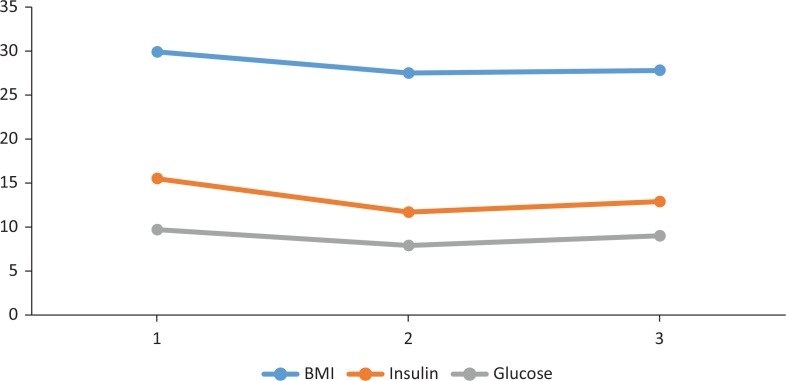
A total of 30 patients (17 women) with type 2 diabetes, mean age 57.5 ± 8.2 years, and body mass index (BMI) 29.9 ± 4.1 kg/m were served the diet for 12 weeks. Fasting hormones were measured by Luminex and enzyme-linked immunosorbent assay (ELISA) before study start and after 12 and 28 weeks, along with anthropometric and metabolic parameters.
The levels of CCK ( = 0.005), cortisol ( = 0.015), C-peptide ( = 0.022), glucagon ( = 0.003), GLP-1 ( = 0.013), GIP ( < 0.001), insulin ( = 0.004), leptin ( < 0.001), and PYY ( < 0.001) were lowered after dietary intervention. These reduced levels only remained for PYY at week 28 ( = 0.002), when also ghrelin ( = 0.012) and visfatin ( = 0.021) levels were reduced. Changes of glucose values correlated with changed levels of C-peptide and PYY ( < 0.001), insulin ( 0.002), and PAI-1 ( = 0.009); changes of triglyceride values with changed levels of C-peptide, insulin, and PYY ( < 0.001) and PAI-1 ( = 0.005); changes of insulin resistance with changes of leptin levels ( = 0.003); and changes of BMI values with changed levels of C-peptide, insulin, and leptin ( < 0.001).
Okinawa-based Nordic diet in type 2 diabetes has significant impact on the endocrine profile, which correlates with anthropometric and metabolic improvements.
基于冲绳的北欧饮食,碳水化合物含量适度偏低,脂肪和蛋白质含量较高,已被证明可改善2型糖尿病患者的人体测量指标和新陈代谢。
本研究的目的是测量这种饮食干预后调节能量代谢和代谢控制的激素的血浆或血清水平,即胆囊收缩素(CCK)、皮质醇、C肽、胃饥饿素、胰高血糖素、胰高血糖素样肽-1(GLP-1)、葡萄糖依赖性促胰岛素多肽(GIP)、胰岛素、瘦素、纤溶酶原激活物抑制剂-1(PAI-1)、多肽YY(PYY)、抵抗素和内脂素,并确定激素水平与人体测量和代谢反应之间的部分相关性。
共有30例2型糖尿病患者(17名女性),平均年龄57.5±8.2岁,体重指数(BMI)为29.9±4.1kg/m²,接受该饮食12周。在研究开始前、12周和28周后,通过Luminex和酶联免疫吸附测定(ELISA)测量空腹激素水平,同时测量人体测量和代谢参数。
饮食干预后,CCK(P = 0.005)、皮质醇(P = 0.015)、C肽(P = 0.022)、胰高血糖素(P = 0.003)、GLP-1(P = 0.013)、GIP(P < 0.001)、胰岛素(P = 0.004)、瘦素(P < 0.001)和PYY(P < 0.001)水平降低。这些降低的水平仅在第28周时PYY仍保持(P = 0.002),此时胃饥饿素(P = 0.012)和内脂素(P = 0.021)水平也降低。血糖值的变化与C肽和PYY(P < 0.001)、胰岛素(P = 0.002)和PAI-1(P = 0.009)水平的变化相关;甘油三酯值的变化与C肽、胰岛素和PYY(P < 0.001)以及PAI-1(P = 0.005)水平的变化相关;胰岛素抵抗的变化与瘦素水平的变化(P = 0.003)相关;BMI值的变化与C肽、胰岛素和瘦素水平的变化(P < 0.001)相关。
基于冲绳的北欧饮食对2型糖尿病患者的内分泌谱有显著影响,这与人体测量和代谢改善相关。