Yeung Andy Wai Kan, Heinrich Michael, Atanasov Atanas G
Oral and Maxillofacial Radiology, Applied Oral Sciences, Faculty of Dentistry, The University of Hong Kong, Hong Kong, Hong Kong.
Research Group "Pharmacognosy and Phytotherapy", UCL School of Pharmacy, London, United Kingdom.
Front Pharmacol. 2018 Mar 15;9:215. doi: 10.3389/fphar.2018.00215. eCollection 2018.
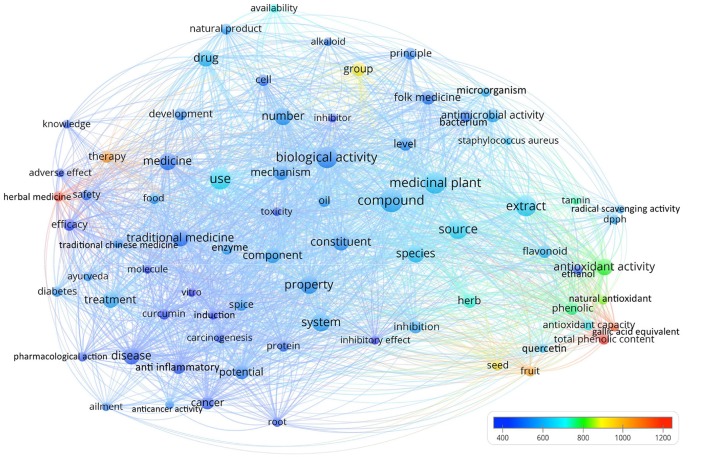
The research into bioactive natural products of medicinal plants has a long tradition, but ethnopharmacology as a well-defined field of research has a relatively short history, only dating back 50 years. With the fast development of this field and its global importance especially in the fast developing economies of Asia it is timely to assess the most influential articles (as measured by citations) and to identify important drivers and research trends in this field. Scopus was searched to identify relevant articles which were assessed by all three authors. The 100 most cited articles were identified and analyzed. Bibliometric software (VOSviewer) was utilized to supplement the analysis and to generate a term map that visualized the citation patterns of the 100 articles containing different terms. Forty-four of the 100 articles are reviews. On average, each of the 100 articles had 632 citations and since publication was cited 43 times annually. The four core journals were ( = 17), ( = 7), ( = 5), and ( = 4). Anti-oxidant effects appeared to be a recurring and highly cited topic, whereas the links into drug discovery and neuropharmacology seemed to be less strong. Numerous medicinal plants and functional foods were the foci of research, and the foci shifted when comparing pre-2000 and post-2000 publications (with the later involving a broader spectrum of plants and foods and a wider range of biological effects). Contributions largely came from Asia, and also from the Americas, Africa, and Oceania, besides Europe. We have identified and analyzed the 100 most-cited articles in ethnopharmacology. Within 50 years the field has gained a profile and while conventionally often linked to "traditional knowledge," drug discovery and some areas of pharmacology, this analysis highlights its emerging importance in the context of disease prevention (food science), but also the development of research driven by the needs and interests of the fast developing economies most notably of Asia.
对药用植物生物活性天然产物的研究有着悠久的传统,但民族药理学作为一个明确界定的研究领域,其历史相对较短,仅可追溯到50年前。随着该领域的快速发展及其在全球的重要性,尤其是在亚洲快速发展的经济体中的重要性,现在是评估最具影响力的文章(以引用次数衡量)并确定该领域重要驱动因素和研究趋势的时候了。通过搜索Scopus来识别相关文章,所有三位作者对这些文章进行了评估。确定并分析了被引用次数最多的100篇文章。利用文献计量软件(VOSviewer)来补充分析并生成一个术语图,该图可视化了包含不同术语的100篇文章的引用模式。100篇文章中有44篇是综述。100篇文章平均每篇有632次引用,自发表以来每年被引用43次。四大核心期刊分别是《民族药理学杂志》(17篇)、《植物医学》(7篇)、《药理学前沿》(5篇)和《天然产物杂志》(4篇)。抗氧化作用似乎是一个反复出现且被高度引用的主题,而与药物发现和神经药理学的联系似乎不那么紧密。众多药用植物和功能性食品是研究重点,比较2000年前和2000年后的出版物时重点有所转移(后者涉及更广泛的植物和食品以及更广泛的生物效应)。贡献主要来自亚洲,除欧洲外,还来自美洲、非洲和大洋洲。我们已经识别并分析了民族药理学领域被引用次数最多的100篇文章。在50年的时间里,该领域已崭露头角,虽然传统上常与“传统知识”、药物发现和一些药理学领域相关联,但这项分析凸显了其在疾病预防(食品科学)背景下新兴的重要性,同时也凸显了由快速发展的经济体(最显著的是亚洲)的需求和兴趣驱动的研究发展。